A lot of folks figure that spending thousands of dollars to ship a high-dollar car guarantees some kind of VIP treatment. You probably think you pick a day, a truck arrives at your house, loads up your vehicle, and heads straight to your destination.
That almost never happens in the actual world of car hauling. Moving an exotic vehicle is actually way slower and more of a headache than shipping a regular daily driver. The whole transportation system just isn't built around the price tag of your car. It runs strictly on route traffic, having the right trailers available, and how physically difficult the car is to load up onto the deck.
When you pay top dollar for premium exotic transport, you are not buying a faster trip. You are mostly just paying for highly specific equipment and the people who know how to load it without scratching it. Knowing the difference between speed and careful handling saves you a ton of stress when you finally gotta ship a high value ride across the map.
Why exotic cars don't move on demand
Whenever you drop serious cash on a premium service in life, you naturally expect immediate action. With luxury and sports cars, people always assume the exact same thing applies. But the truth is, exotic cars usually sit waiting for a pickup much longer than a cheap daily driver does.
The dispatch boards don't care how much your car is worth. Dispatch only cares about piecing together a full load that actually makes sense for the truck's route. Drivers need a totally full trailer to make the massive fuel costs worth their time. Because there are way fewer trucks doing enclosed car transport out on the highway compared to the regular open car haulers, you are obviously going to wait longer for one that is heading your exact direction.
You might list your vehicle on the load board on a Tuesday, but the only rig that has the right setup might not be driving through your state until the following week. Throwing more cash at the broker does not magically create a truck out of thin air. The route always dictates the timeline, not your wallet.
The limitation of enclosed trailers
How far the car is actually traveling is not usually what delays your shipment. The real hold up is trailer compatibility, and it is the main reason the open versus enclosed decision plays out differently for an exotic than it does for a daily driver.
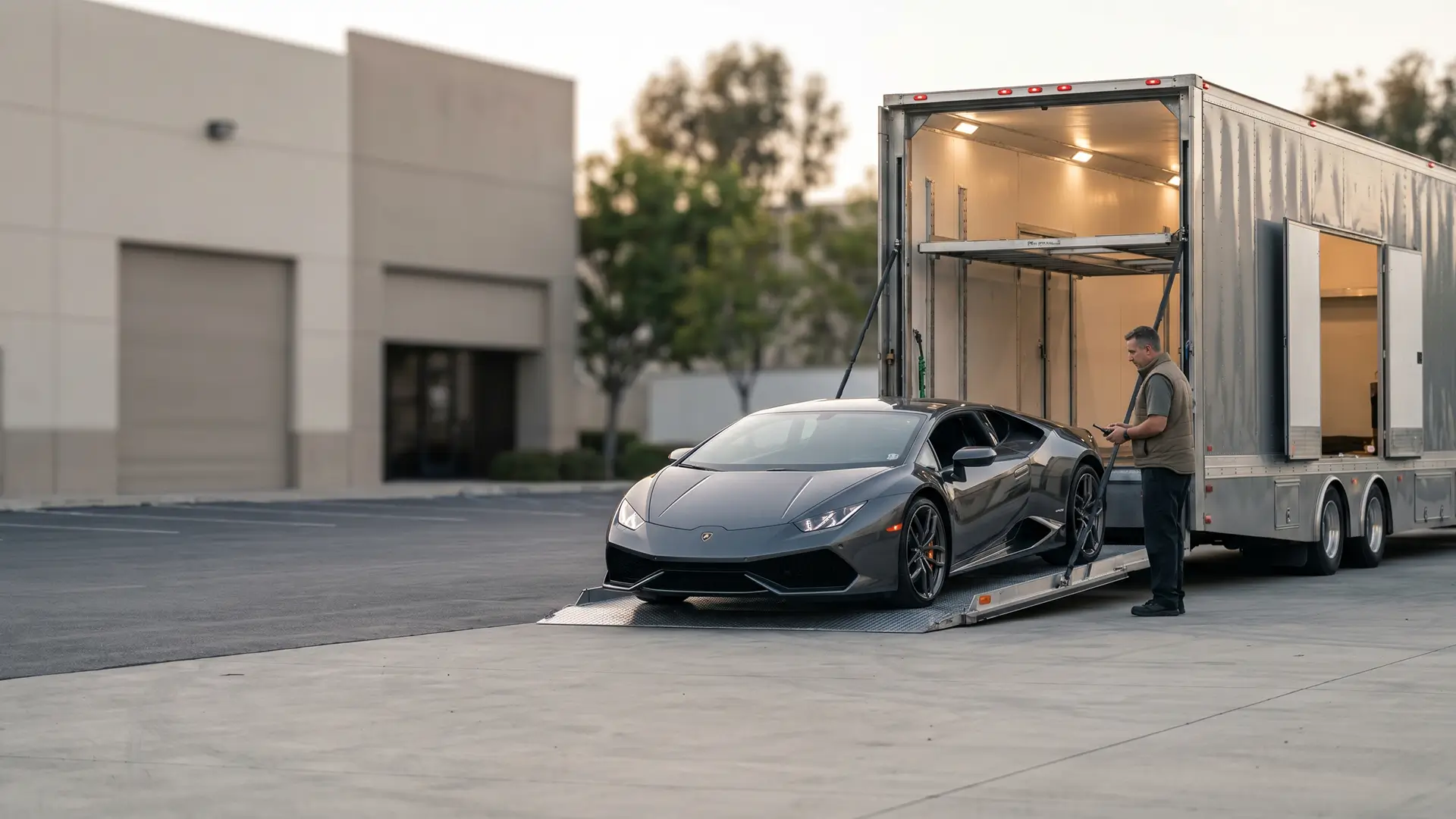
Exotic cars are built super low to the ground. They are usually wider than regular vehicles and have really harsh angles for getting up ramps. A lot of standard enclosed trailers just can't load them without ripping off the front lip or scraping the belly of the car. Because of that physical limitation, the dispatcher has to track down a very specific style of truck that has hydraulic lift gates or extra long specialized ramps just to do the job safely.
That strict requirement cuts down the pool of available trucks to a very small number. And when only a handful of trucks can safely take your car, your vehicle basically just sits there waiting for that specific truck to pass through your zip code. It really is not about the miles between the pickup and the drop off. It is completely about those few inches of ground clearance your car has, and securing the exact trailer that can handle it without causing expensive damage.
Why your exotic car almost never travels alone
A lot of owners think paying premium shipping rates means a private truck is showing up just for their vehicle. But unless you are spending crazy money on a dedicated single vehicle move, which is what white glove service is for, your car is getting bundled into a shared trip with strangers.
A normal enclosed rig usually fits around six cars depending on how long they all are. The truck driver has to put together a weird puzzle of cars to make the trip profitable. Your exotic car will probably go in last or in a weird spot just because of its ground clearance. That means the driver has to go deliver a bunch of other cars before he even drives into your city.
You are essentially just renting safe space on a shared highway route, not a private chauffeur for your car. The driver stops multiple times during the week to load up and drop off other people's vehicles. All those extra pit stops add days onto your transit time. On top of that, drivers have heavy federal limits on how many hours they can legally drive each day. Every stop eats into their legal driving clock, so they eventually have to pull over and sleep for the night, which stretches the timeline even further out.
Reality of door to door car shipping
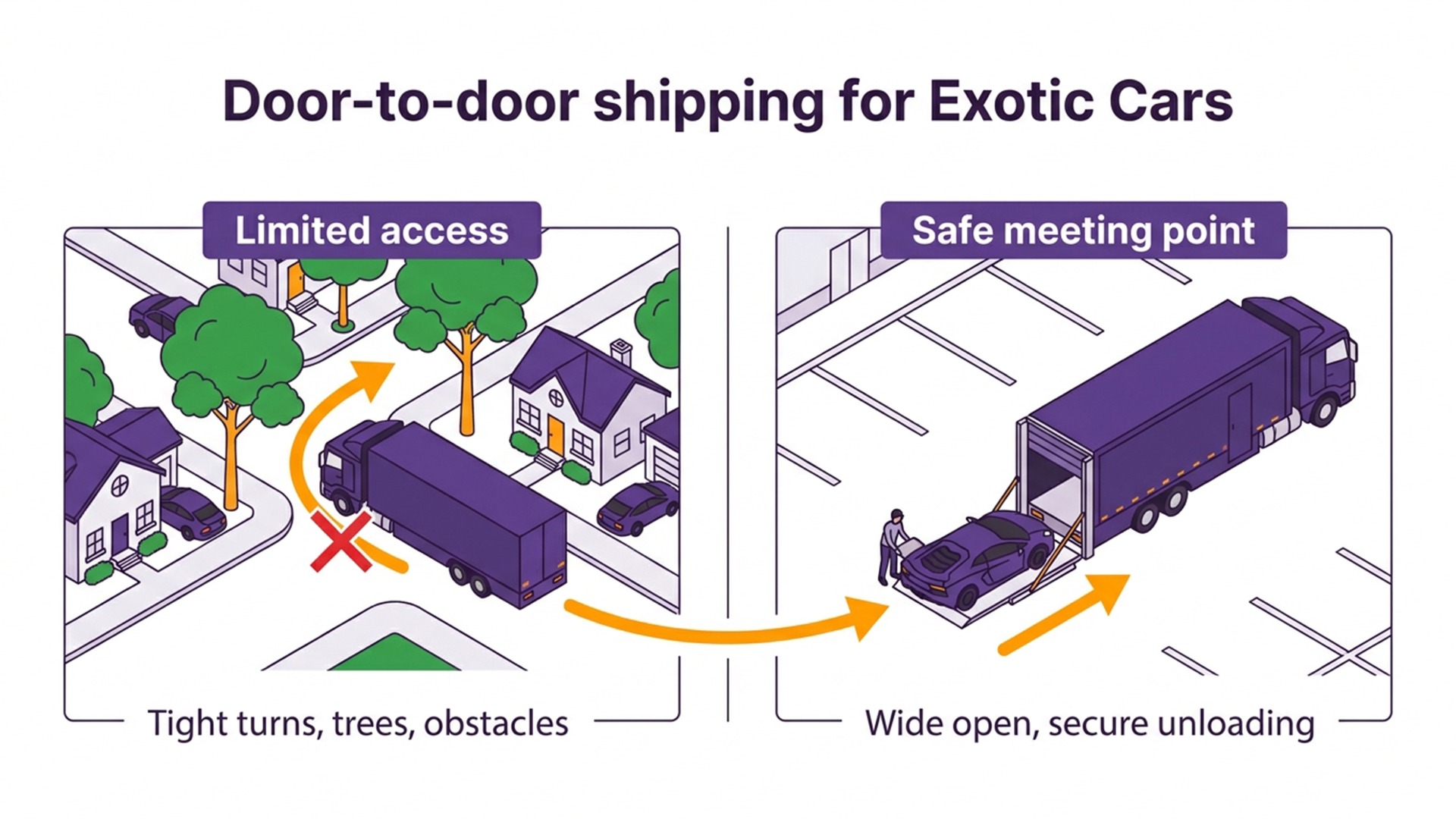
Everybody pictures the truck pulling right up to their front curb to load the car. But how door to door car shipping really plays out is way different when huge industrial equipment is involved.
An enclosed hauler with six cars sitting in it is a long, heavy rig. A truck that big cannot turn around in a standard neighborhood cul-de-sac and it definitely cannot fit under low hanging tree branches on a quiet residential street. The driver needs a massive footprint just to drop the heavy lift gate and back the cars down without hitting anything.
So getting it delivered to your door rarely means your literal front door. What it actually means is the trucker will get as close as they can legally and safely get to your house address. You will almost always end up driving down to meet them at a giant supermarket parking lot or a massive commercial zone nearby to actually get your car off the truck. If they try to force that giant rig down a narrow suburban street, they risk getting stuck or wrecking the whole truck.
What controls your pickup timing
When you pick a date for shipping online, you are really just letting the system know the car is ready to go. The actual truck market is what determines when the car is going to leave your driveway.
If you need to move a car between two giant cities, it happens pretty quick. That is just because route density is thick and trucks run that major interstate all the time. But if you want to move a car from a tiny rural farm town or somewhere deep off the highway, the whole game changes. Truckers absolutely hate driving empty miles into the middle of nowhere because it burns their fuel and kills their profit margin on the trip.
Because of that, your pickup will sit delayed until a driver decides it's finally worth the long detour out into the country. That is exactly why a realistic pickup window gets built around how busy that lane actually is, instead of a date pulled out of the air to make you feel good. Rivalane gives you an estimated pickup and delivery date rather than a promise, because no broker controls when a truck reaches your road. The density of trucks running on that specific highway is the real boss of how long you will be waiting.
Where the risk happens during transport
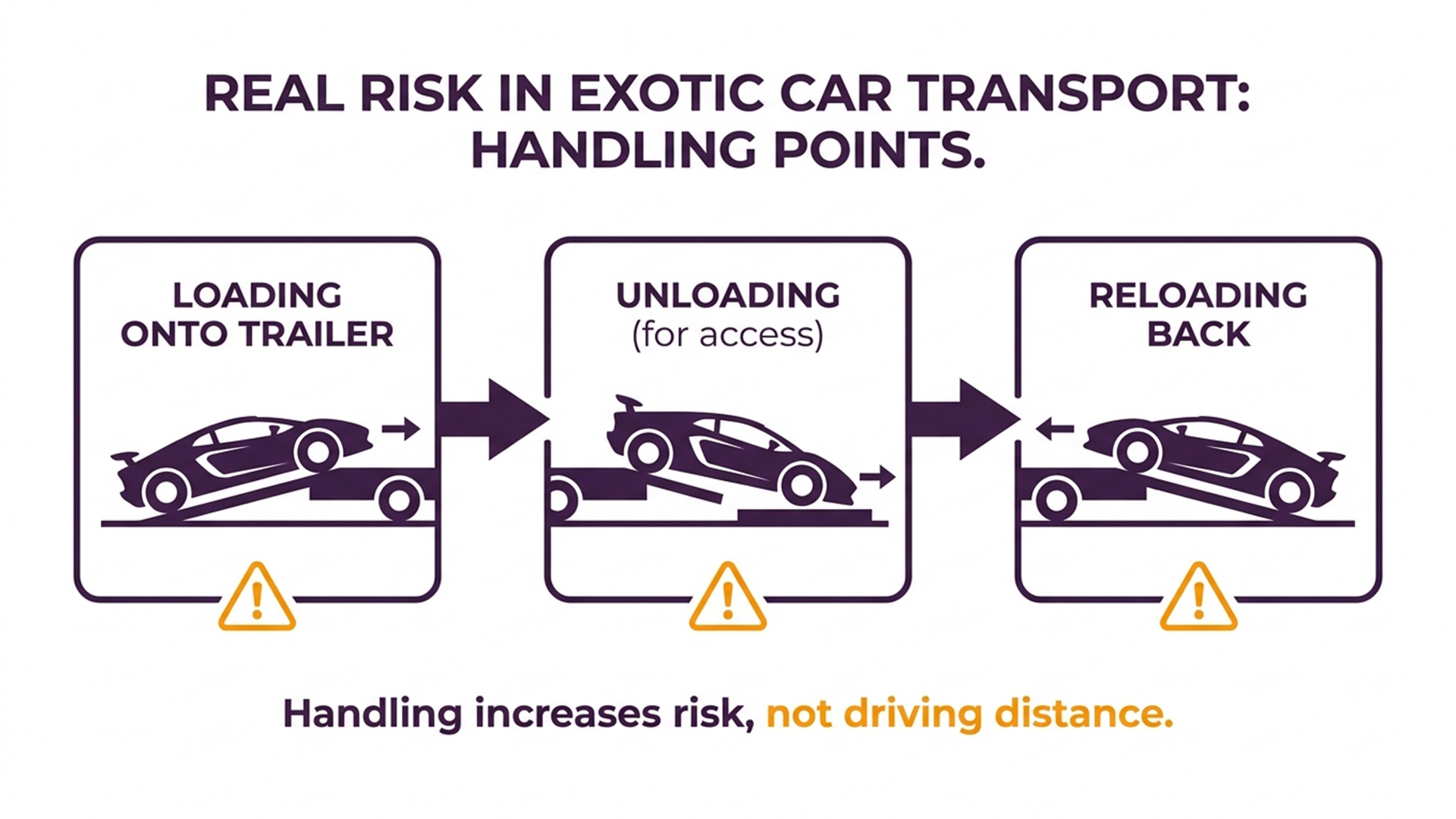
People always stress out about the car sitting on a highway for hundreds of miles. They obsess over bad rain storms rock chips or big wrecks on the interstate. But when you use a hard sided enclosed trailer, the actual driving part is by far the safest part of the entire operation.
The actual danger happens entirely during the physical handling process. Every single time someone drives a car up a ramp or backs it down a ramp, there is a chance for something to bump or scrape.
Since your car is packed in tight with five other vehicles inside the box, the driver might actually have to back your exotic car completely out of the trailer just to get another car unloaded from the front deck. Then they have to load your car back in and secure it again. This shuffling around happens way more than people realize on a long cross country trip. The real risk comes from how many times a human has to touch and move the car, not how many highway miles it drives. That is exactly why paying for specialized lift gate equipment and a smart experienced driver is so much more important than worrying about the long highway.
What actually drives the cost of exotic car transport
Everything above is also the pricing model. The quote is not really about the car being expensive. It is about how few trucks can take it, and how far out of their way one of them has to go.
The biggest single factor is how many trailers can physically load your vehicle. A car with normal ground clearance fits almost anything on the road. A car that needs a lift gate or extended ramps fits a small fraction of the fleet, and a small fraction of the fleet means less competition for your shipment. Width, length and a non running condition narrow that pool further. Enclosed costs more than open for the same reason, because there are simply fewer enclosed trucks running.
After that it is geography and timing. A pickup and a delivery that both sit near a major interstate are easy to slot into a route that already exists. A pickup an hour off the highway is a detour someone has to be paid to make. Season and direction stack on top, which is the next section. And if you need the car moved inside a narrow window rather than whenever the right truck comes through, you are paying to jump a queue that is set by the route rather than by the broker.
None of that produces a sticker price you can look up, which is why an exact figure comes from your actual route and your actual car. Run both through the car shipping calculator to see where your shipment lands.
Luxury car transport with Rivalane means an enclosed trailer, soft straps over the tires instead of chains on the frame, and a lift gate for low cars.
How season changes affect your shipping
Sometimes people get totally shocked when the quote to move their car doubles just because of what month it is. Folks usually guess that gas prices went up. Diesel fuel matters a little bit, but it is never the main culprit.
The real reason prices swing so wildly is demand shifting on the highways. Just think about the winter months when all the snowbirds relocate to warm states. Every single truck gets booked up heading south almost instantly. Trying to find an enclosed spot heading to Florida in late November is slow and crazy expensive because every other wealthy car owner is trying to do the exact same thing at the exact same time. But if you ship a car north during that same week, it is super cheap and lightning fast because the trailers are dead empty and truckers are begging for cargo.
The physical direction all the traffic is naturally moving determines your bill and your wait time. It is always a basic game of supply and demand for that one specific highway lane during that one specific season. You cannot argue with the market when all the trucks are heavily flowing in the opposite direction.
Ultimately, shipping a serious high dollar car means you just have to understand how these heavy trucks operate in the real world. You are basically renting a few feet of space on a very complex piece of machinery that is tied down by strict routing math and legal driving hours. If you can manage to stay a bit flexible on your pickup dates and be willing to meet the driver in a huge parking lot instead of your driveway, the whole ordeal ends up being vastly less stressful for everyone involved. The same rules apply to the rest of the collector world, so if you are moving something older see our classic car shipping guide, and if you move cars regularly the enthusiast transport page covers how we handle them.
Frequently Asked Questions
How much does it cost to transport an exotic car?
Why does an exotic car take longer to pick up than a regular car?
Can an enclosed carrier deliver to my front door?
Will my exotic car travel on a trailer by itself?