What Are the Most Common Auto Transport Scams?
Most auto transport scams follow one of a few patterns, and most of them depend on money changing hands before a real truck is attached to your order. Once you know the patterns, the warning signs are easier to see while you can still walk away.
The quote that rises after you book. A company quotes far below everyone else, takes your booking, then tells you the price has gone up once no carrier will move the car at that rate. This is the classic bait and switch.
The deposit with no carrier behind it. You pay a deposit or the full price up front, then pickup day comes and goes with no truck, no driver name and no paperwork. Some of these companies disappear. Others keep the money and keep promising a truck "tomorrow."
Double brokering. The company you booked hands your car to another broker or carrier without telling you. The name on your paperwork no longer matches the company holding your car, and any insurance or payment dispute between them can land on you.
The cloned company. Scammers copy a real company's name, USDOT number and MC number onto a website of their own. The registration checks out, but the phone number and the people answering it belong to someone else.
The delivery-day hold. The driver arrives and asks for more money than your order states before releasing the car. It often follows a lowball booking, or a double-brokered load where a middleman never paid the carrier.

Why Do Car Shipping Scams Catch So Many People?
Most people look for car shipping in the middle of something bigger: a move, a new job, a car bought in another state. That urgency is what scammers work with. You want a fast answer and a clear price, and they offer both.
Quote forms add to the noise. Fill in one comparison form and your details can reach many companies at once, so calls, texts and emails start arriving within minutes. A professional-looking website costs little to build, and a low number stands out in a crowded inbox. Scammers count on you picking the cheapest reply before checking who sent it.
None of this makes shipping a car risky in itself. With a registered broker and an insured carrier it is a routine service, and our guide to whether it is safe to ship a car separates the real risks from the myths. The goal is to spot the wrong company before you pay it.
What Red Flags Should You Watch for Before You Book?
Most scams show themselves before a truck is ever involved. These are the signals worth stopping for.
A quote far below the others comes first. Carriers choose loads by the rate offered, so a price no carrier will accept does not move your car, whatever the website promises.
A request for a deposit or full payment before any carrier has been assigned is the second. At that point the company has arranged nothing, so you would be paying for work that has not happened.
How they want to be paid matters too. Requests for a wire transfer, a payment app, a gift card or cryptocurrency are hard to reverse, which is exactly why scammers prefer them.
Watch for missing or unclear registration. FMCSA's consumer advisory about automobile transporters tells consumers to avoid any company that does not prominently display its MC number on its website, and to be suspicious of any site that does not make clear whether it is a broker or a transporter.
Pressure is the last signal. Lines like "this price expires in an hour" or "a driver is already nearby" exist to stop you checking. So does a firm delivery date with no written terms for what happens if it is missed, because road, weather and the carrier's other stops all affect when a truck arrives.
Is a Very Low Car Shipping Quote a Scam?
Not always, but a quote far below every other one deserves suspicion. The bait and switch works like this: a company quotes low to win the booking, posts your order to carriers at that rate and waits. When no carrier accepts, you hear that fuel went up, the route changed or the driver needs more. By then you may have paid a deposit, your dates are close, and starting over feels worse than paying.
Real prices do move. Carrier capacity on a lane shifts with the season, and a quote can change when your dates, vehicle or pickup details change. The difference is timing and honesty. A legitimate broker explains a price change before a carrier is assigned, puts it in writing and lets you cancel without paying for work that never happened. Our guide to why car shipping quotes change covers the legitimate reasons in detail.
The fairest comparison is several quotes for the same service: the same open or enclosed trailer, the same pickup window and the same door-to-door or terminal delivery. A quote that sits in the same range as the others is far more likely to be one a carrier will take.
How Does Double Brokering Happen in Auto Transport?
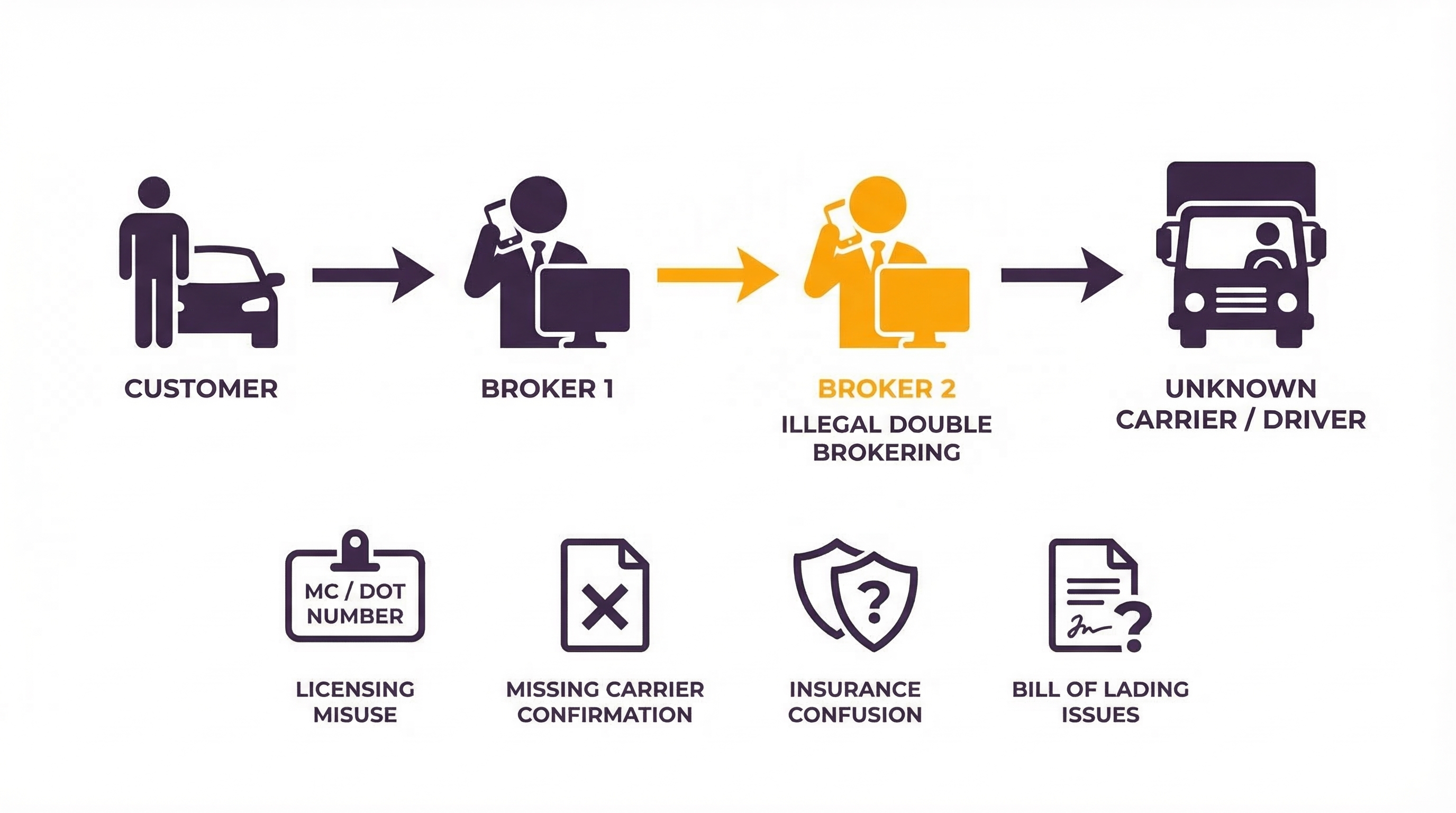
Double brokering happens when the company you booked passes your shipment to another broker or carrier without your knowledge, often at a lower rate so it can keep the difference. Sometimes the load changes hands more than once before it reaches a truck.
The problem is accountability. The company on your order is no longer the company with your car. The carrier named on the bill of lading may not be the one you checked, its insurance may not be the policy you were shown, and if a middleman fails to pay the carrier, the carrier may hold your car until someone does.
Federal law limits who can arrange transport for others. Under 49 U.S.C. 14916, a company may provide interstate brokerage services only if it is registered as a broker and meets the federal financial security requirement. If the company that arranged your shipment has neither, there is no broker bond to claim against when the arrangement falls apart.
Your protection is simple. Get the assigned carrier's name and USDOT number before pickup, look it up, and check that the same company appears on the bill of lading the driver hands you. If the names do not match, ask before the car is loaded.
How Do You Spot a Cloned or Unregistered Company?
Every interstate broker and carrier must register with the Federal Motor Carrier Safety Administration, and that registration is public. Checking it takes a few minutes.
Look the company up on the FMCSA SAFER Company Snapshot using the USDOT or MC number from its website. Check that the authority is active and that the entity type matches what the company told you: broker, carrier or both. Then compare the legal name, DBA name, address and phone number with the website. Legitimate companies sometimes list a registered-agent address or a different main line on their FMCSA record, so a mismatch is not proof of fraud. It is a reason to call the phone number on the FMCSA record and confirm that the company you spoke with is the one on file. That call is what exposes a cloned company.
Brokers have one more requirement. Under 49 CFR 387.307, a broker must keep a $75,000 surety bond or trust fund in effect, filed on form BMC-84 or BMC-85, and the Licensing and Insurance link on the SAFER record shows whether that filing is active.
Then ask who will actually move the car. A broker arranges the shipment and a carrier drives it. Both are legitimate, but the company should tell you plainly which one it is, and our guide to auto transport brokers and carriers explains how each role works. Once a carrier is assigned, ask for its certificate of insurance, since the carrier's cargo policy is the one that covers your car in transit. Our car shipping insurance guide covers what to look for.
For the full set of seven checks, see our guide to auto transport companies to avoid.
When Should You Pay for Car Shipping?
The timing of payment tells you a lot about a company. A broker's job is to find a carrier for your car, so a fee charged before any carrier has accepted the order is a fee for work that has not been done. Full payment up front, or a large non-refundable deposit at booking, is a reason to stop.
A common legitimate structure has two parts: the broker's fee, due once a carrier is assigned, and the carrier's balance, paid to the driver at delivery. If you pay anything before delivery, a credit card gives you a dispute route if the service never happens, and FMCSA advises watching your statement to confirm that only the amount you authorized was charged.
Here is how it works at Rivalane, as written in our Terms and Conditions. Booking costs nothing, and nothing is due to Rivalane until a carrier accepts your order. You can cancel at no cost at any time before that. The balance for the transport is paid to the carrier on delivery, in cash, certified funds, a cashier's check or a money order made payable to the carrier. Our short answer on when you pay for car shipping sets out both payments.
One rule applies at delivery with any company. If the driver asks for more than your order confirmation states, do not hand over the difference until you have called the company that booked the shipment and it has spoken to the carrier.
What Does a Legitimate Car Shipping Process Look Like?
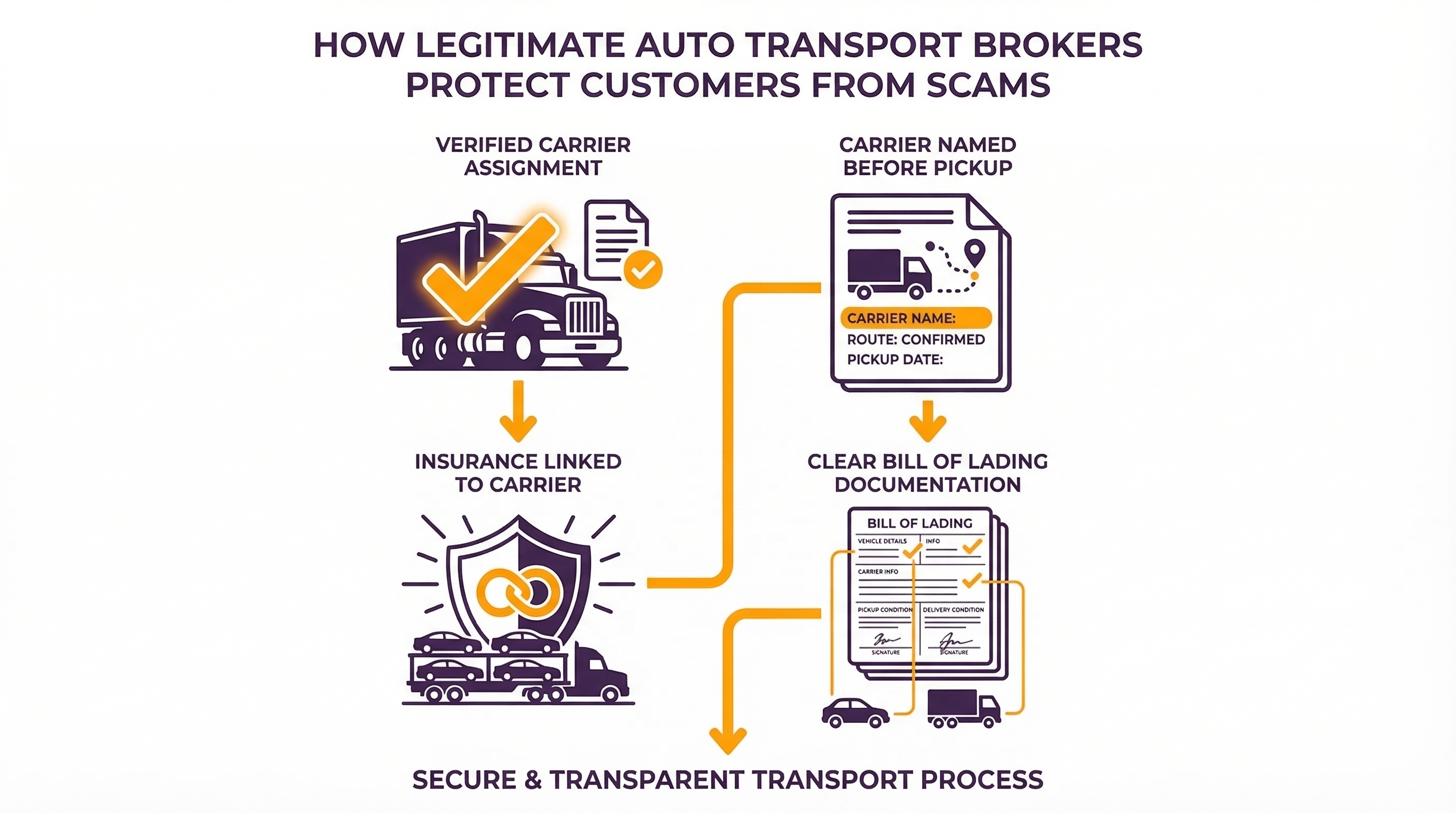
A legitimate shipment follows a clear order, and each step leaves a record.
It starts with a quote and a written order that states the price, the service and the terms. The broker then offers the order to carriers that run your route. At Rivalane, assigning a carrier typically takes one to three working days from booking, depending on the route and your dates. You receive estimated pickup and delivery dates, and they are estimates.
At pickup, the driver inspects the car with you and records its condition on the bill of lading, which you both sign. The car then travels on the carrier's truck under the carrier's insurance, and Rivalane customers can follow it with real-time tracking. At delivery you inspect the car again, note any new damage on the bill of lading before signing, and pay the carrier's balance.
If a step is missing, especially the named carrier or the bill of lading, ask why before the car leaves your driveway. When you are ready to compare prices, run your route through our car shipping calculator, then look up our registration on FMCSA SAFER, where we are listed as Zone Auto LLC doing business as Rivalane, USDOT 4178374 and MC-1608310.

What Should You Do If You Think You Were Scammed?
Act quickly, because money and evidence are easier to recover early.
First, stop any further payment and call your card issuer or bank. If you paid by card, ask about a dispute or chargeback. Your quote, the order and the payment receipt make that conversation much easier.
Next, save everything: emails, texts, the quote, the website address, the names you were given and any USDOT or MC numbers. Take screenshots, because scam websites often disappear.
Then report it. File a complaint with FMCSA through the FMCSA Complaint Center, formerly the National Consumer Complaint Database, or by phone at 1-888-368-7238. Report the fraud to the Federal Trade Commission at ReportFraud.ftc.gov and contact your state attorney general's consumer protection office. A report to the Better Business Bureau's Scam Tracker helps warn the next customer.
If a carrier is holding your car for more money than agreed, keep your order confirmation and bill of lading at hand, contact the company that booked the shipment in writing, and include the carrier's USDOT number in your FMCSA complaint.
Frequently Asked Questions
What is a cloned auto transport company?
What is double brokering in car shipping?
Should I pay a deposit to ship my car?
Is a cheap car shipping quote a scam?
Where do I report an auto transport scam?