The biggest misconception about Fall Carlisle is that hauling a car in is the hard part. It isn't. Getting it back out is what wrecks people's plans, and it wrecks them for reasons that have nothing to do with the truck and everything to do with a set of gate rules and a federal clock that most buyers never think about until they're standing on a grass field at four in the afternoon watching the sun go down.
Quick answer, if you only read one paragraph: Fall Carlisle runs September 30 through October 4, 2026, at the Carlisle Fairgrounds in Pennsylvania, with the collector car auction at the Expo Center on October 1 and 2. No car hauler is coming onto the grounds to meet you at your space. Your car gets picked up or dropped off at a staging point off the field, usually early morning or after hours, and the whole thing works fine as long as you book it that way from the start instead of assuming a truck can just pull up.
Why an 80 foot car hauler will never reach your vendor space
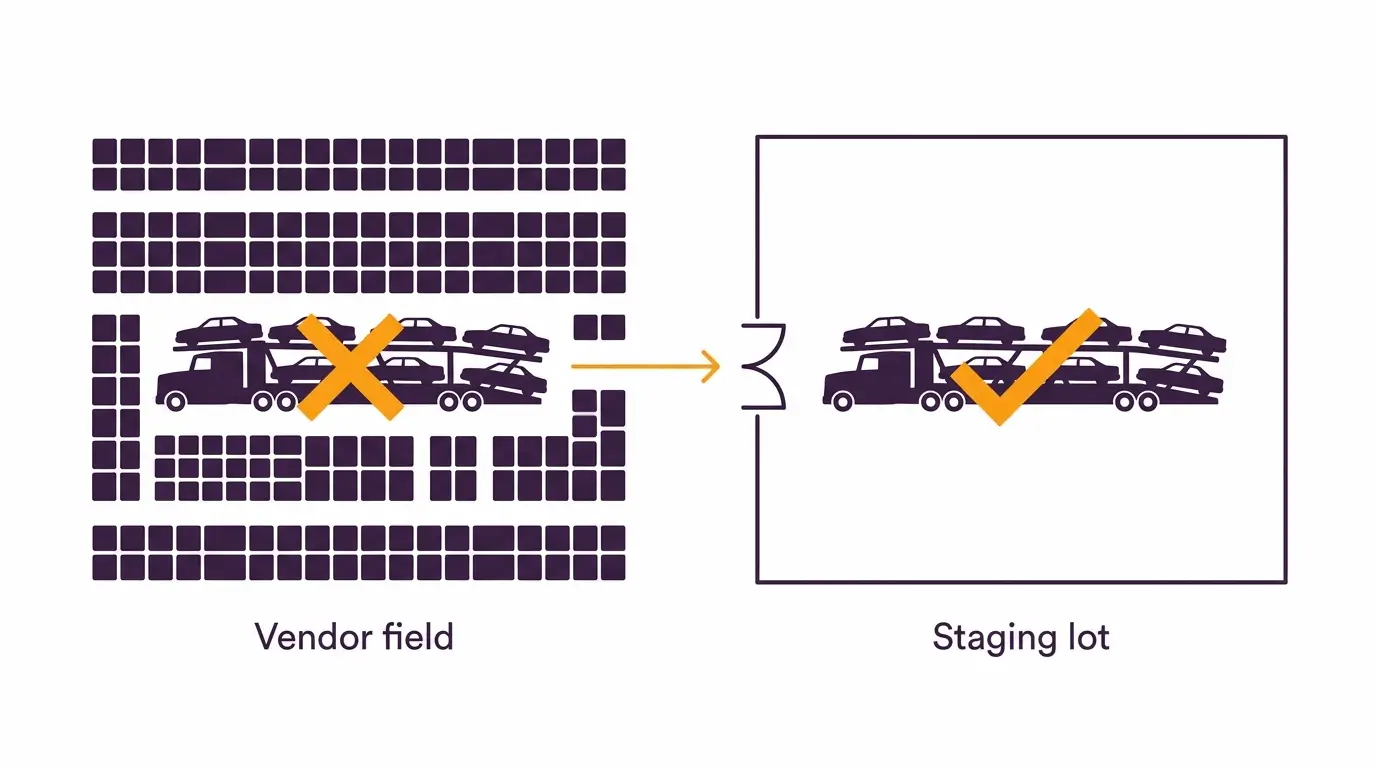
People picture the truck rolling down the row, dropping the ramps, winching the car up, and rolling out. It doesn't happen. A full size open car carrier in this country is legally allowed to run right around 80 feet overall, and that's before you count the overhang the cars themselves add front and rear. Now go look at how Carlisle is laid out. Vending spaces are roughly ten feet wide by thirty deep. Most of them are on grass. There are something like 8,100 of them packed onto the fairgrounds with people, golf carts, parts wagons, and swap meet foot traffic filling every lane between them.
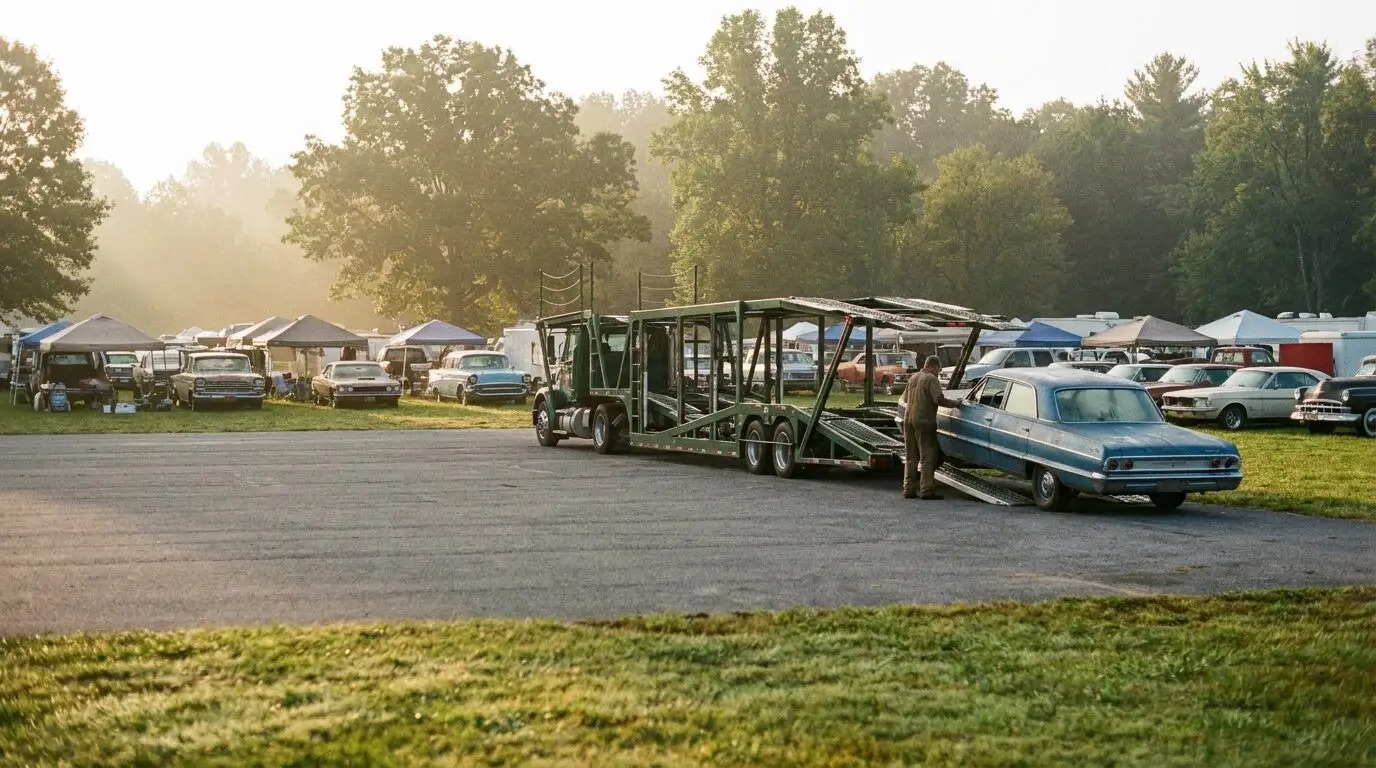
An 80 foot articulated rig on a soft grass field with ten foot frontages is not a policy argument. It's a geometry problem. There's no radius for the truck to turn, no firm surface for it to sit on loaded, and no way to drop ramps without taking out two neighbors' tables. So the answer, every single time, is that the car meets the truck somewhere else. A lot, a lay by, a wide shoulder near the gate, sometimes a spot a few minutes down the road. That isn't a downgrade in service. That's the only version of this that physically exists.
And it isn't only physics. Carlisle Events writes the rule down in its own vendor kit: trailers may be unloaded on the grounds on or before set up day, but during the event they must be unloaded off the grounds, with no exceptions. So even if your space happened to sit on a wide gravel corner, the answer is still no.
The load out window is short, and everyone is standing in it
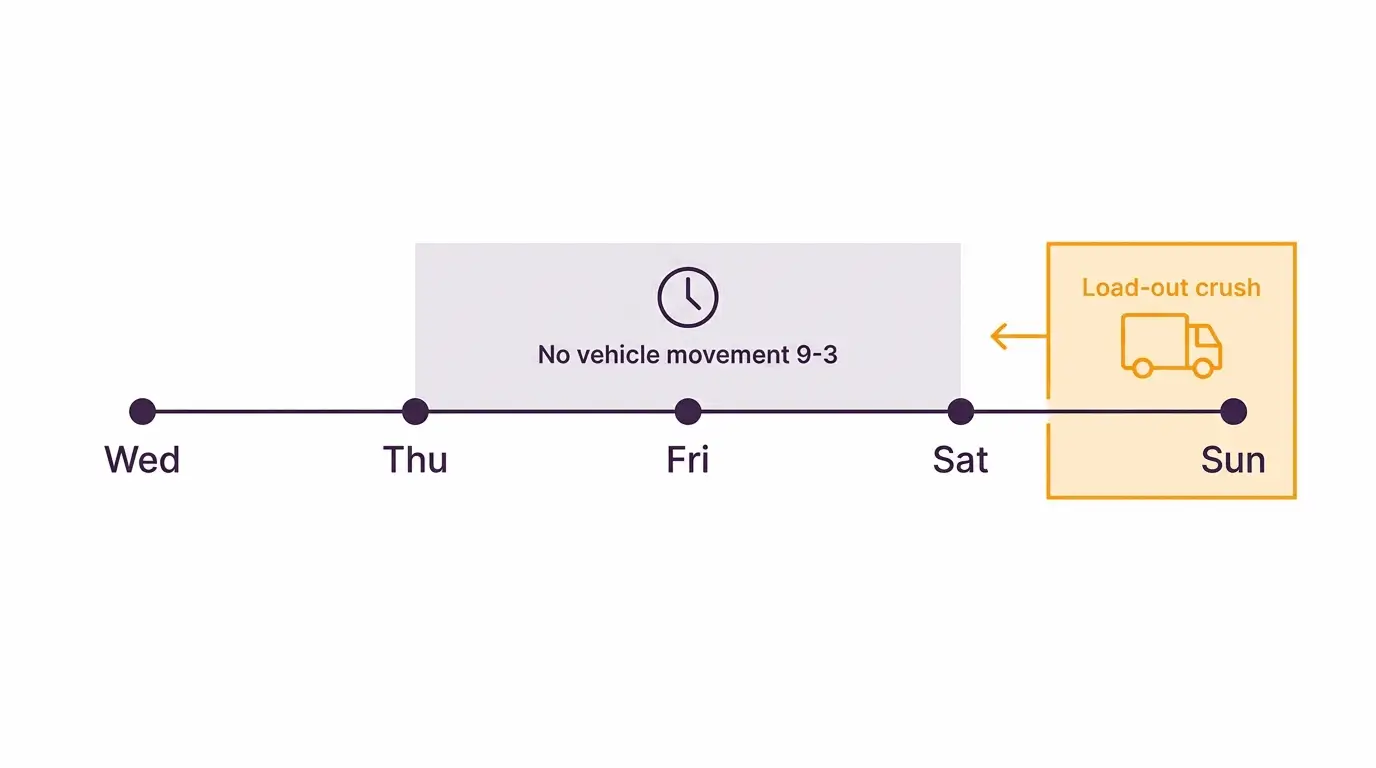
Here's the part almost nobody plans for. Carlisle shuts down wheeled movement on the grounds during show hours. Between nine in the morning and three in the afternoon on event days, every form of transportation with wheels is prohibited, so you are not driving anything anywhere on that field. If you need to bring a vehicle on or off outside the normal set up days, you're working with a temporary entry pass. It buys you one hour, you pick it up at Gate 1 or Gate 3 before 7 AM or after 5 PM, and the driver hands over a licence and a deposit that comes back on a timely exit.
Then tear down starts Sunday at noon and runs to 3 PM, and everything has to be off the property by 5 PM on Monday, with no exceptions. Read that again and think about what it means for a truck driver. Every vendor, every car corral seller, and every buyer who just bought a project car is trying to move metal through the same two or three gates inside the same narrow slice of hours. If your plan is “I'll call a carrier Sunday morning and have it picked up Sunday afternoon,” you are competing with a few thousand other people for a window that's measured in hours, not days.
The fix is boring and it works. Book the transport before you go. Give the carrier a pickup window that lands early Monday morning or on the front end of the week rather than in the Sunday scrum, and be honest about where the car will physically be sitting when the driver arrives.
Your driver is running a clock that doesn't stop for a gate line
This is the one that causes the most friction, and it's the one customers almost never hear explained. A truck driver hauling your car is working inside a hard limit: eleven hours of driving inside a fourteen hour window after ten straight hours off, and critically, that fourteen hour window does not pause when the truck is sitting still. Not for a gate queue. Not while he waits for you to find your keys. Not while you argue with the guy who was supposed to help push the car.
So when a driver tells you he needs the car ready at 6:40 a.m. and he means 6:40, he isn't being difficult. He's telling you that if he burns ninety minutes idling outside Gate 3, that ninety minutes comes straight out of the driving hours he needs to get to his next stop legally. A driver who runs out of hours in Carlisle, Pennsylvania parks in Carlisle, Pennsylvania. That costs him a day and it costs you a day, and it's the reason experienced carriers would rather skip a messy event load than get stuck in one.
Rolls, steers, brakes, runs: the four questions that price your swap meet find
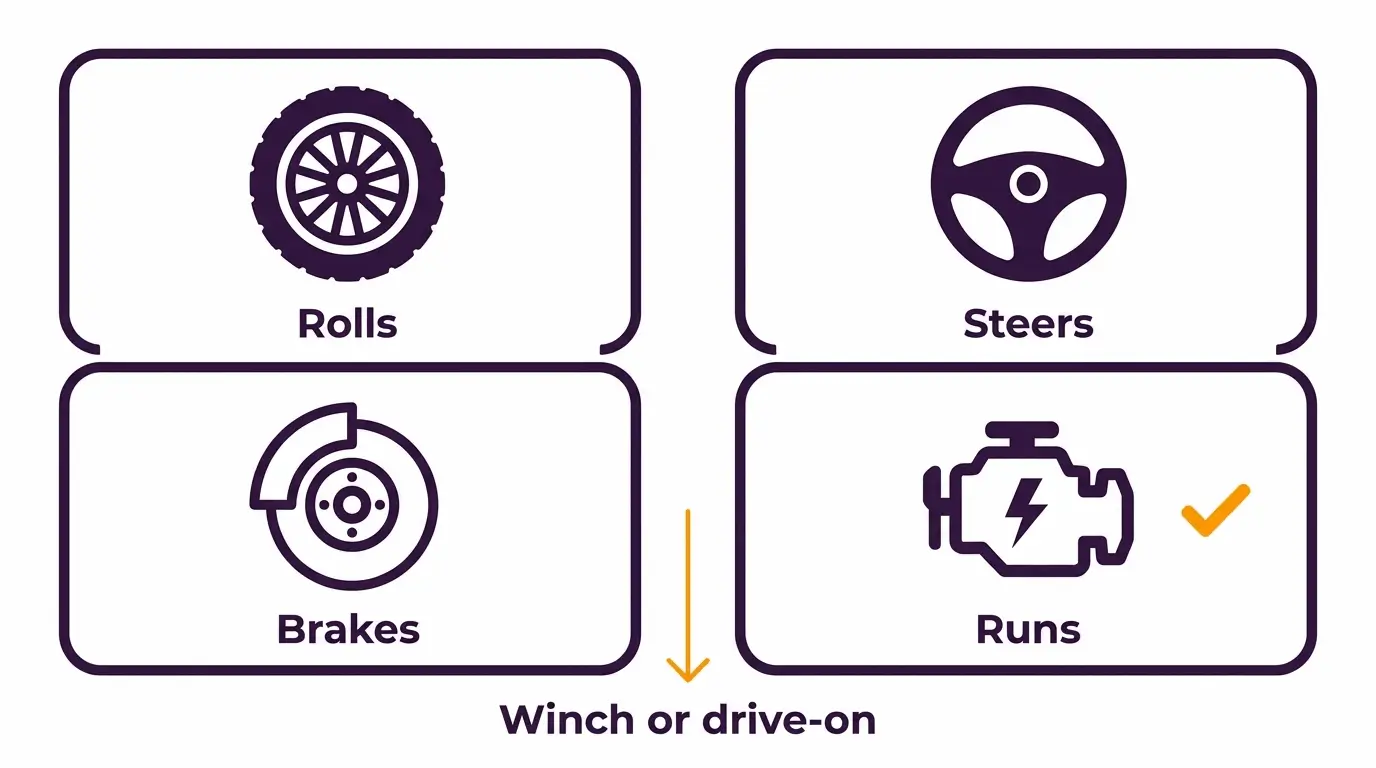
Say you bought something at the swap meet. A parts car, a barn find, a shell somebody dragged out of a field. Before anyone can even quote you, four things have to be true or not true: does it roll, does it steer, does it brake, and does it start.
A car that rolls and steers can be winched onto a trailer. That's a different job than driving one on, and it takes longer, needs the right equipment, and usually means the driver has to load it in a specific position on the trailer instead of wherever it fits. A car that doesn't steer, or has seized brakes, or has a wheel that won't turn, is a whole different animal. Now you're talking about skates, a rollback, or a forklift, and a lot of carriers simply won't take it. None of this makes your car unshippable. It just means the honest answer costs more and needs more lead time, and the quote you got by clicking “running vehicle” on a form was never real.
The other thing people underestimate is securement. Cars get tied down at the front and the rear using points designed to take that load, and a car with rotted rockers or a floor you can see through gives a driver nowhere safe to hook. That's not a driver being fussy. That's him deciding whether your car stays on his trailer over a bridge joint at 65 miles an hour.
Open or enclosed at Carlisle is a question about ramps, not rain
Everyone frames this as protection. Weather, road grit, stone chips. Fair enough, and if you're moving a numbers matching car with fresh paint, enclosed car transport is obviously the call and you already knew that.
But at an event like this, the real difference is often loading geometry. Enclosed trailers frequently carry lift gates and low angle ramps, which matters enormously if the car is low, non running, or fragile in a way that makes a steep open ramp a bad idea. Meanwhile, a driver quality forty year old cruiser going home to Ohio is perfectly happy on open car transport, which is cheaper, has far more trucks available, and books much faster in a crowded week. The mistake isn't picking one or the other. The mistake is picking based on how much you love the car instead of how the car actually loads.
Why the trip home costs more than the trip out
Same car, same miles, different number. People find this maddening, and it makes perfect sense once you see the board from the driver's side.
Going in, your car is one of many heading toward a known point on a known date, so a carrier can build a run around it. Coming out, you're a single car sitting in a small Pennsylvania town, competing for capacity in the exact week when trucks in the Northeast are already starting to get pulled south by the first wave of winter relocations. Fewer trucks, more cars, same handful of days. Price goes where you'd expect.
And there's a second layer. If your car is going somewhere with real lane density, down I-81 toward the Southeast or west along I-70, a driver can fill the rest of his trailer around you. If it's going to a small town three hours off any freight corridor, he's making that detour for one car, and either you pay for the detour or you wait until someone happens to be heading that way. That's why two people can ship identical cars the same distance from the same field and get quotes a few hundred dollars apart.
The auction load out is its own puzzle
The collector car auction runs October 1 and 2 at the Expo Center, and winning on a Thursday is a very different logistics problem than winning on Friday afternoon. Buy early and you have days to arrange classic car shipping while trucks are still available and the grounds haven't gone into tear down chaos. Buy late and you're joining the Sunday crush with a car you now have to store somewhere until a driver can reach it.
If you're bidding, arrange auction vehicle transport conditionally before the gavel drops, not after. Brokers do this constantly. It costs nothing to have a plan you don't use, and it costs plenty to need one you don't have.
One last thing, and then I'll shut up about it. The people who have a good Carlisle are not the ones with the best truck or the deepest pockets. They're the ones who figured out three weeks earlier exactly where the car was going to be standing when the driver pulled up, and told him the truth about it. That's the whole trick. If you want that handled, get a quote and lock your window before the show.
Frequently Asked Questions