Florida car sales tax is the state's 6 percent sales tax on a vehicle sold in Florida, plus any county discretionary sales surtax, which applies only to the first $5,000 of the price. A dealer collects it at the sale. On a private sale, the buyer pays it when the vehicle is titled in Florida, because Florida issues no title without proof the tax was paid.
This guide covers what counts in the taxable price, private sales and exempt transfers, then the cases that matter for a buyer from another state: Form DR-123, the states that give no credit for Florida tax, delivery outside Florida and a North Dakota buyer worked through. The rules come from the Florida Statutes, the Florida Administrative Code and the Florida Department of Revenue.
What Is the Sales Tax on a Car in Florida?
Six percent at the state level. The Department of Revenue's motor vehicle sales tax publication gives Florida's state sales tax rate as 6 percent and says that rate is generally due when a vehicle is sold in Florida, including a sale to a resident of another state.
Counties can add a discretionary sales surtax on top. The Department's discretionary sales surtax page puts county rates between 0.5 and 2 percent, notes that some counties charge none, and limits the surtax to the first $5,000 of the sales amount on any single item. On a car priced above $5,000, the surtax is charged on $5,000.
Section 212.054 of the Florida Statutes treats a vehicle sale as taking place in the county of the buyer's residence address on the registration or title, so the surtax follows where the buyer lives, not where the dealer sits. The Department lists every county's rate on Form DR-15DSS, updated each November.
What Is Included in the Taxable Price?
The full sales price. Under Rule 12A-1.007 of the Florida Administrative Code, a vehicle sale is taxable on the full sales price with no deduction for freight, handling, delivery, commission, advertising or any other cost. Fees the state, a county or a licensed tag agency requires for titling, registration, transferring ownership or recording a lien stay out of the taxable price when they are listed separately.
A trade-in lowers the taxable price when a registered dealer takes it as part of the same transaction, and only the net price is taxed. A private seller who takes another vehicle in trade can deduct it too, though other property taken in part payment does not reduce the price. Selling your old car on its own and putting the money toward the new one is not a trade-in, even when the proceeds go straight into the purchase.
How Are Private Car Sales Taxed in Florida?
The same rule makes the occasional or isolated sale of a vehicle that has to be registered taxable on its total selling price, so a private sale is not tax-free. The tax is paid when the car is titled, through the county tax collector or a private tag agency, and no Florida title is issued unless the application includes a receipt showing the tax was paid.
The reported price is checked. If the price reported to the tax collector for a car, motorcycle, motor home, travel trailer or truck weighing 5,000 pounds or less is under 80 percent of the average loan price for that model and year in the price list the rule names, tax is computed on the average loan price instead. That does not apply when buyer and seller both sign Form DR-99A, the Affidavit for Private or Casual Sale of a Motor Vehicle, stating the actual price, or provide other proof the Department accepts.
Which Vehicle Transfers Are Exempt?
Rule 12A-1.007 lists transfers that are exempt when a certificate stating the facts, signed under penalty of perjury, goes with the title application:
- Gifts. Title passes for nothing of value and the recipient takes on no outstanding lien. If the recipient assumes a lien, the lien amount is taxed.
- Inheritance. A distribution to the heirs of an estate, including to trust beneficiaries after the grantor's death. A sale by the estate's personal representative is taxable.
- Spouses. A transfer of marital property between husband and wife.
- Divorce. A transfer between former spouses as part of a property settlement or a court-ordered division in a divorce decree.
- Even trades and trade-downs. Swapping one registered vehicle for another of equal or lower value, even with a lien, backed by a sworn statement naming the other party.
- Business changes. Certain transfers from a partnership to a partner on liquidation, from a dissolved corporation to a stockholder, and in a merger or qualifying reorganization.
Without the sworn statement for a gift or an even trade, the rule has the Department estimate the vehicle's value and assess tax on it.
How Does Florida Tax a Car Sold to an Out-of-State Buyer?
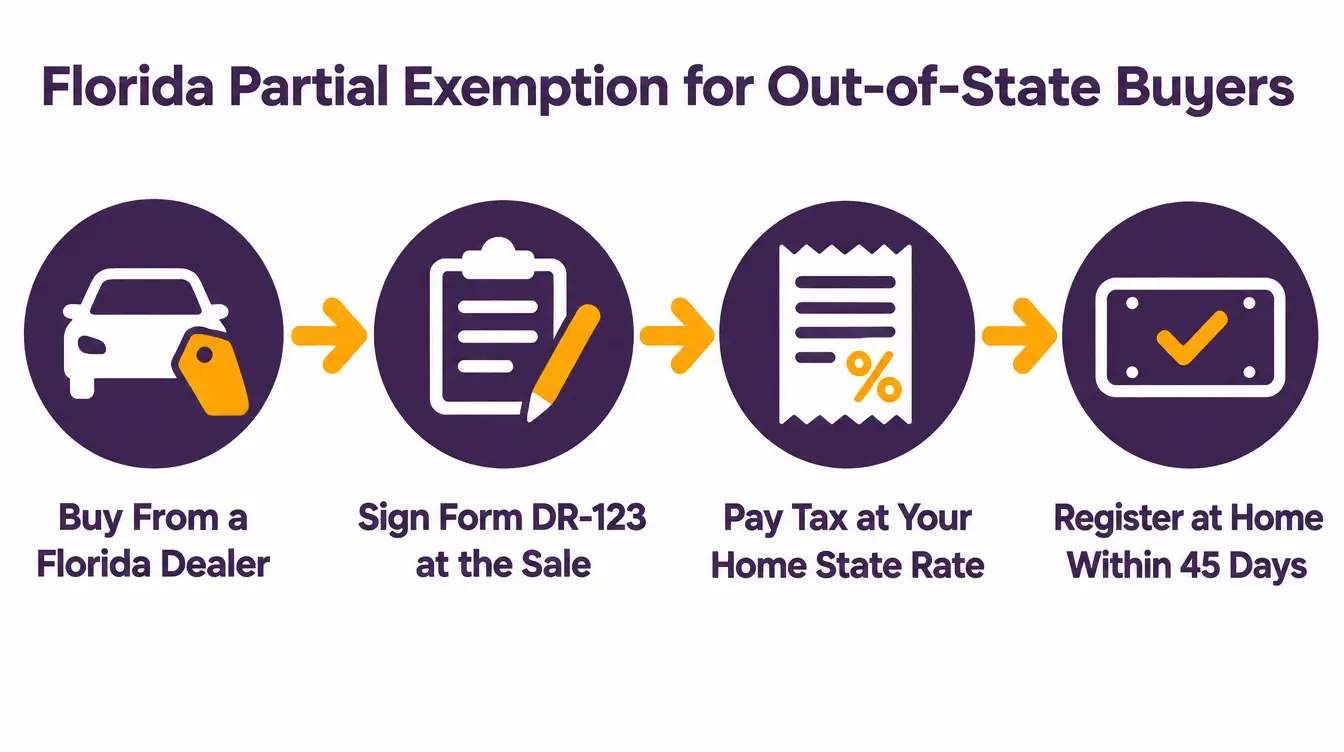
With a partial exemption. Section 212.08(10) of the Florida Statutes sets the tax on a new or used vehicle sold in Florida to a resident of another state at the amount of sales tax the buyer's home state would charge on the same sale, never more than Florida's own tax. The Department's publication adds that when the home state's rate is 6 percent or more, Florida collects the full 6 percent, and the tax is Florida tax paid to Florida.
To claim it, the buyer completes Form DR-123, the Affidavit for Partial Exemption of Motor Vehicle Sold to a Resident of Another State, at the time of sale. It is a notarized statement giving the seller, the sale date, the vehicle, the sales price, any trade-in allowance and the Florida tax paid, and declaring that the car will be licensed in the home state within 45 days of the purchase. The form goes to the selling dealer or, for a car bought from an individual, to the county tax collector or private tag agent when applying for a temporary tag.
A car licensed at home within those 45 days does not have to leave Florida, and without a completed DR-123 at the sale, the Department says the full 6 percent state rate must be collected.
The statute also has the buyer send the notarized statement to the tax agency in the home state. On the form, the buyer initials an acknowledgment that home-state tax may still be owed if that state gives no credit for Florida tax or charges more than 6 percent.
Businesses face a limit. The partial exemption does not apply to a nonresident corporation with an officer, or a stockholder owning at least 10 percent, who lives in Florida, or to a partnership with a Florida partner owning at least 10 percent. Those sales are taxed at the full state rate plus surtax, though the vehicle can still qualify for the partial exemption if it leaves Florida within 45 days of purchase and stays out for at least 180 days.
Which States Do Not Credit Florida Tax?
The Department names three states that tax vehicles but give no credit for tax paid to Florida: Arkansas, Mississippi and West Virginia. A buyer from one of those states pays Florida sales tax when buying and taking delivery in Florida, then pays home-state tax again when licensing the car. The Department tells every nonresident buyer to check with the home state's taxing authority whether a credit will be allowed, and says its chart should not be used to work out tax owed to another state.
What About Delivery Outside Florida?
A dealer sale can be exempt when you accept the car outside Florida. Rule 12A-1.007 allows a vehicle to be sold tax exempt when delivery is accepted outside the state and the buyer signs an exemption certificate saying so, with the seller responsible for keeping the paperwork that supports the exemption.
The rule turns on where delivery is accepted, and it does not say whether a carrier you hire to collect the car at a Florida dealership counts as delivery outside Florida. Ask the dealer how it will deliver the car and document the sale before you rely on this route.
What Does a North Dakota Buyer Pay?
That depends on how the car changes hands, and Florida's side is not settled for every case. North Dakota does not charge sales tax on vehicles. It charges a 5 percent motor vehicle excise tax at titling instead, and the Department of Revenue's chart lists North Dakota with no state sales tax rate, along with a credit from Florida for North Dakota's excise tax.
- Dealer sale with DR-123. Florida collects tax equal to the sales tax North Dakota would charge on the sale, and the dealer applies the Department's chart, which lists North Dakota's state sales tax rate as none. Because North Dakota taxes vehicles with an excise tax rather than a sales tax, confirm with the dealer how much Florida tax it will collect. North Dakota then charges 5 percent at titling, less credit only for Florida tax you actually paid.
- Dealer sale without DR-123. The dealer collects Florida's 6 percent state tax. North Dakota credits tax actually paid in another state only when that state allows a similar credit for North Dakota's tax, and Florida's chart shows it does, so 6 percent paid in Florida should normally leave nothing more to pay at titling. The Motor Vehicle Division decides the credit, and its registration manual says proof of tax payment must be submitted with the application.
- Delivery accepted outside Florida. If the dealer sale qualifies for the exemption above, no Florida tax is paid, so North Dakota's 5 percent is due in full at titling.
- Private sale. The sale is taxable in Florida, and the tax is collected when the car is titled or tagged in Florida, where a nonresident applying for a temporary tag gives DR-123 to the tax collector. North Dakota charges 5 percent at titling, less credit for any Florida tax actually paid. If no Florida tax is paid, North Dakota has nothing to credit, and its 5 percent applies to the purchase price.
Our guide to registering an out-of-state car in North Dakota covers the excise tax, its credit and the Motor Vehicle appointment, and our page on shipping a car from Florida to North Dakota covers the lane itself.
Do New Florida Residents Owe Use Tax on a Car They Bring?
Not on a car you used elsewhere for six months or longer, if you can document it. The Department's publication says a vehicle bought outside Florida and then titled, registered or licensed here is generally subject to Florida's 6 percent use tax plus any surtax. A vehicle used in another state, the District of Columbia or a U.S. territory for six months or longer before coming to Florida is presumed bought for use elsewhere, and with documentation of that use, no Florida use tax is due. Tax lawfully paid in another state counts as a credit: if it equals or exceeds Florida's tax, nothing more is due, and otherwise only the difference is due. Our guide to registering an out-of-state car in Florida covers the rest of that move.
How Does Shipping Fit an Out-of-State Purchase?
Form DR-123 declares that you will license the car at home within 45 days of the purchase, so plan the trip home around that date. Shipping turns it into a booked pickup date rather than a drive of several days.
Rivalane coordinates door to door transport from Florida to North Dakota with licensed, insured carriers. A carrier is typically assigned within one to three working days of booking, and once the car is loaded, delivery usually follows in 4 to 8 days. These are estimates, not guarantees, so leave room before the 45 days run out and before your titling appointment at home, and keep the signed bill of lading with your purchase papers.
Our page on Florida to North Dakota car shipping covers the I-75 lane, our page on car shipping in Florida covers pickups around the state, and the car shipping calculator prices the move.
Frequently Asked Questions
Is Florida sales tax on a car 6 percent?
How much Florida sales tax does an out-of-state buyer pay?
Is there sales tax on a private car sale in Florida?
Does a trade-in reduce Florida sales tax on a car?
Do I pay Florida sales tax if I am taking the car to North Dakota?