Florida will not title a used car that is not already titled in Florida until someone has physically checked its vehicle identification number (VIN). The check is recorded on form HSMV 82042, Vehicle Identification Number and Odometer Verification, or in section 8 of the title application, form HSMV 82040, and only certain people can sign it.
This guide covers when the check applies, what the form asks of you and of the verifier, who can sign it, and how to get it done before the car ships or after it arrives. The rules come from the Florida Department of Highway Safety and Motor Vehicles (FLHSMV), section 319.23 of the Florida Statutes and county tax collector offices. For the full set of new-resident steps, see our guide to registering an out-of-state car in Florida.
When Does Florida Require a VIN Verification?
On every used motor vehicle that is not currently titled in Florida, according to HSMV 82042, including trailers with a net weight of 2,000 pounds or more. That covers a car you bring with you when you move and a used car you buy from an owner in another state and title in Florida.
The form lists the exceptions. You do not complete it for a new motor vehicle, whether bought in Florida or out of state, a mobile home, a trailer or semitrailer under 2,000 pounds, a trailer-type recreational vehicle such as a travel or camp trailer, or an off-highway vehicle. Section 319.23 of the Florida Statutes also names truck campers and fifth-wheel recreation trailers among the vehicles that need no verification.
Classic owners should know one more detail. For a car made before 1955, the form asks the verifier to check the motor number, which served as the identification number on cars of that age.
What Is Form HSMV 82042?
HSMV 82042 is FLHSMV's Vehicle Identification Number and Odometer Verification form. The current version is revision 01/15/21, it has two parts, and the form says to submit it to your local tax collector office.
Part A is yours. After physically inspecting the car, you record the VIN, year, make, color, body type and the state where it was last titled, then the odometer reading and the date you read it. You certify that the reading is the actual mileage, exceeds the odometer's mechanical limits, or is not the actual mileage, and you sign under penalty of perjury. Section 319.23 requires this sworn odometer statement for a used car being titled in Florida for the first time.
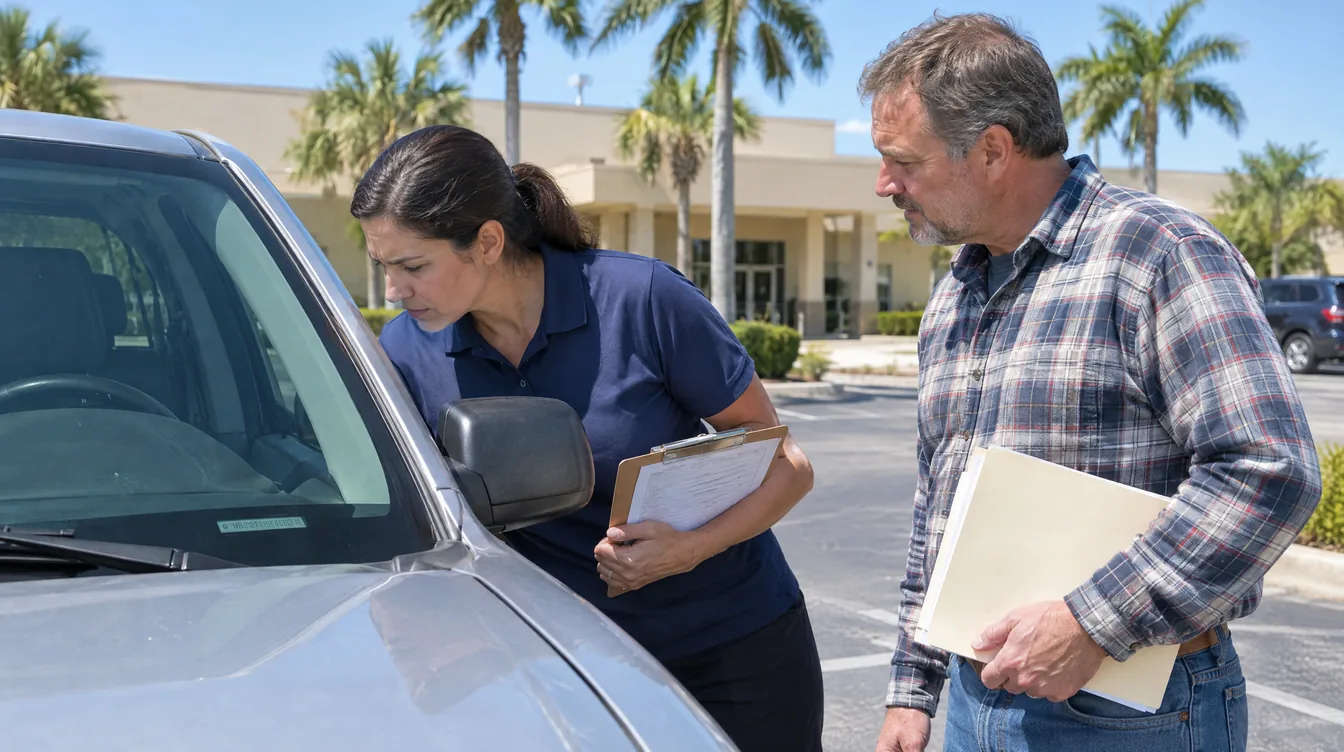
Part B belongs to the verifier. That person physically inspects the VIN under the windshield and in the door jamb, certifies under penalty of perjury that both match the number on the form, and adds a notary's commissioned name and seal or a badge, ID or Florida dealer number.
The title application, form HSMV 82040, has a VIN verification section of its own, section 8, and FLHSMV's New Resident page accepts the verification on either form.
Who Can Verify a VIN in Florida?
HSMV 82042 lists five kinds of verifier:
- A Florida notary public. The form asks for the commissioned name of a Florida notary, and section 319.23 names a notary public commissioned by Florida, so a notary from the state you are leaving cannot sign it.
- A licensed Florida dealer. The form asks for the dealer's Florida dealer number.
- A law enforcement officer. The form sets no state limit here, and section 319.23 accepts a law enforcement officer in any state.
- A military police officer. The form and FLHSMV's New Resident page both list military police officers.
- A Florida compliance examiner or inspector. This means an employee of FLHSMV's Division of Motorist Services or of a county tax collector, and FLHSMV says they can be found at any local service center that offers motor vehicle services.
The New Resident page lists the same verifiers except notaries. The form and the statute both include Florida notaries, and so does every county tax collector page cited in this guide.
What Does the Verifier Check?
The VIN on the car itself, in two places. HSMV 82042 says the verifier must physically inspect the number under the windshield and in the door jamb and confirm that both are identical to the VIN recorded on the form. Miami-Dade County's tax collector describes the purpose as confirming that the vehicle matches its ownership documents.
It is an identity check, not a safety or emissions test. Manatee County's tax collector notes that Florida requires no other safety or emissions inspection to title and register a car.
Can You Get the VIN Verified Before the Car Arrives?
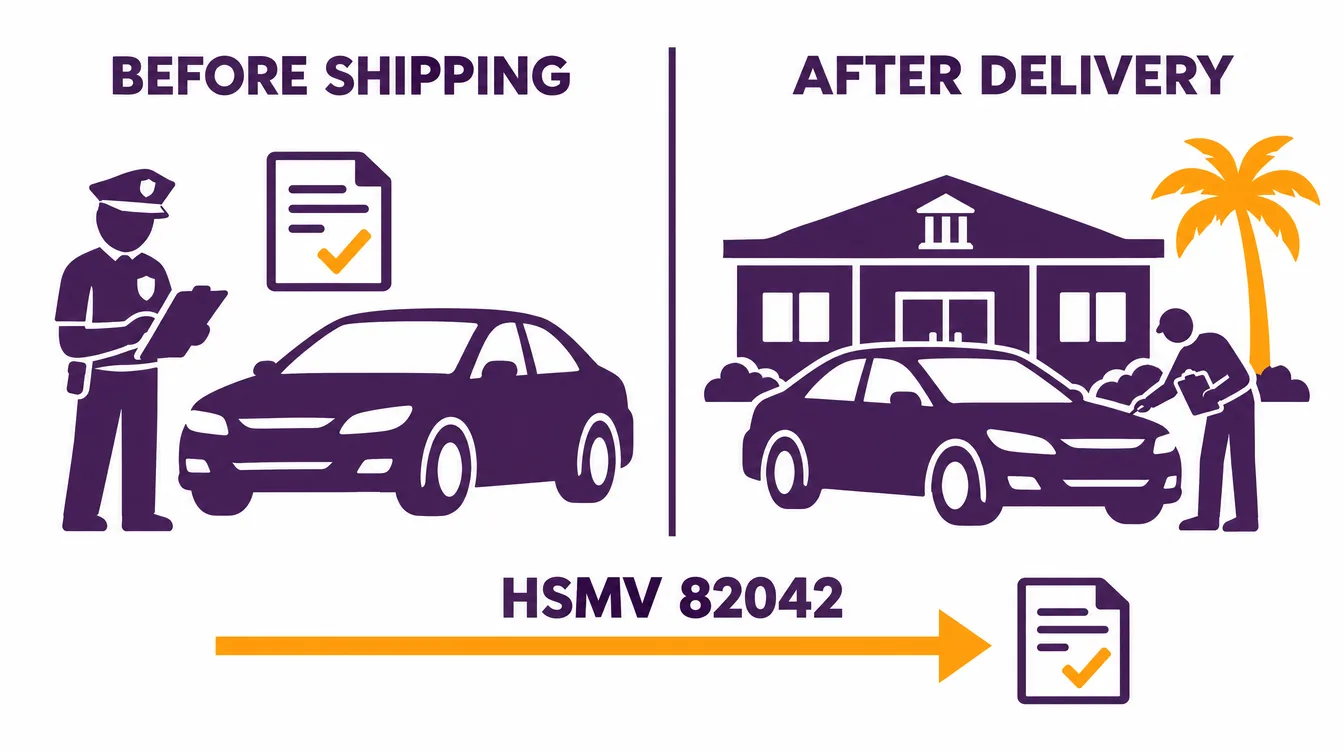
Yes, through a law enforcement officer in the state you are leaving. Section 319.23 accepts a physical examination by a law enforcement officer in any state, and HSMV 82042 lists law enforcement officers without the Florida requirement it places on notaries and dealers. County tax collectors say the same: Lee, Polk, Escambia, Manatee and Miami-Dade counties all list an out-of-state law enforcement officer among the people who can verify the VIN.
For a car leaving Montana, a sheriff's office or police department near the pickup address could complete Part B before the car is loaded. Florida accepts that verification, but each agency decides whether it offers VIN checks, so call ahead. Print HSMV 82042, fill in Part A with the car in front of you, and keep the signed form with your title afterward.
Buying the car rather than moving with it opens a second route. Section 319.23 also accepts a sworn affidavit from the seller and the purchaser that the VIN matches the car, and the Lee and Manatee county tax collectors say the buyer and seller can complete the verification together at the time of sale by signing Part A of HSMV 82042. Do it with the car in front of you, before it is loaded.
Getting it done before pickup takes one task out of the 10 days Florida allows after you establish residency. Florida notaries, licensed Florida dealers and Florida examiners are tied to Florida, so plan on those after delivery.
Where Can You Get It Done After Delivery?
At a county tax collector service center, in most of the counties checked for this guide. FLHSMV says a tax collector employee or a Division of Motorist Services compliance examiner can be found at any local service center that offers motor vehicle services, and county tax collectors describe how their own staff handle it:
- Lee County asks you to bring the car to the service center at the time of titling, and its staff do not perform VIN inspections in bad weather.
- Polk County staff can do the check, weather permitting, though it can make the visit longer, so the county suggests completing the form before you come in.
- Escambia County, home to Pensacola, says its staff can do it at its offices in most cases, weather permitting, and charges no fee for the service.
- Miami-Dade County lists its own office among those who can inspect the VIN.
Not every county works this way. Manatee County requires the whole HSMV 82042 to be completed before you arrive, and it serves out-of-state title transfers by appointment only. Check your county tax collector's page before you go.
If you cannot bring the car in, Escambia's tax collector points to the other verifiers on the list, including a law enforcement officer, a licensed Florida dealer and a Florida notary. Some sheriff's offices offer the check as a service: in Orange County, which includes Orlando, the Sheriff's Office offers VIN verification by a notary or a deputy at its West Colonial Drive location, arranged by phone or email.
What Do You Take to the Tax Collector?
The completed verification goes into your title packet. For a car without a lien, FLHSMV's New Resident page lists proof of identity for every owner, proof of Florida insurance, the original out-of-state title, HSMV 82040 signed by all owners, and the VIN verification on HSMV 82040 or HSMV 82042.
That packet is one step in a longer sequence. Our Florida registration guide for new residents walks through the 10-day deadline, Florida insurance, a title held by a lender, the fees and the driver license in order.
How Does Shipping Fit the VIN Verification?
A shipped car arrives still registered in the state it left, on Montana plates if it is coming from Montana. Florida's 10 days count from when you establish residency, not from delivery, so if the VIN was not verified before pickup, plan the check for soon after the car arrives. Keep the title, the signed HSMV 82042 and your other paperwork with you rather than in the car.
Rivalane coordinates door to door transport into Florida with licensed, insured carriers. We typically assign a carrier within one to three working days after you book, and pickup and delivery dates are estimates, not guarantees, so book any service center visit for after the car has actually arrived rather than for the expected delivery day.
For a car coming from Montana, our page on Montana to Florida car shipping covers that route. Our page on car shipping in Florida covers pickups and deliveries across the state, and you can price the move with the car shipping calculator.
Frequently Asked Questions
Is a VIN verification required in Florida?
Who can do a VIN verification in Florida?
How do you verify a VIN in Florida?
Can I verify a VIN online in Florida?
Can a police officer in another state do a Florida VIN verification?