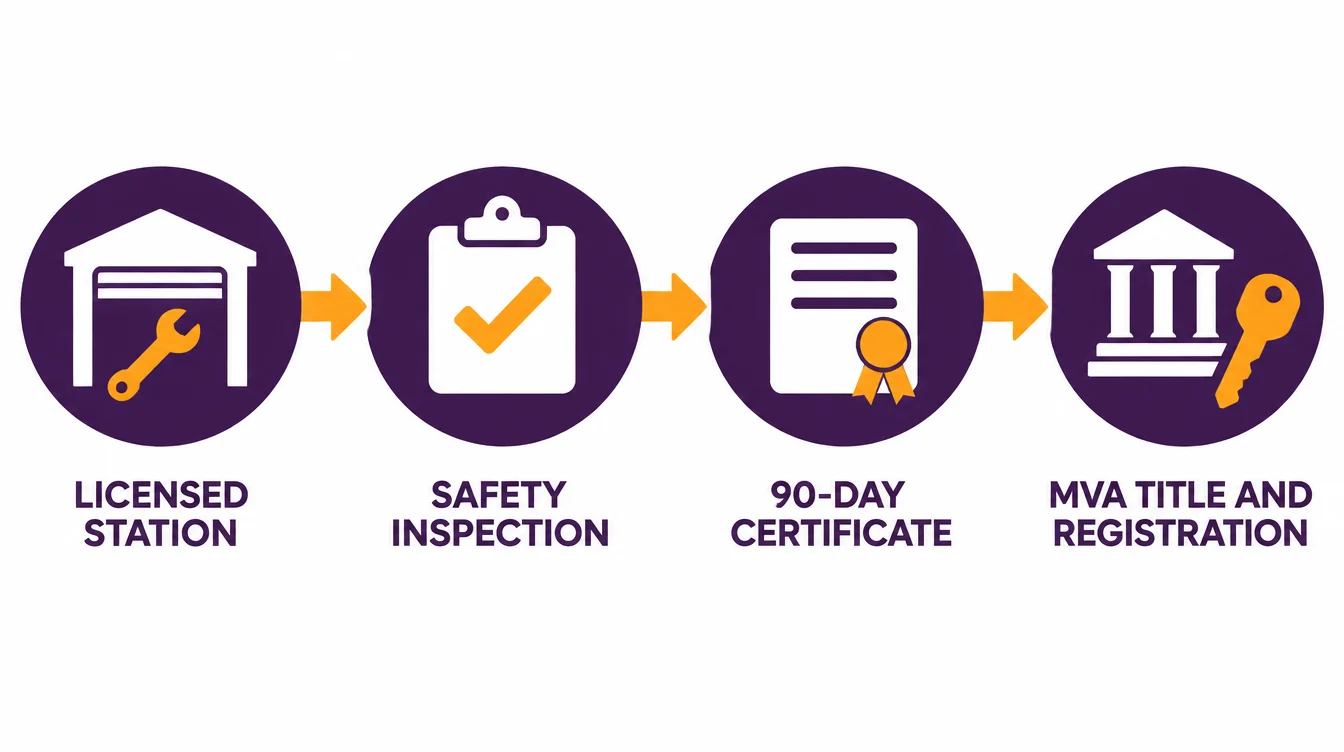
A Maryland state inspection is the safety inspection a used car has to pass before the Motor Vehicle Administration (MVA) will title and register it. It happens once, when the car is titled in Maryland, at a repair shop or dealer licensed by the Maryland State Police (MSP), and it does not repeat every year.
This guide covers who needs the inspection, what the mechanic checks, how stations set the fee, where to go, how to get a car on New York plates there legally, how long the certificate lasts and what happens if the car fails. The rules come from the MSP, the MVA, Maryland's Transportation Article and the inspection regulations in COMAR 11.14.
What Is a Maryland State Inspection?
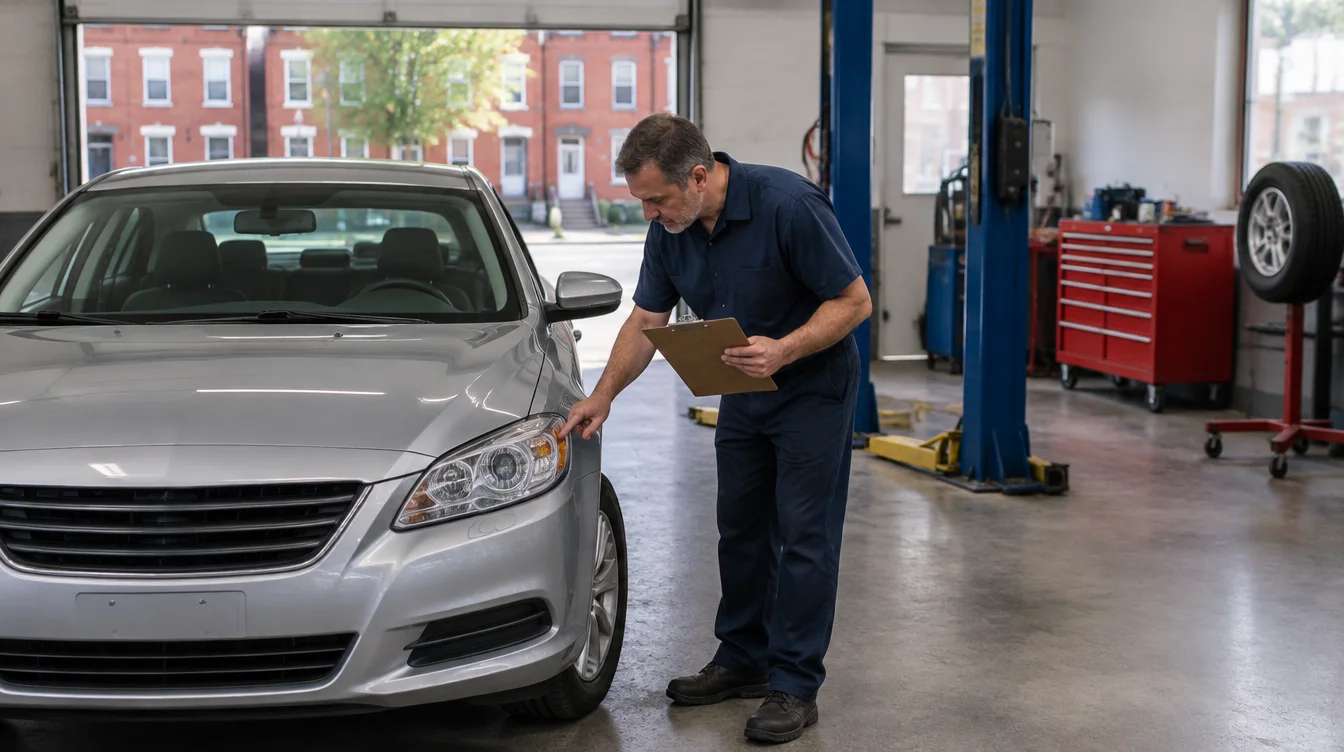
It is a check by a registered inspection mechanic that the car meets Maryland's minimum safety standards, covering the brakes, tires, lights, steering, suspension and the other parts the MSP lists. The MVA calls it the Maryland Safety Inspection, and most drivers call it the state inspection, the MD inspection or the vehicle inspection. The mechanic enters the results in the Maryland Safety Inspection System, and a car that passes is certified electronically, with the result sent straight to the MVA.
It is not the emissions test. The Vehicle Emissions Inspection Program, known as VEIP, measures pollution and repeats every two years in parts of the state. A section below sets the two side by side.
Who Needs a Maryland Safety Inspection?
Anyone titling a used car in Maryland. The MVA's safety inspection page says state law requires a passed inspection before a vehicle can be sold, titled or transferred in Maryland, and that the car must pass before the MVA titles and registers it. That covers a new resident bringing a car from New York or another state, a Maryland resident buying a used car from a private seller or a dealer, and a Maryland resident bringing home a car bought in another state.
In a sale inside Maryland, the seller usually gets the certificate, according to the MSP, though for some trucks and trailers either the buyer or the seller may. A buyer can confirm that the car already has a current inspection with the MSP lookup described below.
A few owners skip the step. A returning resident whose car was previously titled in Maryland in their name does not need a new inspection, according to the MVA. Transportation Article 23-106 also lifts the seller's duty to get a certificate for transfers to a dealer, between spouses, between a parent and child, between co-owners when one name comes off the title, into a living trust where the person transferring the car is the primary beneficiary, and to the lessee at the end of a lease.
What Does the Maryland Inspection Check?
The MSP sums it up as brakes, tires, lights, steering, suspension and other critical components. Its official inspection chart, which follows the regulations in COMAR 11.14, sets out the mechanic's work on a passenger car in this order:
- Paperwork and the VIN. The owner's details, the year, make, model and mileage, and the vehicle identification number read from the car itself. If the public VIN is missing or altered, the inspection stops there.
- Checks before the road test. Tire size, construction and pressure, exterior and dash lamps, mirrors, hood latches, wipers and washers, the driver's seat, seat belt, door and window, the steering wheel, the horn and brake pedal firmness.
- The road test. Brake performance, the speedometer and odometer, steering and handling, wheel alignment and the turn signal mechanism.
- Inside the car. Every seat belt, the parking brake, the neutral safety switch and gear indicator, the brake warning light, brake pedal reserve and leaks, steering play and travel, and the turn signal, hazard and high beam indicators.
- Outside and under the hood. Headlamp aim, fog and driving lamps, the fuel cap, glass, bumpers, fenders and door latches, then the exhaust, emission equipment, fuel system, brake master cylinder and booster, fluid lines and hoses, power steering, engine mounts and battery wiring.
- Underneath the car. Suspension, ball joints and wheel bearings, tires, wheels and lug nuts, brake linings, drums and rotors with the readings recorded, brake lines and hoses, floor and frame mounting points, fuel lines, exhaust leaks, the catalytic converter and evaporative system, and the drive shafts and CV joints.
Before the visit, the MSP suggests checking the lights, windshield wipers, brakes, tires, exhaust and interior yourself. Bumper height counts too: the limit is 20 inches for a passenger car and 28 inches for an SUV or other multipurpose vehicle, or a pickup of 10,000 pounds GVWR or less, measured from level ground to the lowest point of the bumper bar behind any plastic cover. A lifted truck or SUV is worth measuring first.
How Much Does a Maryland State Inspection Cost?
Each station sets its own price, so there is no single statewide fee. The MSP explains that the fee depends on the station's labor rate: Maryland regulates how many labor hours a station may bill for an inspection, but not what it charges per hour. Under COMAR 11.14.01.10, a complete inspection of a car or light truck of 10,000 pounds GVWR or less is billed at 1.5 hours of the station's flat hourly rate for similar repairs, including 0.4 hour for headlight adjustment, and at 2.0 hours for a four-wheel-drive vehicle or one with full-floating axles.
The station must display its approved inspection fee in public view, framed with its license and the official inspection chart, and it needs the MSP's approval before it raises that fee. Ask for the posted price when you book.
A recheck after a failure can cost less. No fee is charged when a repair can be confirmed by eye, such as a bulb that has been replaced. When the mechanic has to jack, lift, measure or test the car again, the station may charge a prorated fee for those items. Repairs are billed separately, like any other shop work.
Where Can You Get a Maryland State Inspection?
Only at a station licensed by the Maryland State Police. There are about 1,600 across the state, and not every repair shop is one, so check the address first with the MSP's Inspection Station Lookup.
Stations are licensed by vehicle type. Most passenger cars, SUVs, minivans and pickups of 10,000 pounds GVWR or less are Type A, while motorcycles, heavier trucks and trailers have types of their own, so confirm the station is authorized for yours. The MVA recommends booking ahead, and under COMAR a station that cannot do a scheduled inspection has to rebook it within three business days.
How Do You Get an Out-of-State Car to the Inspection?
Drive it there on its current plates. The MVA says the car must be properly registered in Maryland or another state before the inspection, so a car still on valid New York registration can go to the station as it is. Getting it there legally is the owner's responsibility.
If the car has no valid registration, for example because the New York registration has lapsed or you bought it without plates, the MVA can issue a 30-day temporary registration so you can drive it to and from the station. You apply with the Temporary Inspection Waiver (form VR-129) and pay a fee, and the MVA's page on registering a vehicle links the form. Only one 30-day temporary registration may be issued, so the MVA suggests applying only when the car is ready for inspection. A car that needs repairs first can be titled in your name now, with the title mailed to you, and the temporary registration requested later.
How Long Is a Maryland Inspection Certificate Good For?
Ninety days from the date it is issued, according to the MVA, so the car has to be titled and registered inside that window. If the certificate lapses before you title the car, you need a new inspection.
There is no sticker to carry. The station sends the pass to the MVA electronically and may give you a paper receipt or email one. If the car is on a temporary registration when it passes, the MVA says you can finish registering on myMVA from the next business day without visiting a branch.
Buyers can check a car before paying. The MSP lookup has a Find an e-inspection option that shows, by VIN, whether the car has a current Maryland inspection.
What Happens If Your Car Fails?
The station cannot issue a certificate. Your inspection report lists every defect, and you can fix them yourself, have the station do the work or take the car to another shop.
The MSP's rule is that the reinspection is done by the same registered inspection mechanic at the same station. Under COMAR 11.14.01.10, if the car comes back to that station within 30 days and 1,000 miles of the first inspection, only the failed items, plus any new defect the mechanic sees, are checked again. Miss either limit and the car needs a complete new inspection at the full fee. If the original mechanic is not available on the reinspection date, the station must do a complete reinspection while charging only the reinspection fee, or refund the first inspection.
A Safety Equipment Repair Order, or SERO, is a separate matter. A police officer can issue one at a traffic stop for defective equipment, and the MSP has its own process for clearing a SERO.
How Is the Safety Inspection Different From the VEIP Emissions Test?
The safety inspection checks whether the car is safe to drive, happens once at titling and is done at a private station licensed by the MSP. The Vehicle Emissions Inspection Program checks pollution levels at VEIP stations and self-service kiosks and repeats every two years for qualifying vehicles in 13 counties and Baltimore City.
They fall at different points in the move. The safety inspection comes before the MVA titles the car, while a newly registered car gets its first VEIP notice about three months after registration, according to the MVA.
When Should You Book the Inspection If Your Car Is Being Shipped?
Book it for soon after delivery. A new resident has 60 days from the move to title and register, and the certificate lasts 90 days, so an inspection in the first weeks after the car arrives leaves time for repairs, a reinspection and the MVA appointment. Our guide to registering an out-of-state car in Maryland takes the appointment step by step.
Have the car delivered with its New York registration still valid, so you can drive it to the station on those plates. Keep the signed bill of lading from pickup and delivery with your title papers.
Rivalane coordinates door to door transport from New York to Maryland with licensed, insured carriers. A carrier is normally assigned one to three working days into the booking, and once the car is loaded it usually reaches Maryland in 1 to 3 days. Pickup and delivery dates are estimates, not guarantees. Our page on car shipping from New York to Maryland covers the I-95 lane, our page on car transport across Maryland covers deliveries statewide, and the shipping cost calculator prices your move.
Frequently Asked Questions
Does Maryland require a safety inspection every year?
Can any repair shop do a Maryland state inspection?
Can you title a car in Maryland before it passes inspection?
Is a reinspection free in Maryland?
How can you tell if a used car already passed a Maryland inspection?