New Mexico does not charge sales tax on cars. It charges a motor vehicle excise tax instead, 4 percent of the price paid for the vehicle, collected when you apply for a New Mexico title. The rate rose from 3 percent on July 1, 2019, and the state treats every title it issues as a sale unless an exemption applies or the car changed hands without a sale.
This guide covers how the tax is figured: what counts as the price paid, how trade-ins and private sales are valued, the credit for tax paid in another state, who is exempt and the penalties for titling late. Every rule comes from New Mexico's statutes and administrative rules, the Taxation and Revenue Department or its Motor Vehicle Division (MVD).
Does New Mexico Charge Sales Tax on Cars?
No. A vehicle sale in New Mexico falls under the Motor Vehicle Excise Tax Act, Chapter 7, Article 14 of the state's statutes, rather than under a sales tax. The Taxation and Revenue Department's motor vehicle excise tax page sets the tax at 4 percent of the price paid for the vehicle, less any trade-in credit, and applies it to the sale of every vehicle that has to be registered in the state.
The rate depends on the purchase date. Chapter 6 of the MVD's Vehicle Procedures Manual says the excise tax rose from 3 percent to 4 percent on July 1, 2019, so a vehicle bought before that date is assessed at 3 percent and one bought on or after it at 4 percent.
Section 7-14-3 of the act explains why the tax reaches almost every title transaction. New Mexico presumes that issuing a certificate of title is a sale for tax purposes, unless the act exempts it or the applicant shows that the vehicle came to them as a voluntary transfer without payment or as a transfer by operation of law.
When and Where Do You Pay the Excise Tax?
At the title application. Section 7-14-5 has the applicant for a certificate of title pay the tax when applying, and the Taxation and Revenue Department adds that a dealer may handle the application and collect the tax when you buy through one. Otherwise you pay it to the MVD or one of its agents when you apply for the title.
For a newcomer's car, that makes the tax part of the first MVD visit. The visit itself, with the documents to bring, the VIN inspection and the registration fees, is covered in our guide to registering an out-of-state car in New Mexico.
What Counts as the Price Paid?
Rule 3.11.4.7 of the New Mexico Administrative Code defines the price paid as the total net purchase price the buyer pays for the vehicle itself at the time of sale, including any deposit or down payment. It includes charges for accessories, transportation, delivery and dealer preparation.
Several things reduce it. The rule takes off the value of any vehicle trade-in, any discounts or rebates applied to the balance due at the time of sale, and a manufacturer's or other rebate that is contractually guaranteed to the buyer at the time of sale, even if the money arrives later. The MVD procedures manual also leaves out two dealer charges: a transfer service fee for document preparation and processing, which is a separate service subject to gross receipts tax, and an insurance premium the dealer charges at the sale.
Trade-ins have limits of their own. Rule 3.11.4.13 allows only the value of a vehicle to be deducted, though any vehicle counts, so a recreational vehicle traded in on a truck qualifies. A manufactured home does not, because the excise tax does not apply to manufactured homes.
How Is a Car From a Private Sale Valued?
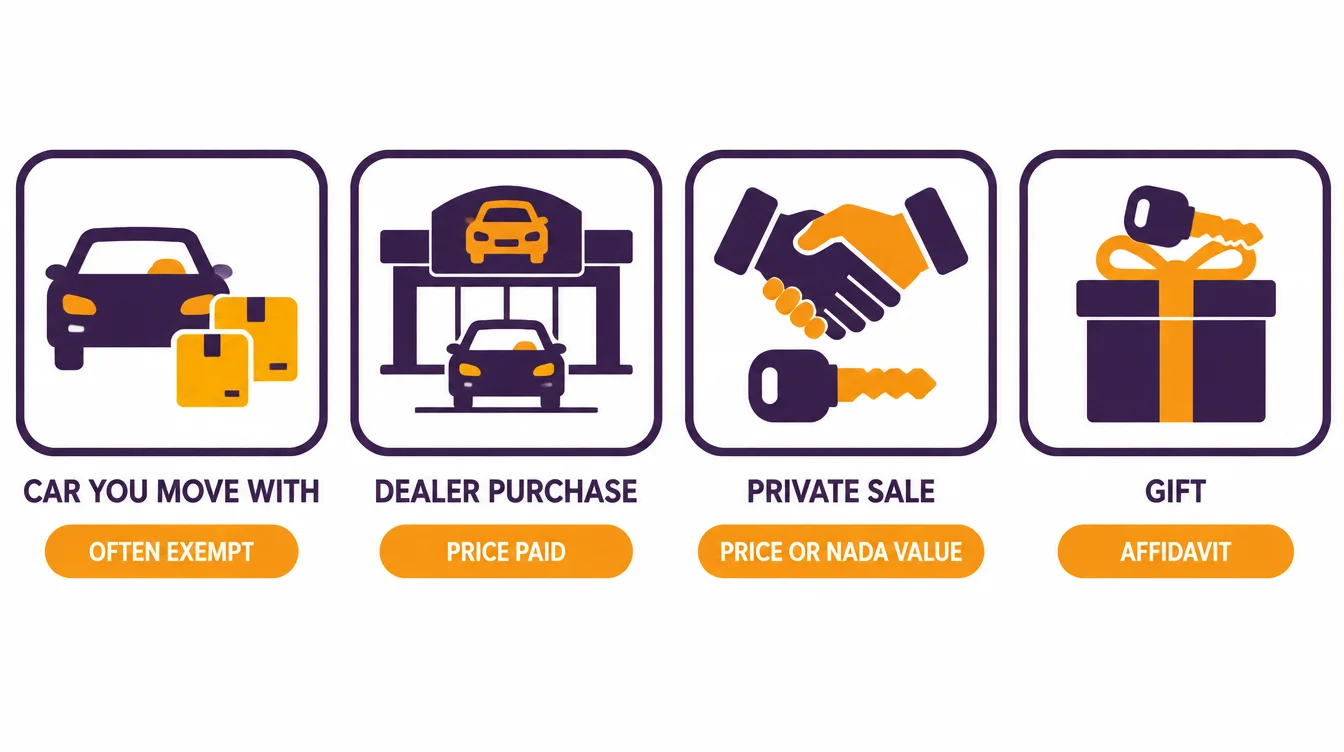
Not always at the price on the bill of sale. Chapter 6 of the MVD procedures manual, applying rule 3.11.4.14, tells agents that the price paid for a used vehicle cannot be relied on to show its value. When a used vehicle has been sold and is being titled, the agent looks up its NADA average trade-in value from the VIN and the actual mileage where available, without counting options, and taxes the higher of the declared purchase price or 80 percent of that NADA value.
The manual lists four exceptions:
- Dealer sales with an invoice. When a licensed dealer sells the car and presents its invoice, the MVD accepts the price on the invoice, as it would for a new car.
- No NADA value. When the MVD cannot find one online for the vehicle, it accepts the price stated on the title or bill of sale.
- Salvage titles. A vehicle whose title carries a salvage brand is taxed on the stated price.
- No average trade-in value. When the guide gives only rough and clean trade-in values, as it does for motorcycles, the MVD uses 80 percent of the lower, rough trade-in value.
Field office staff do not negotiate the value. If you think the NADA figure overstates what the car is worth, the manual says you can ask for the difference back with a Request for Refund (MVD-10208), supported by evidence of a lower value, typically a body shop estimate of needed repairs or a formal statement of value from a licensed dealer or other professional appraiser. Paperwork that only confirms the price you paid does not count.
Who Is Exempt From the Excise Tax?
Section 7-14-6 lists the exemptions, and the MVD summarizes them in chapter 6 of its manual. The ones that apply to individual owners are:
- A car you move with. A vehicle acquired out of state for personal use 30 or more days before you establish a domicile in New Mexico is exempt. A car bought within those 30 days, or bought out of state after you move, is taxed. If that car is coming from Florida, our page on shipping a car from Florida to New Mexico covers the lane.
- A car you titled here before. If you previously registered and titled the vehicle in New Mexico and have owned it continuously since, you are exempt when you title it in New Mexico again after it was registered in another state.
- Vehicles modified for a disability. A person who has a disability when buying a vehicle is exempt on proving to the MVD that modifications made to it are due to that disability and necessary for the person to drive it or be transported in it.
- Certain veterans. A bona fide New Mexico resident who served in the U.S. armed forces and, while serving or from a service-connected cause, lost or lost all use of one or both legs at or above the ankle, or one or both arms at or above the wrist, is exempt.
The statute also exempts vehicles owned by the state or its political subdivisions, and vehicles bought to lease for terms of more than six months under the conditions it sets.
Gifts work differently. A gift is not a sale, so no excise tax is due, but the MVD requires a notarized Affidavit of Gift of Motor Vehicle or Boat (MVD-10018), signed by both the giver and the recipient, who affirm under oath that the vehicle really was a gift. Without the affidavit, the MVD treats the transfer as a sale and taxes the higher of the actual price or the vehicle's reasonable value.
Do You Get Credit for Sales Tax Paid in Another State?
Yes. Under section 7-14-7, when you acquire a vehicle through an out-of-state transaction and another state or one of its political subdivisions levied a gross receipts, sales, compensating or similar tax on it, the amount you paid may be credited against the New Mexico excise tax due on the same vehicle. The Taxation and Revenue Department's excise tax page describes the same credit.
What Happens If You Title Late?
Two charges can apply. Section 7-14-8 adds a penalty of 50 percent of the excise tax for a New Mexico resident who takes ownership of a vehicle in the state and does not apply for a title within 90 days of the transfer, or who takes ownership outside the state and does not apply within 90 days of bringing the vehicle into New Mexico. The MVD notes that the penalty effectively raises the rate from 4 percent to 6 percent.
The second is a $20 late transfer fee under section 66-3-103. The MVD procedures manual charges it when the application for title comes more than 30 calendar days after the transfer, and applies it to out-of-state titles too. The fee may be waived if you tried to complete the transfer in time and hold a Notice of Additional Requirements for Completion of Vehicle Transactions (MVD-10282) that is 10 days old or less, or at the office manager's discretion. A newer bill of sale does not help, because the date on the original decides.
Shipping a Car to New Mexico
If the car still has to make the trip, Rivalane coordinates door to door transport with licensed, insured carriers. We typically assign a carrier within one to three working days after you book, and pickup and delivery dates are estimates, not guarantees. Our page on car shipping in New Mexico covers pickups and deliveries across the state, and the car shipping calculator prices the move.
Frequently Asked Questions
Does New Mexico have sales tax on cars?
Do you owe New Mexico excise tax on a car you bring when you move?
How does New Mexico value a car bought in a private sale?
Does sales tax paid in another state count in New Mexico?