Almost every vehicle moving to or from New Mexico is crossing a long distance, and the state's own markets sit a long way apart. Tell us the pickup and delivery addresses and we match the vehicle to a carrier already working that route, rather than sending one out to build it from scratch.
Albuquerque, Rio Rancho, Santa Fe and Las Cruces sit on the I-25, I-40 and I-10 corridors and are the easiest places to schedule. Addresses farther out take more planning, and that is work we do before you book rather than after.





5-Star Average Rating
Fully Insured
Top Rated Service
Nationwide Coverage
Vetted Carriers
Getting a vehicle moved in New Mexico starts with the route rather than the paperwork. Once you share the pickup and drop-off points, we map the route against the carriers already running I-25, I-40 and I-10, and arrange the transport details from there.
When the carrier arrives, the driver completes a condition check, secures the vehicle on the trailer, and starts the run to your destination. You get clear updates as the shipment moves, and the same point of contact from the first call to delivery.
That coordination counts for more in a state where the distances are long and the markets sit far apart. Knowing which lanes are already busy, and which addresses take extra planning to reach, is the difference between a route that is booked and one still waiting on a truck.

Cost and timing depend on your route, trailer type, vehicle size, and the time of year. The ranges below reflect typical market pricing and transit windows by distance, not a commitment on either. Your actual quote is based on real carrier availability on your specific route at the time of booking.
New Mexico prices the opposite way from most states. I-25 runs north to south and I-40 runs east to west, crossing at Albuquerque, and I-10 carries the southern edge past Las Cruces, so a long distance move rides freight lanes that are already busy and prices competitively for the miles covered. What the state does not have is a dense internal market. Albuquerque to Las Cruces is over 200 miles, Farmington and Roswell are farther out still, and a short move inside New Mexico often costs more per mile than a run to another state, because the carrier has to build a route rather than add to one.
Direction moves the number as well, so the same two cities can price differently depending on which end you start from, and a Florida to New Mexico quote is not a reliable guide to the trip back. Where you are inside the state counts too. Albuquerque, Rio Rancho and Santa Fe sit on or near the I-25 and I-40 crossing and price at the low end, and Las Cruces prices well for anything moving along I-10. Farmington up in the Four Corners, Roswell and Hobbs out on the eastern plains, and the mountain towns away from the corridors all take longer to reach and cost more to serve.
Vehicle size, whether the car runs, and trailer type all move the number, and enclosed transport runs roughly thirty-five percent above open because fewer vehicles fit on the trailer. The factor most within your control is lead time. Booking a week or two ahead puts your vehicle on a truck already running I-25, I-40 or I-10 rather than one routed out to collect it, and in a state this large with this little between the markets, that gap widens sharply once your address sits away from those corridors.
Get your New Mexico quoteEvery New Mexico shipment follows the same five stages, from the first quote to the handover at your door. Here is what happens at each one, and what we need from you.





Share your pickup and delivery points, and we review the route straight away.
Your estimate is explained in plain terms, so you know the cost and what it covers before you approve anything.

Choose the pickup window that suits you, and we match the shipment to a carrier already working your direction, which on most New Mexico routes means one running I-25, I-40 or I-10. You get a plain breakdown of what happens next before anything is booked.

Remove personal belongings, keep the keys accessible, and make sure the vehicle can be reached. When the driver arrives, they complete a short inspection, record the condition, and secure the vehicle on the trailer.
While the vehicle is in transit you get clear updates on progress and timing. That counts for more on the longer New Mexico lanes, where there is a lot of ground between one checkpoint and the next.

At the drop-off point, the driver walks around the vehicle with you to confirm it matches the condition recorded at pickup. Once you have both signed off on that, the shipment is complete.

Here are the core services we offer in New Mexico, each built around clear communication, organized planning, and a route that fits the vehicle you are shipping.
New Mexico leaves long gaps between its markets, and a pickup or delivery address away from I-25, I-40 or I-10 changes how the route gets built. We plan these moves around how often a carrier actually passes rather than assuming one does daily, which is the difference that matters for Roswell, Hobbs, Farmington, Gallup and the mountain towns. Where a full-size hauler cannot reach the address itself, we arrange a meeting point on an accessible road nearby instead of leaving you to work it out at pickup.
Open carrier shipping is the most practical choice for everyday vehicles. Your car is secured on an open trailer alongside other vehicles, with an insured carrier and clear updates from pickup to delivery. It also draws on the widest pool of carriers, which means less waiting for one to be assigned to your lane.
For high-value, classic, or specialty vehicles, enclosed transport offers an added level of safety. Your car travels inside a covered trailer, shielded from weather, dust, and road debris for the entire trip. That matters in New Mexico, where long stretches of I-40 and I-10 cross open desert and blowing sand is a normal part of the drive.
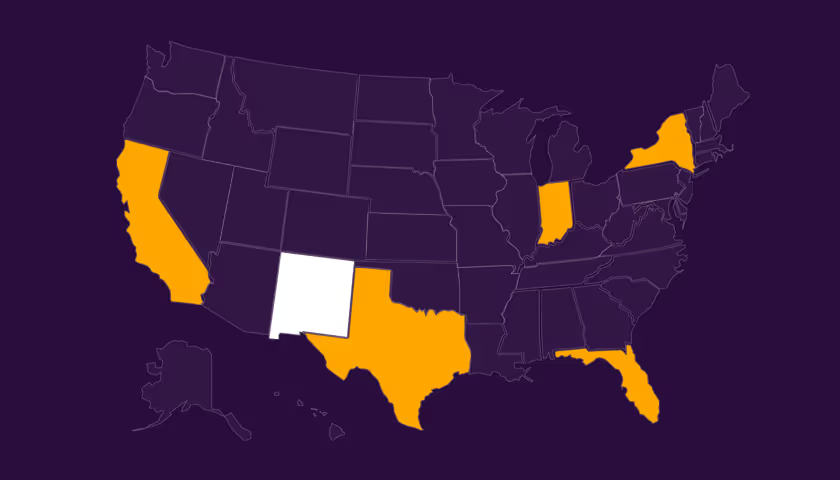
Most New Mexico shipments travel a long way, and the state's position on I-25, I-40 and I-10 means cross-country lanes are better served than the raw distances suggest. We arrange long-haul transport between New Mexico and every other state, including Florida, California, Texas and the Northeast.
Your vehicle can be delivered directly to your home, workplace, dealership, storage facility, or any address you choose in New Mexico. The final handoff is kept simple and convenient.
Every shipper claims to be reliable. Here is what actually separates a well-run move from a risky one, and what to ask before you book anyone for a New Mexico route.
Ask whether the company can name a real New Mexico constraint before you raise it, such as how they reach an address in the Four Corners or out on the eastern plains, or whether your delivery address falls inside the Bernalillo County emissions boundary.
Ask whether the price you are quoted is based on your actual route and vehicle, or a generic distance estimate that gets revised once a carrier is assigned.
Ask what happens if no carrier is available on your exact date. That matters more here than in a dense market, because there are fewer trucks to fall back on. Monsoon storms between July and September can close lanes on I-10 and I-25 with little warning, and winter weather on the northern passes above Santa Fe and around Raton does the same from November onward. A shipper working from an established carrier network can usually offer options faster than one starting from scratch.
Get your New Mexico quoteVehicles move into and out of New Mexico for a few clear reasons. Here is who ships most often.
.svg)
If you bought a vehicle sight unseen from somewhere else in the country, we arrange pickup from the seller or the dealership and have it delivered to your New Mexico address, so nobody has to fly out and drive it back. One thing is worth knowing before you buy. New Mexico charges a four percent motor vehicle excise tax at titling rather than sales tax, calculated on the price paid less any trade-in allowance, or on a private sale the higher of that price or 80 percent of the NADA average trade-in value. If you already paid sales or a similar tax to another state on the same vehicle, that amount can be credited against what New Mexico charges. The part that trips people up is the deadline. If you live in New Mexico, you have 90 days from the day the vehicle arrives to apply for the title, and missing it adds a fifty percent penalty that lifts the effective rate to six percent. Our guide to New Mexico car sales tax covers the exemptions and private-sale valuation.
Estimate your shipment →.svg)
A vehicle you already own still has to be titled and registered here, and there is a step most states do not have. Not every field office performs the VIN inspection and some ask for an appointment, so call ahead rather than turning up. If you are landing in Bernalillo County the emissions test is a separate errand to plan into your first weeks. Our guide to registering a car in New Mexico walks through the MVD visit.
Vehicle transport services →
A vehicle that does not start needs a carrier with a winch and the right loading setup, and in New Mexico that pool is smaller than it would be in a dense market. Tell us the condition up front, including whether it rolls, steers and brakes, so we can match it to a carrier equipped for the job rather than discovering the problem at pickup. The same applies to a project car coming home from a workshop, an auction buy that has not run in years, or a long-stored vehicle leaving a garage.
Quote a non-running vehicle →
Work, retirement and relocation move vehicles out of New Mexico in every direction. An outbound quote on a pair of cities can look different from an inbound one, so price the direction you need. We arrange pickup from Albuquerque, Rio Rancho, Santa Fe, Las Cruces, Roswell, Farmington and the towns between them, then hand the vehicle to a carrier already working that direction.
Estimate a long-distance move →Looking to ship your car to another state or across the country? Rivalane arranges transport between New Mexico and all 50 states. Select a state to see how that route works.
Most of New Mexico's population sits in a single north to south band along the Rio Grande, which is also the line I-25 follows, running from Las Cruces up through Albuquerque and Rio Rancho to Santa Fe. Everything else is spread thinly across a very large state, so Farmington in the northwest, Gallup out on I-40, and Roswell, Hobbs and Clovis on the eastern side are each served on their own terms rather than as part of a metro run. Find your city below for the ZIP codes we cover.