


From Salt Lake City to Jacksonville, an open-carrier shipment of a running sedan costs $1,100 to $1,550. The 16 pairs we routed cover 2,165 to 2,558 road miles, and once loaded, the car is typically in Florida within 5 to 8 days. Florida then gives the car 10 days from residency to be registered.
Which Roads Take a Car From Utah to Florida?
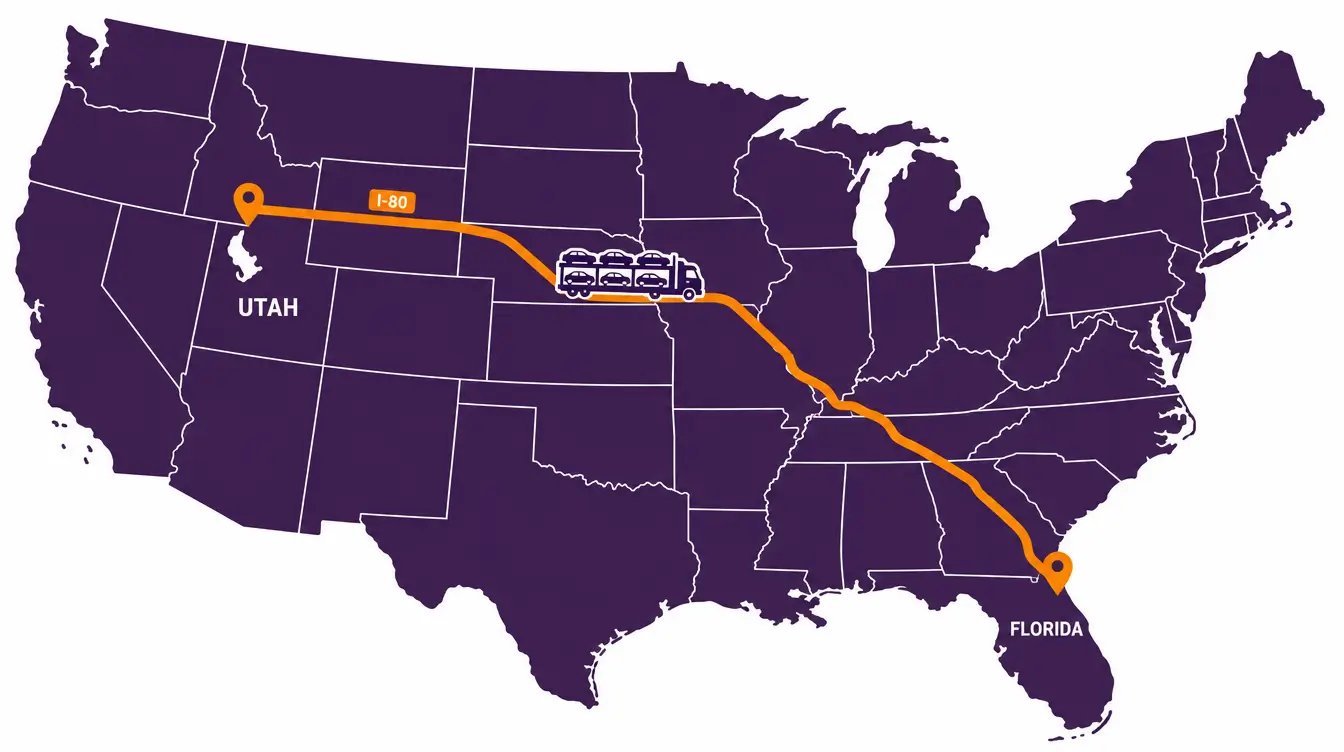
We routed four Utah pickups, Ogden, Salt Lake City, Provo and St. George, against four Florida deliveries, Jacksonville, Orlando, Tampa and Miami, and utah to florida car shipping across those 16 pairs runs 2,165 to 2,558 road miles. St. George to Jacksonville is the shortest pair and Provo to Miami the longest. Salt Lake City to Jacksonville, the core pair, measures 2,224 miles and close to 40 hours of driving: 873 miles on I-80, 119 on I-29, 243 on I-70, 316 on I-24 and 369 on I-75, with shorter links between them. The three northern towns share that line for all 12 of their pairs, east across Wyoming and Nebraska, south through Iowa to Kansas City, past St. Louis and Nashville, and down through Georgia. St. George loads take a separate southern line on I-40, I-20 and I-10 through New Mexico, Texas, Louisiana, Mississippi and Alabama.
What Sets the Price of Shipping a Car From Utah to Florida?
Your quote depends on your vehicle, the exact pickup and delivery addresses, the season and the trailer type, so run the calculator for a figure on your dates.
The Florida address decides most of the distance. From every one of the four Utah towns, Orlando adds about 93 road miles over Jacksonville, Tampa about 110 and Miami a full 316, so a Miami delivery sits well up the range below.
The Utah end moves far less. The four towns land within 77 miles of each other for any Florida city, and St. George comes out nearest in miles even though its southern line takes about as many driving hours as the northern one.
Every pair runs past 1,500 miles, so the long-haul rows of the Utah car shipping table and the Florida car shipping table are the ones that apply here.
Salt Lake City to Jacksonville runs $1,100 to $1,550 for a sedan that drives, on an open carrier. Miami deliveries add 316 miles and sit toward the top, and the four Utah towns differ by no more than 77 miles. Type your own Utah pickup town, Florida address and date into the car shipping calculator and it sets the figure for that trip.
Bigger vehicles cost more: a full-size pickup, SUV or minivan usually adds $100 to $200. A non-running car is winched aboard at extra cost, and switching to an enclosed trailer pushes the bill up by 40 to 60 percent in most cases.

What Factors Actually
Influence Pricing on This Route?
Five things move the price on any lane: the vehicle's size, whether it runs, how easy each end is to reach, the season and the trailer type. Booking early protects your timeline, keeps pricing steady and reduces the risk of last-minute carrier changes.


Type
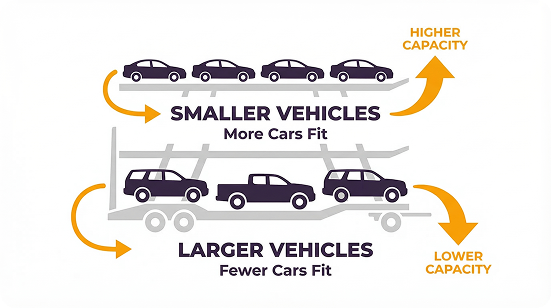
Size decides how much deck space your vehicle takes and how many other cars fit alongside it. A standard sedan is the cheapest thing to move because it slots almost anywhere on the trailer. SUVs, pickups and vans take more room and usually cost more on the same lane.


Should You Ship the Car to Florida or Drive It From Utah?
Putting it on a truck
Salt Lake City to Jacksonville is about 40 hours behind the wheel, which a single driver spreads over four or five days. A carrier takes those 2,224 miles off the car and off your calendar.
It fits a move where you fly ahead to Florida, a second car with no second driver, or a winter home that needs a car waiting when you land.
Taking the wheel yourself
Driving it yourself means four or five days on the road and three or four hotel nights, plus fuel and meals for more than 2,000 miles.
It can still win if the car has to be in Florida the day you get there, or if you want stops along the way. Add up rooms, fuel and food first, then hold that figure up against a shipping quote.
How Long Is a Car in Transit From Utah to Florida?
Once it is on the truck, a car on this lane typically gets to Florida in 5 to 8 days, a window that fits the long-haul rows of both state tables (typically 5 to 12 days on the Utah one, 5 to 9 on the Florida one). Jacksonville loads lean to the short side, and Miami pairs, past 2,480 miles and roughly 45 hours of driving, may use the whole span.
Dispatch runs first. Finding a licensed carrier for the order usually takes one to three working days, the car waits at your Utah address in the meantime, and real-time tracking begins at loading.
When Is the Best Time to Book a Utah to Florida Shipment?
Broker rate pages read this month tie this lane to the snowbird calendar. One prices September through December 10 to 20 percent above its average and March through May 5 to 15 percent below it. Another says southbound demand into Florida peaks from October through January and that rates climb with it.
A fall or early winter pickup is worth booking two to three weeks ahead so dispatch can line up a truck; in spring and summer a lead of one to two weeks usually works. Prices for the trip back run differently, and the Florida to Utah route covers that direction.
Open or Enclosed Trailer for a Car Going From Utah to Florida?
The lower-cost choice, open car transport, carries the majority of cars here. Over more than 2,100 miles the car meets road grime and weather in the open, so a wash after delivery is normal.
Enclosed car transport is the better fit for a classic or exotic, for new paint and for a low-slung body. Walls and a roof keep out rain, dust and stone chips, but covered trailers are fewer, so plan on a higher price and a longer wait for a slot.
Enclosed Car Transport
Enclosed demand rises for high-value, specialty and seasonal vehicles, and enclosed trailers protect against road debris and weather, which matters most on longer hauls. Enclosed rigs are a small fraction of the trailers working any given lane, and that scarcity is what drives both the higher price and the longer booking lead time.
Open Car Transport
Most vehicles move on open trailers, and for most routes that is the more cost-effective way to ship a car.
Open transport works well for standard vehicles and keeps costs predictable. It also offers the widest carrier availability.
Which Florida Steps Can a Utah Owner Finish Before the Counter Visit?
The Duval County Tax Collector, which serves Jacksonville, lists what a new resident brings on its new resident information page. The clock starts with whichever comes first: a homestead exemption filing, a Florida voter registration, a child placed in public school in Florida, a job or business begun in Florida, or a stay that passes six consecutive months. Florida registration for the car follows inside 10 days of that date, and your own Florida license inside 30.
Before the counter
- Insurance. Buy a Florida policy from an agent licensed in Florida, because the car is not titled or registered without it.
- The VIN check. It goes on Section 8 of form HSMV 82040 or on form HSMV 82042, and FLHSMV takes it from a Motorist Services compliance examiner, someone on the staff of a county tax collector, a dealer holding a Florida license, or an officer of a police or military police force.
- A title held by a lender. Duval County lets this title work start online or by mail to its title services office.
At the counter
- Registration. Bring the Utah title or current registration, proof of Florida insurance and a driver license or ID. A first Florida plate may carry a $225 initial registration fee, and a car titled within the past six months needs a bill of sale or proof that sales tax was paid.
- The driver license. New license applications are completed in person.
If the Utah plate has expired or expires within 30 days, Duval County sells a 30 day temporary plate for $5. Each Florida county runs its own office, so check the Orlando, Tampa or Miami page before relying on the Jacksonville list.
What Should You Pack From Utah and Expect at Each Handover?
Pack the Florida paperwork before the truck arrives in Utah. The county office in Florida asks for the Utah title, or the current Utah registration when a lender holds the title, along with the lender mailing address. Keep those papers with you instead of in the car.
Because a loaded carrier stretches a long way, its driver looks for a broad road or an empty parking area to pull over and drop the ramps. If your Utah street or the Florida address is tight, settle on a nearby meeting spot with the driver in advance.
At pickup, walk the car with its driver so that every scratch or dent it already has goes onto the bill of lading. Take photos from all four sides, empty the car of personal things, keep the fuel low and give the driver a single key. In Florida, repeat the inspection before signing and write any fresh damage on that same form.
What Does Rivalane Do on a Utah to Florida Order?
Rivalane, a broker working from Melville, New York, has no Utah or Florida office, yard or lot. Each Utah to Florida order goes to a licensed carrier, the trucking company that actually hauls the car, and that match normally takes one to three working days. From loading onward the car shows on real-time tracking. The Florida section below splits the paperwork into what you can finish before a counter visit and what needs one.

Frequently Asked Questions