


Burlington to Dallas on an open carrier, for a running sedan, costs $1,200 to $1,650. The page measures 16 pairs of 1,719 to 2,058 road miles, mostly by I-90, I-40 and I-30. Once loaded, cars typically arrive in 4 to 7 days, and the Texas registration deadline is 30 days after the move.
Which Roads Take a Car From Vermont Down to Texas?
Pickups on this page come from four Vermont towns, Rutland, Brattleboro, Burlington and Montpelier, and deliveries go to Dallas, Houston, Austin and San Antonio in Texas. Vermont to Texas car shipping across those 16 pairs means 1,719 to 2,058 road miles, from Rutland to Dallas at the short end to Montpelier to San Antonio at the long end. The core pair, Burlington to Dallas, measures 1,734 miles, about 33 hours behind the wheel. Twelve pairs, every one ending in Dallas, Austin or San Antonio, pick up I-90 in New York, then run I-71 and I-65 through Columbus, Louisville and Nashville, I-40 past Memphis to Little Rock and I-30 by Texarkana into Dallas; the Austin and San Antonio loads carry on south through Waco. The four Houston pairs take a different line: I-81 by Hagerstown and Roanoke, I-59 by Birmingham and I-10 by Baton Rouge and Lafayette.

What Moves the Price of a Vermont to Texas Shipment?
Your quote depends on your vehicle, the exact pickup and delivery addresses, the season and the trailer type, so run the calculator for a figure on your dates.
The Texas city does more to the mileage than the Vermont town. For a given Texas delivery, the four Vermont starts sit within 67 to 93 miles of each other. Pick a different Texas city and the gap grows: Austin is 194 to 195 miles past Dallas from every start, and San Antonio 272 to 273.
Every one of the 16 pairs is longer than 1,500 miles, so read the long-haul row of the price table on the Vermont state page and on the Texas state page. Beyond distance, the size of the vehicle, whether it runs, the trailer type and the month you ship carry more weight than which town the car leaves from.

Burlington to Dallas, with a sedan that runs and an open carrier, lands between $1,200 and $1,650. A Rutland pickup is 15 miles shorter, while a San Antonio delivery adds 273 miles and a Houston one 174, so those quotes sit closer to either end of the range. Run the car shipping calculator with your own towns and dates for a figure that fits them.
Larger vehicles typically cost $100 to $200 more, which covers an SUV, a pickup and a minivan alike. Winching a car that will not start onto the trailer carries an extra charge, and enclosed transport is typically priced 40 to 60 percent higher than an open load.

What Factors Actually
Influence Pricing on This Route?
Five things move the price on any lane: the vehicle's size, whether it runs, how easy each end is to reach, the season and the trailer type. Booking early protects your timeline, keeps pricing steady and reduces the risk of last-minute carrier changes.


Type
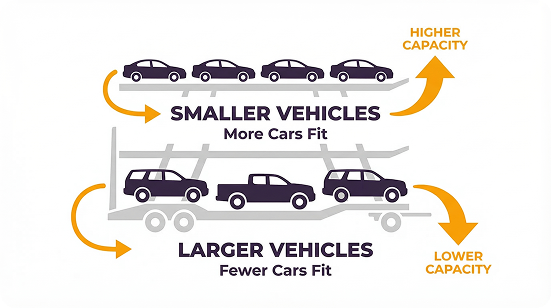
Size decides how much deck space your vehicle takes and how many other cars fit alongside it. A standard sedan is the cheapest thing to move because it slots almost anywhere on the trailer. SUVs, pickups and vans take more room and usually cost more on the same lane.


Should You Hand the Car to a Carrier or Drive It to Texas Yourself?
Handing it to a carrier
A carrier covers the 1,734 miles from Burlington to Dallas, roughly 33 hours of driving, or close to four days at nine hours a day.
It makes sense when the car is a second vehicle with nobody free to drive it, when you would rather fly to Texas, or when a week without the car is easy to live with.
Taking the wheel yourself
Driving Burlington to Dallas yourself means about 33 hours on the road, which works out to four days with three nights in motels, plus fuel and food for 1,734 miles.
The drive pays off when you need the car in Texas the day you arrive. Add up fuel, rooms and meals, then set that figure beside a shipping quote before you decide.
How Many Days Does a Vermont Car Spend on the Road to Texas?
After loading, cars on these 16 pairs typically reach Texas in 4 to 7 days. The long-haul rows on the two state pages give typically 4 to 12 days for Vermont and typically 4 to 8 days for Texas. Driving time on the pairs runs from about 32 hours to about 38 and a half, so the shortest and longest trips land inside the same window.
Before the truck rolls, the booking has to be matched with a licensed carrier, which is typically settled within one to three working days. The car stays at the pickup address until a truck is confirmed, and real-time tracking starts once it is loaded.
Which Months Make a Vermont to Texas Booking Easier?
Published rate data for this corridor does not agree on the calendar. One broker prices May through July slightly over its usual level and August through October slightly under, yet the same broker names September through November as its cheapest window on the reverse lane. Another broker says demand for Vermont shipments rises in spring and fall. Treat all of it as a reason to get a quote for your actual dates.
Asking for a pickup a week or two ahead usually leaves dispatch with enough trucks to pick from. For a May through July pickup, allow two weeks or more.
Is an Open Carrier Enough for a Car Bound for Texas?
Most owners on this lane book an open carrier, the standard and lower cost choice. Over 1,719 to 2,058 miles the car is exposed to the weather, so expect some road grime at delivery.
A classic, a low sports car or a new paint job is the case for enclosed car transport, where a closed trailer keeps weather and road spray off the finish. Fewer enclosed trailers run, so give that option extra lead time.
Enclosed Car Transport
Enclosed demand rises for high-value, specialty and seasonal vehicles, and enclosed trailers protect against road debris and weather, which matters most on longer hauls. Enclosed rigs are a small fraction of the trailers working any given lane, and that scarcity is what drives both the higher price and the longer booking lead time.
Open Car Transport
Most vehicles move on open trailers, and for most routes that is the more cost-effective way to ship a car.
Open transport works well for standard vehicles and keeps costs predictable. It also offers the widest carrier availability.
Why Does a Texas Policy Come Before the Plates and the License?
In Texas each step depends on the one before it, and the chain starts with insurance. The Texas Department of Insurance auto insurance guide is the page linked here; the registration and license steps come from the state motor vehicle and public safety pages for new residents.
- The policy. The minimum the guide lists is $30,000 of injury coverage for each person, $60,000 in total for one accident and $25,000 for damage to property. Line up a policy that meets it before the county visit, because the insurance card is one of the documents you bring.
- The county office. Registration is due at the county tax assessor-collector office within 30 days of moving to Texas. Bring the insurance card, the Vermont title or registration as proof of ownership and Form 130-U. Texas does not require you to retitle the car.
- The inspection. Dallas, Harris, Travis and Bexar counties, home to all four delivery cities, are among the 18 counties where a passing emissions inspection comes before registration.
- The license. A Texas driver license is due within 90 days of the move, issued by the state public safety department. The public safety page asks that your vehicles be registered first and that you surrender the Vermont license.
Active duty military members and full-time students who are not Texas residents do not have to register in Texas, according to the motor vehicle page.
What Happens at a Vermont Pickup and a Texas Delivery?
Where a load first meets the interstate depends on the town. Montpelier and Rutland loads pass Glens Falls, New York, Brattleboro loads for Dallas, Austin or San Antonio pass Albany while its Houston loads head south on I-91, and Burlington loads cross into New York before turning south. A full-size carrier may not fit a narrow street or a steep drive at either end, so the driver sometimes asks for a nearby lot or a wider street to load from.
Before loading, inspect the car alongside the driver, check that each existing scratch and dent made it onto the condition report, and then sign. Photograph every panel with the date visible, take personal things out of the cabin, leave roughly a quarter of a tank in it and give the driver a single key.
Halfway along the core pair, the truck is in Kentucky. When it arrives in Texas, check the car again, in daylight if possible, and note anything new on the report before you sign.
What Is Useful to Know Before Booking Vermont to Texas Transport?
Rivalane is a broker working out of Melville, New York. It runs no office or yard in either Vermont or Texas. A licensed carrier, the company that owns the truck, takes each booking and hauls the car. Expect one to three working days for that carrier to be lined up. Tracking runs in real time from the moment the car is loaded. Further down, the Texas section explains why the insurance policy has to come before the registration and the license.
Frequently Asked Questions