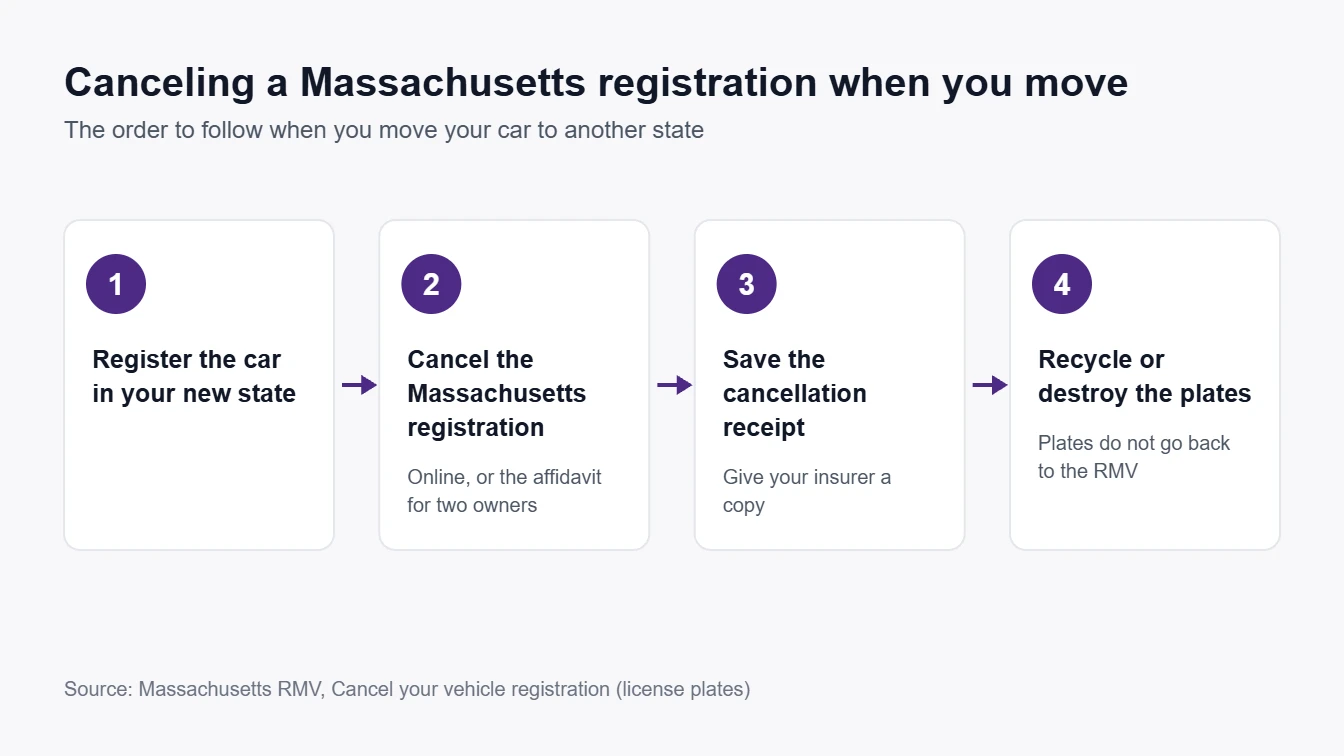
When you move out of Massachusetts, cancel the Massachusetts registration with the Registry of Motor Vehicles (RMV), keep the Registration Cancellation Receipt and give a copy to your insurance company. The plates do not go back to the RMV. You recycle or destroy them yourself.
Canceling also matters for the local motor vehicle excise, because a mover may qualify to have part of the year's excise abated. Canceling alone does not settle that, so this guide covers the conditions too. The rules come from the RMV's page on canceling a registration, its cancellation affidavit and the Massachusetts Department of Revenue (DOR) guide to the motor vehicle excise.
How Do You Cancel a Massachusetts Registration?
Online, unless the car has two owners. The RMV's page on canceling your vehicle registration says you log in with a MyMassGov personal account and provide the registration (plate) number and an email address. When the cancellation is complete, you can download the Registration Cancellation Receipt.
If two people own the car, the online route does not apply. Both owners complete and sign the Affidavit for Cancellation of Registration, which asks for owner information, the registration number and expiration date, and the year, make and model. Mail it to the RMV address printed on the form, P.O. Box 55889, Boston, MA 02205-5889, or bring it to a full-service RMV location. Someone canceling for an owner uses the non-owner section of the same form.
The RMV charges no fee to cancel a registration.
What Do You Do With Massachusetts Plates After Canceling?
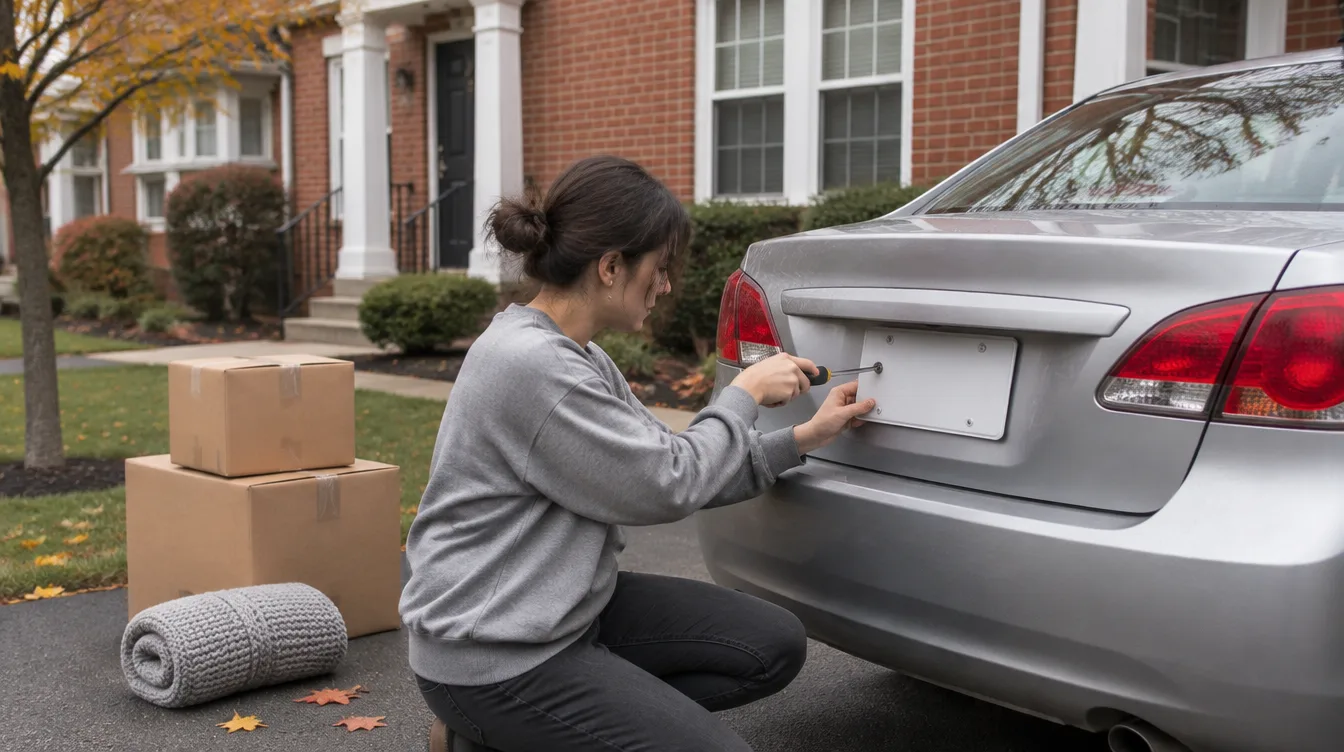
Keep them out of circulation yourself. The RMV says plates do not have to be returned when a registration is canceled, and that once it is canceled you must recycle or destroy them. Its page suggests cutting them in half and throwing them away, or recycling the destroyed plates if your town accepts them at the local recycling center.
Once the registration is canceled, the car cannot be driven on any public way in Massachusetts. Cancel after the car has left the state on a carrier, or after you no longer need to drive it there.
What Should You Do With the Cancellation Receipt?
Keep it with your moving records and give a photocopy to your insurance company. The RMV asks for both on its cancellation page. The receipt is your proof that the Massachusetts registration ended on that date, and the local assessor may ask for proof of cancellation if you apply for an excise abatement.
When Can You End Your Massachusetts Insurance?
After the registration is canceled. In a 2021 reminder to Massachusetts insurers about customers who move out of state, the RMV said an insurer should not cancel a policy covering a Massachusetts registration until it has proof that another insurer covers the vehicle or that the Massachusetts plates have been canceled. The same reminder says a registration left without a reported Massachusetts policy is revoked 33 calendar days after the policy cancellation, and the RMV's cancellation page adds that a revoked registration is still subject to excise unless it is canceled.
So cancel the registration first, send your insurer the receipt, and then end the Massachusetts policy. Your new state's insurance has to be in place before you register the car there.
Can You Get Part of Your Excise Back After Moving?
Possibly, but canceling the registration on its own does not qualify you. The RMV says you are not entitled to an abatement just by canceling, and that your local assessors need documentation of the required steps.
The DOR guide to the motor vehicle excise lists the moved-out case. During the same calendar year as the excise, you must:
- Move to another state or country.
- Register the vehicle there.
- Cancel or not renew the Massachusetts registration.
The abatement covers the months left in the year after the month the last of those steps happens. In the DOR's example, someone who moves in July and registers in the new state and cancels in August gets September through December abated, a third of the year's excise. The DOR adds that assessors may treat registration in the new state as a cancellation, and that if the Massachusetts registration carries into another calendar year, you should cancel it to avoid being taxed again.
Apply to the board of assessors in the city or town that billed the excise, within 3 years after the excise was due or 1 year after it was paid, whichever is later. Assessors have 3 months to act on the application. Assessors cannot grant an abatement of less than $5 or one that leaves less than $5 of excise, unless the whole excise is abated. Ask your assessor which documents it wants, such as the cancellation receipt and the new state's registration.
What If You Are Moving to New York?
Set up New York insurance first, because the New York DMV registers a car only with coverage from an insurer licensed in New York, and new residents have 30 days to register. Our guide to registering an out-of-state car in New York walks through the forms, the sales tax step and inspection timing. Once the New York registration is issued, cancel the Massachusetts registration, send your Massachusetts insurer the receipt and then end that policy.
Shipping Your Car Out of Massachusetts
A car that travels on a carrier still needs its paperwork in order at both ends. Our page on Massachusetts to New York car shipping covers that lane, our page on car shipping in Massachusetts covers pickups across the state, and the car shipping calculator prices the move.
Frequently Asked Questions
Do I have to return my Massachusetts plates when I move?
Can I cancel my Massachusetts registration online?
Does it cost anything to cancel a Massachusetts registration?
Should I cancel my registration or my insurance first?
Do I get my excise back when I move out of Massachusetts?