If you live outside New York and buy a car here, two things decide how the purchase goes: whether New York charges you sales tax, and how the car leaves the state. A buyer who meets New York's nonresident test can buy from a New York dealer without New York sales tax by giving the dealer Form DTF-820, then drive the car home on a 30-day interstate in-transit permit or have it shipped.
This guide covers both, in the order you deal with them, for a buyer who will register the car in their home state. If you live in New York and are buying a car in another state, our guide to buying a car out of state as a New York resident covers that side.
Do You Pay New York Sales Tax If You Live in Another State?
Not if you qualify as a nonresident and handle the paperwork at the sale. The Tax Department's bulletin on motor vehicles, vessels and trailers (TB-ST-590) says sales to nonresident purchasers are exempt from both state and local sales tax. To claim the exemption, you give the seller a completed Form DTF-820, the Certificate of Nonresidency, at the time of sale. The form's instructions say it has to reach the seller before you take delivery.
If you do not hand over the form, the dealer collects sales tax at the rate in effect where the car is delivered, which is usually the rate at the dealership. When the exemption applies, the dealer records it on the retail certificate of sale, Form MV-50, by marking the sale as exempt for an out-of-state purchaser.
An exemption in New York does not make the car tax free. Your home state applies its own sales or use tax rules when you register the car there. The Wyoming example near the end of this guide shows how that works on one lane.
Who Counts as a Nonresident on Form DTF-820?
Living somewhere else is not enough on its own. Box 1 of DTF-820, which claims the exemption from both state and local tax, requires all four of these to be true:
- You are not a resident of New York State.
- You have no permanent place of abode in New York. The next paragraph explains what counts.
- You will not use the car in any employment, trade, business or profession you carry on in New York.
- You will not register the car in New York. The form says this includes any temporary registration.
The place of abode test catches more people than they expect. The form defines it as a dwelling kept for you on other than a temporary or transient basis, whether or not you own it, and lists examples that include a second home, an apartment, a room in a college residence hall and housing provided by the armed forces, on or off base. If you keep any of these in New York, you do not meet the box 1 test. Misusing the certificate can bring civil and criminal sanctions as well as the tax and interest due.
If you are actually moving to New York, you are not a nonresident buyer, and the steps run the other way. Our guide to registering an out-of-state car in New York covers that move. Plans can also change after the sale. If you leave on an in-transit permit and later decide to register the car in New York after all, the DMV's dealer manual says you handle it at a DMV office, and the Tax Department's memo says New York collects sales tax when a nonresident registers a car bought in New York, apart from a few listed exceptions.
Why Ask for an In-Transit Permit, Not a Temporary Registration?
Because one keeps the exemption and the other ends it. The Tax Department's memo TSB-M-95(2)S, on sales of motor vehicles to nonresidents, says getting an in-transit permit to take a car out of New York for registration in another state does not make the sale subject to New York sales tax. If the dealer issues you a temporary certificate of registration or a temporary registration instead, for transport or any other reason, the dealer has to collect the tax.

So the request to make at the dealership is specific: ask for the interstate in-transit permit, not New York plates with a temporary registration. According to the DMV's dealer manual, a dealer that issues the permit cannot then issue registration plates to the same buyer for the same car, so the choice is effectively made at the sale.
How Do You Get a NY In-Transit Permit?
A New York in-transit permit lets you drive a car bought in New York to the place where it will be registered. The DMV's in-transit permit page describes two kinds. An interstate permit covers taking the car from New York to another state, and an intrastate permit covers moving it to another part of New York. An out-of-state buyer needs the interstate permit.
- Length and fee: 30 days for $12.50. The DMV's dealer manual counts the issue date as the first day, and the permit ends earlier if the car is registered outside New York first.
- What it allows: under Vehicle and Traffic Law section 401-a, the car may be driven on public roads only to take it where it will be registered, and the permit is displayed in place of plates. The dealer manual adds that it is not for casual driving within New York.
- One per car: a dealer can issue only one permit to the same buyer for the same car. A second permit comes only from a DMV office, and the manual says that happens only in very unusual circumstances.
You can get the permit from the dealer at the sale, if the dealer takes part in the DMV's Dealer Plate Issuance Program, or at a DMV office. The next section covers what each route needs.
Buying From a Dealer or a Private Seller: What Paperwork Do You Need?
From a dealer in the plate program. Dealers enrolled in the DMV's Dealer Plate Issuance Program can issue the interstate permit at the time of sale, as the dealer manual (MV-461) explains. You have to tell the dealer you are taking the car out of New York to register it elsewhere, you must have bought the car from that dealer, and you must not already hold a registration or title for it. The dealer completes the In-Transit Permit/Title Application, Form MV-82ITP, with your full destination address, and writes the permit number on the MV-50.
Bring your driver license or other proof of identity and your proof of insurance, covered in the next section. You leave with the permit, the original title or manufacturer's certificate of origin, and the original MV-50. Keep them together, because the manual tells dealers to advise buyers to present the ownership document to the motor vehicle office in the destination state.
From any other dealer or a private seller. Not every dealer is enrolled. Without the program, you apply at a DMV office with a completed MV-82ITP, proof of ownership such as the certificate of title or the manufacturer's certificate of origin, proof of identity, proof of insurance and the fee. In a private sale, the seller does not collect sales tax. The DMV's sales tax page says the DMV collects it when a privately bought car is registered in New York, and the permit page lists sales tax as a possible extra charge only for intrastate permits.
If a lender is involved. The MV-82ITP tells buyers whose car is leaving New York to have the lender record its lien in the destination state, so mention the move to your lender before the sale closes.
What Insurance Proof Works If You Live Out of State?
You do not need a New York policy. The DMV says you do not have to be a New York resident to get an in-transit permit, and a nonresident can show one of two documents instead of a New York insurance card:
- A letter from your out-of-state agent or broker, on their letterhead, showing the insurance company, the policy number, the effective and expiration dates, your name and address, and the car's year, make and VIN.
- An insurance binder, usually a full-page form titled Insurance Binder, showing the producer, the insured, the insurer, the policy dates and the full vehicle description. In its Automobile Liability section, one of the boxes for Any Auto, All Owned Autos or Scheduled Autos must be checked.
The DMV wants originals, though a letter or binder faxed to the office by the insurer also counts, and photocopies are not accepted. The dealer manual says resident status is decided by the address on the proof of identity you present.
Should You Drive the Car Home or Ship It?
Driving works when the trip fits comfortably inside the permit's 30 days and you want the car right away. Weigh the limits first. The permit covers only the drive to the place of registration, a dealer can issue just one, and a second comes from a DMV office only in rare cases. A long drive also means nights on the road, fuel and miles on a car you just bought.
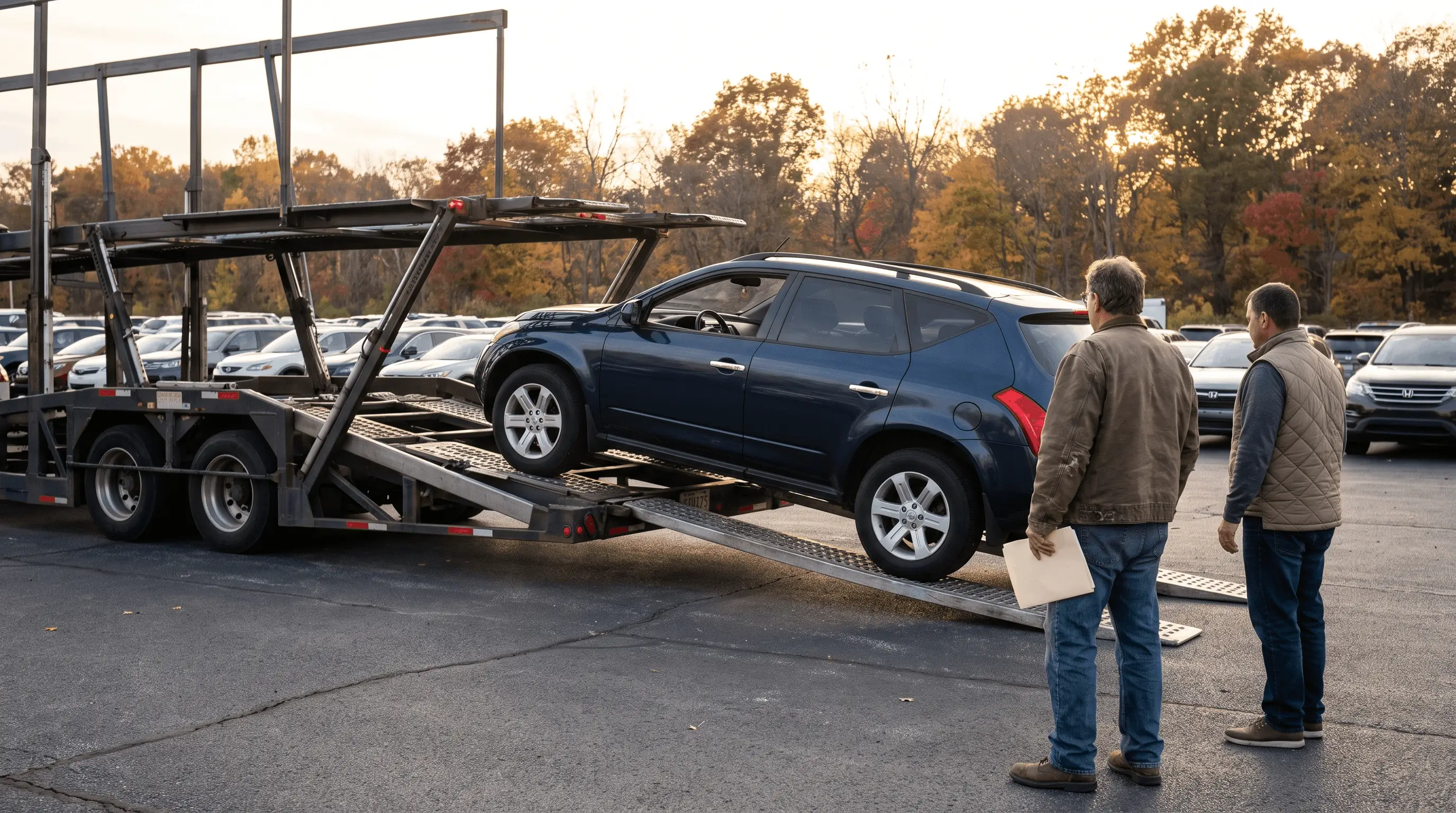
Shipping takes the drive out of it. Section 401-a ties the permit to driving the car on public roads on the way to registration, and when a carrier picks the car up in New York and delivers it to you, nobody drives it there. The sales tax side does not change. The DTF-820 conditions are the same however the car travels, so give the dealer the form before delivery either way.
Rivalane coordinates door to door transport from New York with licensed, insured carriers. We typically assign a carrier within one to three working days after you book, and pickup and delivery dates are estimates, not guarantees. Our guide to getting a car you bought out of state delivered covers what to plan between the seller's lot and your driveway, and the car shipping calculator prices the move.
Example: Buying in New York and Registering in Wyoming
Here is how the two states fit together for a Wyoming resident who buys from a New York dealer and meets the nonresident test.
In New York, you give the dealer Form DTF-820 before delivery, the dealer marks the MV-50 as an exempt out-of-state sale, and no New York sales tax is collected. You then drive the car west on an interstate in-transit permit or have it shipped.
In Wyoming, the tax comes due before the car's first registration. Under 2026 Senate File 79, in effect since July 1, 2026, the county treasurer collects it before the first Wyoming registration, at the rate for the county of your principal residence as shown on your driver license or other government ID. The law's exemption for a car the same nonresident owner previously registered in another state does not help here, because you have never registered this car anywhere. Wyoming credits sales tax legally imposed and paid to another state, up to the Wyoming amount, but with DTF-820 there is no New York tax to credit. If the dealer did collect New York tax, for example after issuing a temporary registration, the credit can apply to that amount.
Timing matters too. Interest applies if the Wyoming tax is not paid within 65 days of the sale. For a car brought into Wyoming, the 65 days can run from the date it entered the state instead, if you give the treasurer an affidavit and proof of that date, so keep the permit or the delivery paperwork from the shipment. Our guide to registering a car in Wyoming covers the title, the VIN inspection and the treasurer visit, and our New York to Wyoming car shipping route covers the lane itself.
Frequently Asked Questions
How long is a New York in-transit permit good for?
Can you get a New York in-transit permit if you do not live in New York?
Do you pay New York sales tax on a car if you live in another state?
Does an in-transit permit make the sale taxable in New York?
Does a second home or a college dorm room in New York change anything?
Do you need an in-transit permit if the car is shipped?