
Georgia taxes a vehicle when it is titled, through a one-time title ad valorem tax, or TAVT, that replaced sales tax and the old annual car tax on March 1, 2013. A purchase titled in Georgia pays the standard rate, currently 7.0 percent of the car's fair market value, while a new resident registering a car in Georgia for the first time pays 3 percent. You pay it at the County Tag Office in the county where you live, or through the dealer when you buy from one.
This guide covers who pays which rate, how the state sets the value, the deadlines and penalties, cars bought in another state, and the owners who pay no TAVT at all. Every rate and rule comes from the Georgia Department of Revenue unless a county office is named.
What Is Georgia's Title Ad Valorem Tax?
TAVT is a one-time tax paid when a vehicle is titled. The Department of Revenue's TAVT and annual ad valorem page says it took effect on March 1, 2013, replacing sales tax and the annual ad valorem tax, and that it is paid every time vehicle ownership is transferred or a new resident registers a vehicle in Georgia for the first time.
The Department's TAVT FAQ adds that vehicles purchased on or after March 1, 2013 and titled in Georgia are exempt from sales and use tax and from annual ad valorem tax. Registration still renews every year, but a car in the TAVT system carries no yearly value tax.
Who Pays 7 Percent and Who Pays 3 Percent?
The rate depends on how the car comes into your name in Georgia. The Department of Revenue sets the current TAVT rate at 7.0 percent of fair market value and lists 3 percent as the rate for new residents, under a law that took effect July 1, 2019.
New residents pay 3 percent. When you move to Georgia and register a car you bring with you for the first time, the County Tag Office charges 3 percent of its fair market value.
Buyers pay the standard rate. A car bought and titled in Georgia pays the rate in effect on the date of purchase, which is 7.0 percent today. That holds whether you buy from a dealer or from a private seller, and it holds for a Georgia resident who buys a car in another state and brings it home to title. The 3 percent rate covers a new resident's car on its first Georgia registration, not car purchases in general.
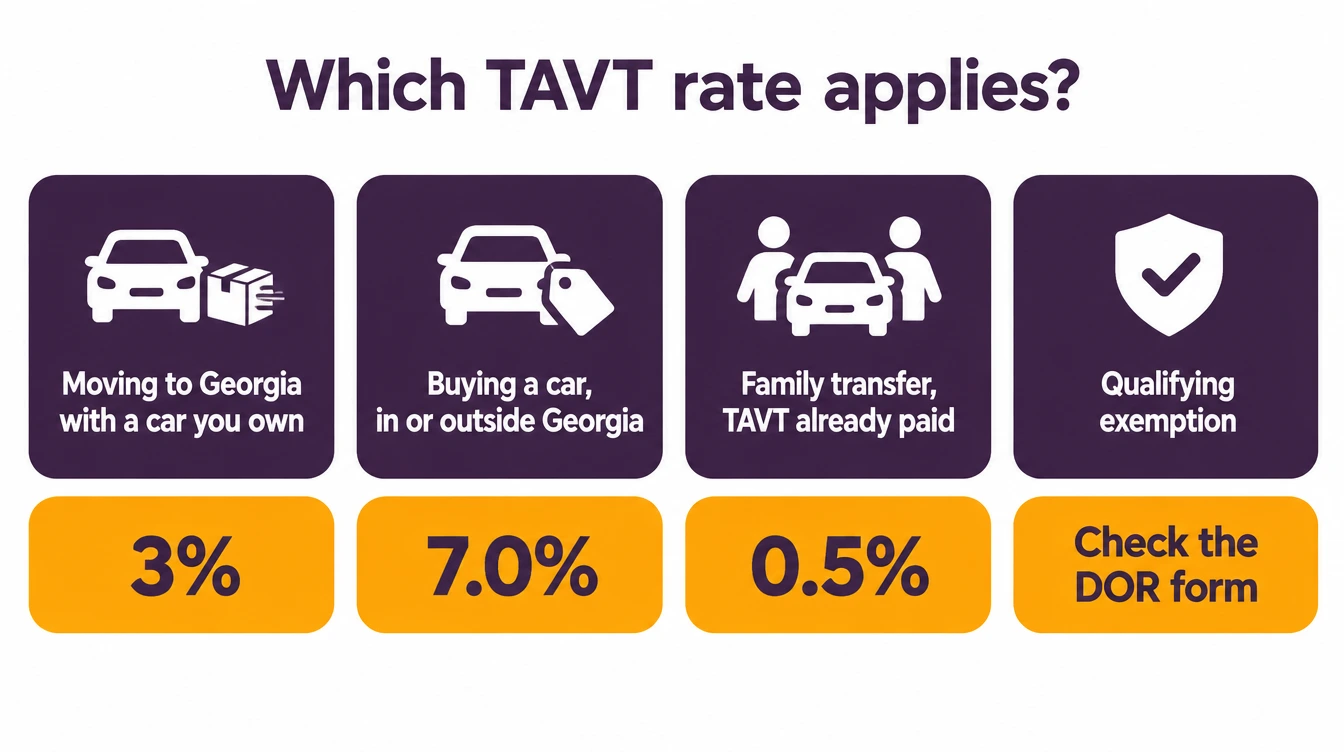
So the same used car can carry two different tax bills. Brought to Georgia by its owner, it is taxed at 3 percent; sold to a Georgia buyer, it is taxed at 7.0 percent of the same state value.
What Do Family Transfers and Inherited Cars Pay?
Less. When a car passes between immediate family members, the Department of Revenue allows a reduced rate of 0.5 percent of fair market value if the vehicle has a Georgia title and TAVT was already paid on it. The Department requires Form MV-16, the Affidavit to Certify Immediate Family Relationship.
A car still in the old annual ad valorem system gets a choice: the family member can stay under annual ad valorem tax or pay the full one-time TAVT. Inherited cars follow the same pattern with Form T-20, the Affidavit of Inheritance: 0.5 percent when the vehicle is already in the TAVT system, and the same choice when it is still taxed annually.
How Does Georgia Set the Value?
TAVT is charged on fair market value, and the Department of Revenue's TAVT FAQ sets separate rules for new and used vehicles.
New vehicles. The value is the greater of the retail selling price or the value in the state motor vehicle assessment manual. The selling price includes delivery, freight, doc fees and similar charges, mirroring what sales tax used to be charged on. The higher figure is then reduced by any trade-in and by rebates or cash discounts the selling dealer gives at the time of sale.
Used vehicles. The value is the one in the state assessment manual, which averages current wholesale and retail values under O.C.G.A. 48-5-442. If a used car is not listed, the Department uses a used car market guide designated by its Commissioner. Because the manual sets the number, the price you paid in a private sale does not decide the tax.
Trade-ins. The trade-in reduction applies only when you buy from a dealer. The FAQ says the reduction is made for dealer sales but not for sales by a private individual, and it defines the trade-in value as the value stated in the bill of sale for the car traded in to the dealer.
How Can You Estimate Your TAVT Before the Tag Office?
Use the Department of Revenue's TAVT Estimator on DRIVES e-Services. It asks for the VIN and whether you are a new Georgia resident, and it draws on the same valuation data the tag office works from. The estimator notes that it does not account for exemptions or reduced rates, so check the family transfer and exemption sections of this guide if either applies to you.
The estimate can still move. A 2013 Department informational bulletin on estimator values explains that vehicle values are updated every year, so the value in the estimator can change between the day a car is sold and the day the title work is processed. To keep the result fair, the Department lets a county tag office use the value from the date of purchase when the dealer documents it, for example with a date-stamped screenshot of the estimator. The tag office sets the final figure.
To see how the rates compare, take a hypothetical car the state values at $20,000. A new resident registering it for the first time pays 3 percent, or $600. A buyer titling it after a purchase pays 7.0 percent, or $1,400. A family member taking it over with TAVT already paid pays 0.5 percent, or $100. Title and registration fees come on top of the tax.
When Is TAVT Due, and What Happens If You Pay Late?
TAVT is due when you apply for the Georgia title. The TAVT FAQ says the title application and payment go to the county where the buyer lives, and on a dealer sale the dealer must take your title application and TAVT payment and deliver them to your County Tag Office.
The deadlines depend on how you got the car. The Department's page on when and where to register a vehicle gives new residents 30 days from the move and asks Georgia residents who buy from a private seller to register within 7 business days. On a dealer sale, the dealer has 30 days from the purchase to submit the TAVT.
The Department's fees, fines and penalties page sets these penalties:
- Private, or casual, sale: 10 percent of the TAVT due after day 30, plus 1 percent more every month after that.
- Dealer sale: 5 percent of the TAVT due after day 30, plus 5 percent more every month after that.
- Late title application: a $10 title penalty when no Georgia title application is made within 30 days of the purchase or transfer.
The Department's table has no separate line for new residents. DeKalb County's new-resident checklist says a new resident who registers more than 30 days after establishing residency owes a 10 percent TAVT penalty plus 1 percent for each further 30-day period, so ask your county tag office how it applies the rule.
Do You Pay TAVT on a Car Bought Outside Georgia?
Yes, once you title it in Georgia. TAVT follows the Georgia title, not the place of sale, and the Department's TAVT FAQ says vehicles titled in Georgia are subject to TAVT and exempt from Georgia sales and use tax. A Georgia resident who buys a car in another state pays TAVT at the standard rate on the state's fair market value when titling it at home.
Tax paid to the other state does not reduce the bill. The Gwinnett County Tax Commissioner's page on out-of-state purchases says vehicles do not qualify for reciprocal tax credits, so sales tax collected where you bought the car is not credited against Georgia's TAVT. Before you sign, find out whether the selling state will charge its own tax.
Buying from a New York dealer is a common case. On a New York dealer sale, Form DTF-820 decides whether New York charges sales tax, and only a nonresident buyer who meets every one of its conditions qualifies. Our guide to New York's sales tax exemption for out-of-state buyers covers the form and the paperwork at the dealership.
Who Is Exempt from TAVT?
The Department of Revenue's TAVT page lists a few groups that pay no TAVT, or that can choose another tax, each with its own form:
- Qualifying veterans. Disabled veterans compensated at 100 percent, former prisoners of war, Purple Heart recipients and Medal of Honor recipients are exempt with Form MV-30, the Georgian's Veteran Affidavit for Relief of State and Local Title Ad Valorem Tax Fees, plus military documentation.
- Public safety first responders. A law enforcement officer, firefighter or publicly employed emergency medical technician, or the surviving spouse of one, who receives indemnification payments from the Department of Administrative Services for certain line-of-duty injuries or death is exempt on up to $50,000 of fair market value across all vehicles registered in any three-year period. The claim uses Form MV-PSFR-TAVT and the award letter from the Department of Administrative Services.
- Non-resident service members. An active member of the U.S. armed services who lives in Georgia only because military orders station them here, and who is a U.S. citizen but not a Georgia resident, files Form PT-472NS for a vehicle titled in their name or a qualifying dependent's. On the form, the service member either pays TAVT voluntarily or declines it, in which case the vehicle falls under sales and use tax rules instead. A separate affidavit is needed for each vehicle or dependent.
- Non-titled vehicles and trailers. They are exempt from TAVT but pay annual ad valorem tax instead.
Does Annual Ad Valorem Tax Still Apply?
Only to vehicles outside TAVT. The Department of Revenue says annual ad valorem tax applies to most vehicles purchased before March 1, 2013 and to non-titled vehicles. It is a value tax assessed every year and paid at registration, and paying it is a condition of getting a tag or renewal decal.
The amount depends on the vehicle's current fair market value and the tax district where you live, and the Department's Annual Ad Valorem Tax Estimator gives an estimate. The tax must be paid by the last day of your registration period, usually your birthday, to avoid a 10 percent penalty.
Moving to Georgia With Your Car
If you are relocating with a car you own, expect TAVT at 3 percent of its fair market value at your first Georgia registration, plus the $18 title fee and the $20 annual registration fee. The license, insurance, emissions and paperwork steps that come before the tag office visit are in our guide on how to register a car you bring to Georgia. If the car still has to make the trip, Rivalane coordinates door to door transport with licensed, insured carriers: our page on New York to Georgia car shipping covers that lane, and our Georgia car shipping page covers other routes into the state.
Frequently Asked Questions
What is the TAVT rate in Georgia?
Do new Georgia residents pay the full 7 percent TAVT?
How is TAVT calculated on a used car?
Do you owe TAVT if you bought the car in another state and paid sales tax there?
Who is exempt from TAVT in Georgia?