



Idaho to New York runs about 1,980 to 2,620 road miles, mostly on I-80, and a loaded car typically arrives in 6 to 8 days. Expect $1,200 to $1,800 for an open-trailer sedan from Boise. Allow two or three weeks' notice, and arrange New York insurance before you register within 30 days.
How Car Shipping From Idaho to New York Works
Google Maps sends a car leaving Boise east on I-84, into northern Utah and onto I-80, which it then follows for most of the trip through Wyoming, Nebraska, Iowa, Illinois, Indiana, Ohio, Pennsylvania and New Jersey, with I-78 covering the last miles into Manhattan. Nampa and Meridian sit on the same I-84 line, and Twin Falls is just off it. Pocatello cars head south on I-15 and cut across to I-80 in southwest Wyoming, while Idaho Falls cars take US-26 and US-191 down to Rock Springs. The panhandle works differently: Coeur d'Alene and Lewiston loads run I-90 across Montana and meet the eastbound interstates much farther north. On a multi-car trailer, your car may share the trip with vehicles bound for other stops along the way. Expect the longest pause before the truck arrives, while dispatch looks for an eastbound carrier with room for one more car.
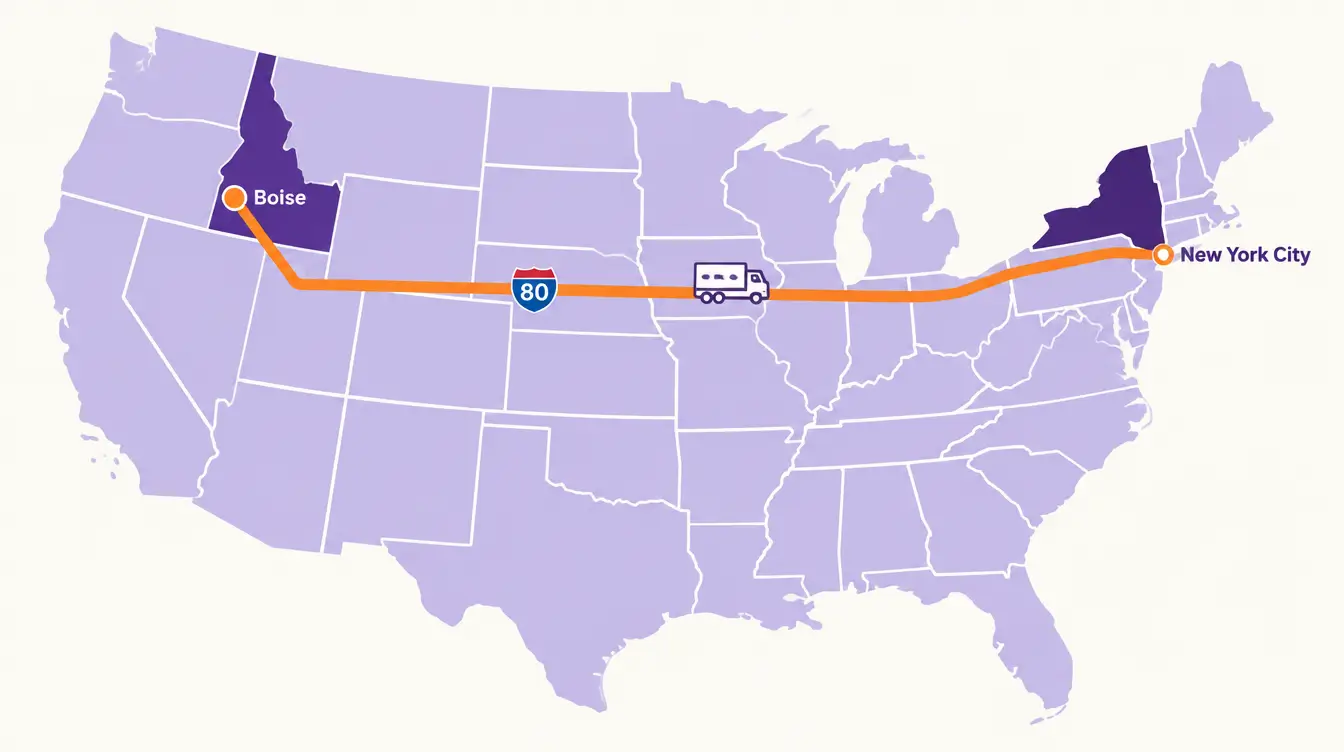
How Much Does Car Shipping Idaho to New York Cost?
Over close to 2,500 miles the distance sets the base rate, but the two addresses decide where in the range a quote falls. What a dispatcher really weighs is how far each end sits from a truck's line of travel.
In Idaho, Boise, Nampa and Meridian are right on I-84 and usually price best. Twin Falls is just off it, Pocatello and Idaho Falls reach I-80 by other highways, and the panhandle around Coeur d'Alene and Lewiston needs a carrier working the northern interstates, which tends to add cost. In New York, Long Island and Westchester are straightforward, Manhattan needs a meeting point, and from Boise, Buffalo and Rochester lie roughly 190 to 250 road miles nearer than Manhattan does.
Size adds cost as well. A full-size SUV, a three-row van or a pickup truck needs a bigger share of the trailer than a sedan does.
A number far under the rest is often an estimate made before any trucker has agreed to haul the car. On a lane that takes a week, that estimate often fails to hold once the search for a truck begins, so ask who will carry the car and when before you commit.

An open-trailer sedan from Boise to New York City typically runs $1,200 to $1,800. Collection in Boise, Nampa or Meridian, delivery on Long Island or in Westchester, plus a few spare days either side of the collection date keep the price near $1,200. A Coeur d'Alene or Lewiston start, a Manhattan handover or a date that cannot move pushes it toward $1,800, and sometimes past it. An eastern Idaho car bound for Buffalo or Rochester can land in the lower half.
Enclosed space adds roughly 40 to 60 percent. Over this many miles of open road the premium pays off for vintage cars, supercars or new paint rather than a commuter car.
Three factors decide more of the bill than mileage:
- Where in Idaho. Treasure Valley addresses sit on I-84. Pocatello and Idaho Falls join I-80 in Wyoming by other roads, and panhandle cars start on a different interstate altogether.
- Where in New York. Suburban delivery addresses are the simplest. Manhattan and the most crowded neighborhoods of the outer boroughs generally mean a meeting point, and upstate cities depend on a truck whose route already runs that way.
- The vehicle. Budget $150 to $250 more for an SUV or pickup truck than for a sedan. Non-running cars need a winch to load, so fewer carriers can accept them and the rate rises.
Treat any figure as provisional until a named carrier accepts the load.

What Factors Actually
Influence Pricing on This Route?
Booking early protects your timeline, keeps pricing steady, and reduces the risk of last-minute carrier changes.
Many customers on this route relocate permanently or move seasonally, which makes predictability more important than speed.
This article explains how auto transport Alabama to New York works, what it costs, and how long it takes, so you can make a clear, informed decision before you schedule your shipment.


Type
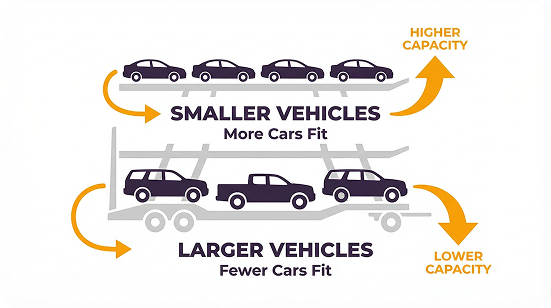
Size decides how much deck space your vehicle takes and how many other cars fit alongside it. A standard sedan is the cheapest thing to move because it slots almost anywhere on the trailer. SUVs, pickups and vans take more room and typically add a few hundred dollars on the same lane.


Is It Cheaper to Drive or Ship a Car From Idaho to New York?
Shipping Instead of Driving
Shipping fits when you are catching a flight east for a job, a college term or a family move, or delivering a car you sold to a Northeast buyer. It also spares everyone a winter crossing of I-80 through southern Wyoming.
Handing over the keys once in Idaho replaces four or five long driving days and leaves about 2,500 miles off the odometer.
Driving the Route Yourself
By Google Maps, the Boise to New York City drive is about 37 hours, and Coeur d'Alene or Lewiston adds one to three more. That usually means four or five long days, with three or four motel nights, meals, fuel and the tolls Maps marks on I-80 in Illinois, Indiana and Ohio.
Once those nights, meals and roughly 2,500 miles of fuel are counted, driving is often not much cheaper than shipping on this lane, and it adds all of those miles to the car. It still makes sense if you need the car during the trip or are turning the move into a road trip.
How Long Does Shipping a Car From Idaho to New York Take?
Once the car is loaded, it typically reaches New York in 6 to 8 days. An eastern Idaho car headed for Buffalo or Rochester can arrive toward the short end, while a panhandle car bound for Manhattan or Long Island usually runs the full eight.
A carrier is usually in place between one and three working days after you book. The more collection days you can offer, the more eastbound trucks dispatch has to choose from.
With 400 to 500 miles as a normal day's drive, and stops for other cars, about 2,500 miles fills most of a week. Google Maps notes that parts of I-80 may be closed at certain times, and any closure on the way adds time.
When is the Best Time to Book Auto Transport From Idaho to New York?
Nothing in the search demand for this lane points to a seasonal rush, so plan around your own dates rather than a calendar.
On a run this long, dispatch needs time to find a carrier with an eastbound slot. Give two or three weeks' notice where you can, and more if the date is fixed or the car starts in the panhandle. A wider collection window does more to secure a truck than booking early alone.
In winter, build a buffer of a few days into the delivery date. Google Maps flags that parts of I-80 may close, and a closed stretch of interstate can stall a truck.
Open vs Enclosed Auto Transport on an Idaho to New York Route
Open carriers move most of the cars on this lane, and for good reason. For about a week the car rides uncovered on the deck and collects roughly the weather and grime a drive east would give it.
An enclosed trailer shuts the car away from rain, dust and gravel for the whole trip. Each one holds fewer vehicles, so the space is pricier and openings come up less often.
Go enclosed for a collectible, a rare or costly import, new paintwork or a lowered car that scrapes on ordinary ramps. A daily driver needs nothing more than open transport.
Enclosed Car Transport
Enclosed demand rises for high-value, specialty and seasonal vehicles, and enclosed trailers protect against road debris and weather, which matters most on longer hauls. Enclosed rigs are a small fraction of the trailers working any given lane, and that scarcity is what drives both the higher price and the longer booking lead time.
Open Car Transport
Most vehicles move on open trailers, and for most routes that is the more cost-effective way to ship a car.
Open transport works well for standard vehicles and keeps costs predictable. It also offers the widest carrier availability.
What New York Requires When Your Car Arrives
Insurance comes first in New York. A car cannot be registered in New York until a New York-licensed insurer covers it, and new residents get 30 days to finish registering, so it pays to set up the policy while the car is still in Idaho.
- Insure it in New York. Coverage has to be written by a company the state Department of Financial Services licenses, and policies from other states are refused. At minimum the policy must carry $25,000 of injury coverage and $50,000 of death coverage for one person, then $50,000 and $100,000 respectively when more than one person is hurt or killed, and $10,000 of property damage. The DMV looks for two confirmations, your insurance ID card and an electronic notice from the insurer, and registration must follow within 180 days of the date on the card.
- Register inside 30 days. File Form MV-82 with the original title (photocopies are refused), identity documents and sales tax paperwork. When a lender holds the Idaho title, the DMV asks for a copy the lender certifies, with the certification and the copy on one page, along with a lender letter stating that it holds the original. You can also apply by mail before you arrive.
- Clear the sales tax question. Registration requires paying New York sales tax, showing it was paid, or showing an exemption, and even an exempt registration gets a sales tax receipt. For a car bought while you lived outside New York, the DMV directs you to Form DTF-803 for the non-resident exemption. Expect county use tax too, which the DMV says is probably due.
- Book a New York inspection. Every New York-registered car needs a yearly safety inspection, and most also get an emissions check. An unexpired sticker from another state stays good until it runs out or for a year, whichever comes first, and a car arriving with no sticker from its last state must go through a New York inspection. According to the Idaho Department of Environmental Quality, Idaho's vehicle emissions testing requirement was repealed effective July 1, 2023.
- Trade in your Idaho license within 30 days. It is done in person at a DMV office, with a vision test there or an eye test report, and the Idaho card is surrendered. The DMV normally does not count out-of-state students at New York schools as residents, so they may keep their current license.
Sources: the New York DMV page Register an Out-of-State Vehicle, plus the DMV's pages on insurance requirements, inspections, sales tax and exchanging an out-of-state license, and the Idaho Department of Environmental Quality for the emissions repeal. The DMV revises these pages now and then, so confirm the current requirements at dmv.ny.gov ahead of shipping.
What to Expect at Pickup and Delivery
Most of the planning falls on the New York side. Manhattan's streets and the tightest blocks in the Bronx, Brooklyn or Queens rarely have room for a full-size car hauler. The driver usually phones ahead to pick a nearby spot with space to unload, such as a big store lot or a broad industrial street. Long Island, Westchester and upstate New York usually allow a curbside handover.
On the Idaho side, subdivisions around Boise, Nampa and Meridian are often reachable by a large truck. In mountain towns, on gravel and at the end of long private drives, the driver may ask to meet on the nearest paved road, so describe the access when you book.
Attend both handovers. At collection the driver notes any damage the car already has on the bill of lading, which becomes the reference at delivery, so read it before signing and keep dated photos of your own.
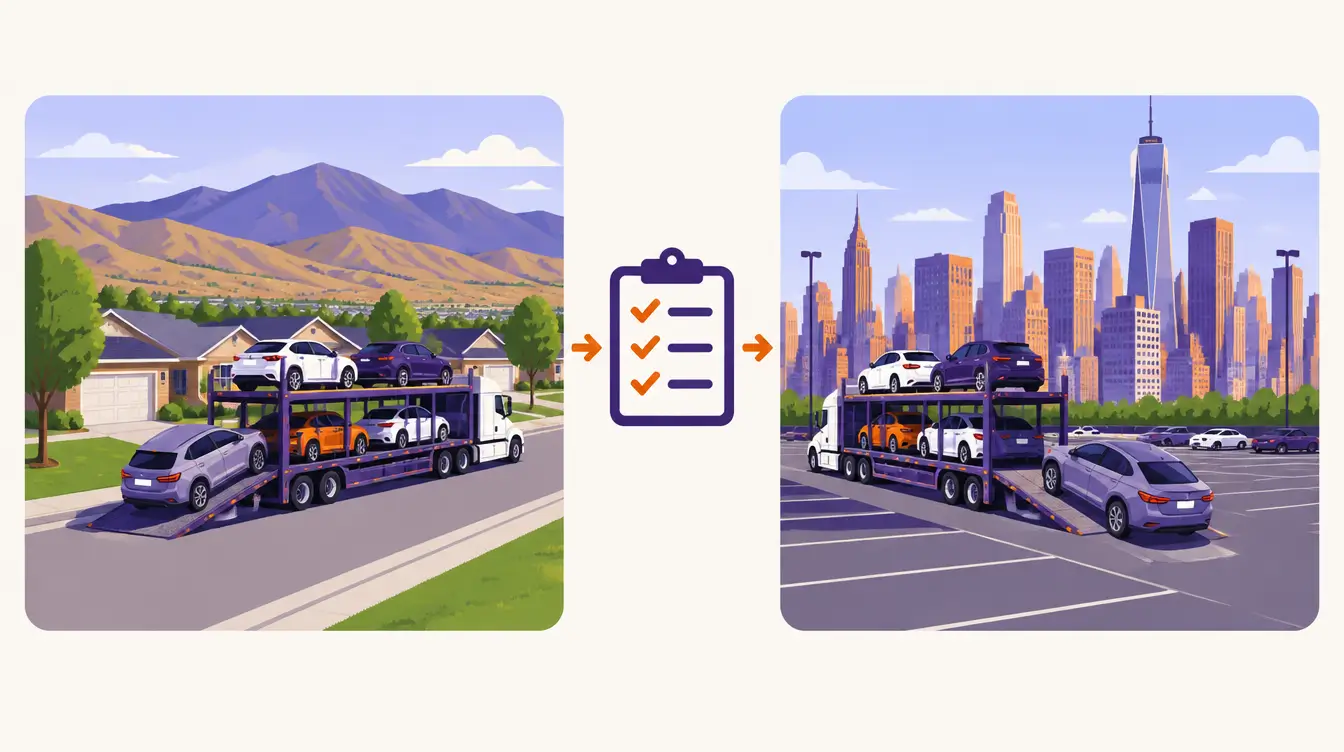
Key Things to Know Before Shipping a Car From Idaho to New York
Rivalane arranges every Idaho shipment bound for New York out of its Long Island office, where the lane ends, and places the car with a carrier running east on I-80 or the northern interstates. Name your Idaho town at booking: a Boise car and a Coeur d'Alene car leave on different highways and are priced accordingly.
Frequently Asked Questions



