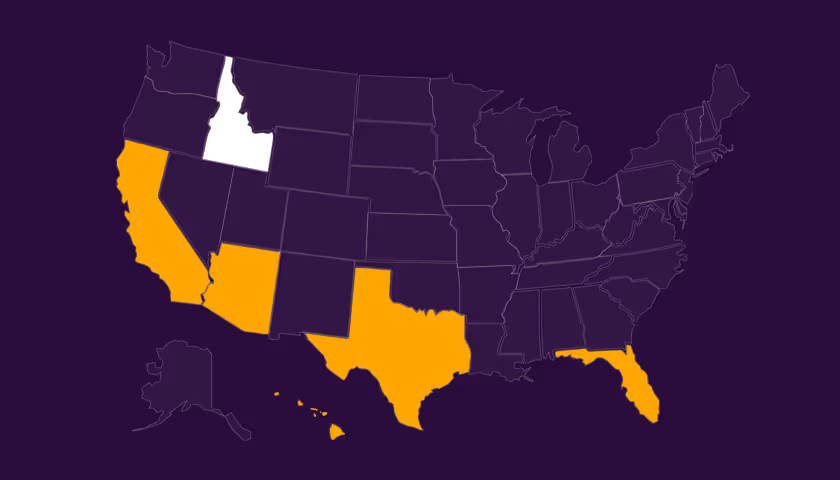
Rivalane arranges car shipping to and from Idaho with licensed, insured carriers, open or enclosed, delivered to the address rather than a terminal. Pickups run from Boise, Idaho Falls and Coeur d'Alene out to the smaller towns between them, matched to a carrier already working that route, with a timing window you can plan around.





5-Star Average Rating
Fully Insured
Top Rated Service
Nationwide Coverage
Licensed, Vetted Carriers
A car moving to or from Idaho is on the road longer than most shipments, and a long transit is where the difference between companies shows. More can change over the five to nine days a cross-country Idaho run takes than over a two-day hop: weather closes a pass, a carrier runs behind, a delivery window moves. What matters then is whether you can reach someone able to do something about it. Rivalane verifies operating authority and cargo insurance before any carrier is assigned, stays with the shipment after dispatch, and keeps one point of contact from quote through delivery, so a change on the road reaches you from us rather than from a driver you have never spoken to.


Cost and timing on an Idaho route depend on distance, trailer type, vehicle size, how reachable the pickup address is, and the time of year. The ranges below reflect typical market pricing and transit windows by distance, not a commitment on either. Your actual quote is based on real carrier availability on your specific route at the time of booking.
Idaho does not price as a single market. The Treasure Valley sits on I-84 between Salt Lake City and Portland, eastern Idaho rides I-15 toward Salt Lake, and the panhandle is served off I-90 out of Spokane. Each region is fed by carriers running toward a metro in another state rather than toward each other, so what a route costs depends less on total mileage than on whether a truck is already working the corridor your pickup sits on.
Trailer type is the next variable, since enclosed transport uses specialized space and there is less of it in circulation. Vehicle size and whether the car runs both change how it loads and how much deck it takes up. Season carries real weight here, because winter weather can close mountain passes and slow the routes linking one part of the state to another, which tightens carrier availability past the weeks when snow is actually falling.
Lead time is the part you control. Booking one to two weeks ahead usually opens up more carrier options than a last-minute request, and on a route that depends on a truck already heading your way, it can decide whether you get a scheduled pickup or wait for the next one.
Get your Idaho quoteHere’s how auto transport with Rivalane works from start to finish:





Send the pickup and delivery addresses, the vehicle year, make and model, and roughly when you want it moved. You get a price built on that route, the trailer type you choose, and the dates you give us.

Choose a pickup window that works for you. We assign a carrier whose route already covers it, confirm the details in writing, and give you a contact for the run before the truck sets off.

Take out personal items, leave the fuel low, and note any existing damage. A clean vehicle makes the condition report easier to read at both ends of the trip.

The carrier walks the vehicle with you, records its condition, and secures it on the trailer before setting off. From there it travels on the carrier's route, and you get updates as it moves rather than having to chase them.
At drop-off you walk around the vehicle with the driver and check it against the condition report signed at pickup. Once you are both satisfied, you sign it off and the shipment is complete.

Five ways to move a vehicle to or from Idaho. Which one fits depends on what you are shipping, how fixed your dates are, and how much protection the vehicle needs.
Most Idaho shipments cross a state line. We arrange transport between Idaho and anywhere in the lower 48, on open or enclosed trailers, with the same licensing and insurance checks applied to every carrier before it is assigned.
The standard choice, and what most vehicles ship on. Your car travels on an open trailer with several others, which is why open transport costs less, and it suits anything you would be comfortable driving in ordinary weather.
For classics, low-clearance builds and anything you would rather not expose to road grit, the vehicle rides inside a covered trailer. It costs more than open because that equipment is less common, and the table above reflects the difference.
When the date is fixed and cannot move, expedited puts your vehicle higher up the dispatch queue for a premium. It earns its cost when a closing date, a job start or a flight is driving the timing, and less so when you have a week either side to work with.
No terminals and no extra handling in between. The carrier collects from the address you give and delivers to the one at the other end, so the vehicle is loaded once and unloaded once, and you are there for both inspections.
Every shipper claims to be reliable. Here is what actually separates a well-run move from a risky one, and what to ask before you book anyone for an Idaho route.
Ask whether the company can name a real Idaho constraint before you raise it, such as which mountain passes can close in winter on the route your vehicle has to take, and what happens to your pickup date when one does.
Ask whether the price you are quoted is based on your actual route and vehicle, or a generic distance estimate that gets revised once a carrier is assigned.
Ask what happens if no carrier is available on your exact date. That matters most between November and March, when a storm can close a pass and hold up every load routed through it, and there are few alternate ways around. A shipper working from an existing carrier network can usually offer options faster than one starting from scratch.
Get your Idaho quoteDemand into and out of Idaho comes from a few clear directions. Here is who ships most often.
.svg)
Buying a vehicle in another state raises a tax question worth settling before you buy. Idaho presumes a vehicle bought out of state was bought for use in Idaho, so use tax is due when you title it. The Idaho State Tax Commission is direct about what that means: if the state you are buying in offers an exemption for out-of-state buyers and you qualify for it, claim it, because tax you did not properly owe there does not reduce what you owe here. Tax properly paid to another state can offset the Idaho amount, so keep the receipt. We arrange pickup from the seller or the dealership and deliver to your Idaho address, and it helps to confirm the seller can hand over a properly assigned title before the carrier collects.
Estimate your shipment →.svg)
A vehicle you already own still has to be titled and registered once you arrive, and whether you owe use tax on it depends on how long you owned it before the move. Own the vehicle more than ninety days before you move and the Tax Commission treats it as bought for use in your old state, so no Idaho use tax is due. Own it for less than that and Idaho presumes otherwise. This matters most coming from Oregon or Montana, because neither charges a general sales tax, so there is nothing paid elsewhere to credit and the ninety-day rule is the only route to an exemption. Registration itself is priced by the age of the vehicle rather than its value, which is worth knowing when you budget the arrival.
Vehicle transport services →
A vehicle that does not start needs a carrier with a winch and the right loading setup, and that is a smaller pool than standard open transport. It thins further once you leave the interstate, so a non-running pickup near McCall, Salmon or Stanley needs more lead time than the same vehicle in Boise or Idaho Falls. Tell us the condition up front, including whether it rolls, steers and brakes, and we match it to a carrier equipped for it rather than discovering the problem at pickup. The same applies to a project car coming home from a workshop or a long-stored vehicle leaving a garage.
Quote a non-running vehicle →
Work, retirement and family moves take vehicles in and out of Idaho in every direction. Runs such as Idaho to New York car shipping cross the full width of the country, which puts them in the long-haul band above and makes booking early worth more than trying to fix an exact date. California and the Pacific Northwest move steadily too, because carriers work I-84 west toward Portland and south toward Salt Lake year round. We arrange pickup from Boise, Meridian, Nampa, Idaho Falls, Pocatello, Twin Falls, Coeur d'Alene and the towns between them, then hand the vehicle to a carrier already working that direction. Tell us where it is going and we will build the pickup around it.
Estimate a long-distance move →Looking to ship your car to another state or across the country? Rivalane arranges transport between Idaho and all 50 states. Select a state to see what shipping to or from it involves.
Looking to ship your car to another state or across the country? Rivalane arranges transport between Idaho and all 50 states. Select a state to see what shipping to or from it involves.
The twenty cities below cover most of where vehicles actually move in Idaho, and they are spread across the state rather than concentrated in one metro. No single area accounts for even half the list. Expand any city to see the ZIP codes covered there, and if your address is not listed it is still within reach, since the list is a starting point rather than a limit.