


Shipping a running sedan by open carrier, Burlington to Phoenix, costs $1,350 to $1,800. The 16 measured pairs cover 2,422 to 2,616 road miles, all long-haul, with I-40 the top road on 12. Delivery typically follows 6 to 8 days after loading, and Arizona offers three permits for a car with unfinished paperwork.
How Many Road Miles Lie Between a Vermont Driveway and an Arizona One?
Sixteen pairings are measured here: pickups in Burlington, Montpelier, Rutland and Bennington in Vermont, matched with deliveries in Phoenix, Tucson, Tempe and Flagstaff in Arizona. Across that set, Vermont to Arizona car shipping spans 2,422 to 2,616 road miles, Bennington to Flagstaff being the shortest run and Montpelier to Phoenix the longest. Burlington to Phoenix, the pair behind the price on this page, measures 2,594 miles. Since none of the 16 comes in under 1,500 miles, both state pages class the whole lane as long-haul. I-40 carries more miles than any other road on the 12 pairs ending in Phoenix, Tempe or Flagstaff, while I-44 leads on the four Tucson pairs. Rivalane arranges each move from Melville, New York and keeps no office in Vermont or Arizona.

What Moves the Price of a Vermont to Arizona Car Shipment?
Your quote depends on your vehicle, the exact pickup and delivery addresses, the season and the trailer type, so run the calculator for a figure on your dates.
Mileage sets the base of every quote on this lane, and the mileage hardly moves between pairs. Hold the Arizona city fixed and the Vermont town changes the route by 98 to 99 miles: Bennington is the nearest of the four starts to every city, Montpelier the farthest. Hold the Vermont town fixed and the Arizona city changes it by 95 to 96 miles, with Flagstaff the nearest stop and Phoenix the farthest. Tucson measures 33 to 34 miles less than Phoenix, and Tempe 8 to 9 less.
All 16 pairs clear 1,500 miles, so each one is read against the long-haul row of two tables, the one on the Vermont car shipping page and its counterpart for Arizona car shipping, never the regional or mid-range rows. With the towns this close together, the vehicle, the trailer type and the month move a quote further than the address does.

Burlington to Phoenix runs $1,350 to $1,800 when the car is a sedan in running order and the trailer is open. A Montpelier pickup or a Phoenix delivery sits at the long end of the mileage and nearer the top of that range; a Bennington pickup or a Flagstaff delivery sits at the short end and nearer the bottom. For a figure tied to your own town, city and date, use the car shipping calculator.
An SUV, a pickup or a minivan typically adds $100 to $200, since it fills more of the deck. A car that cannot run has to be winched aboard, which brings an added fee. Expect the enclosed quote to land 40 to 60 percent over the open one for the same trip.

What Factors Actually
Influence Pricing on This Route?
Five things move the price on any lane: the vehicle's size, whether it runs, how easy each end is to reach, the season and the trailer type. Booking early protects your timeline, keeps pricing steady and reduces the risk of last-minute carrier changes.


Type
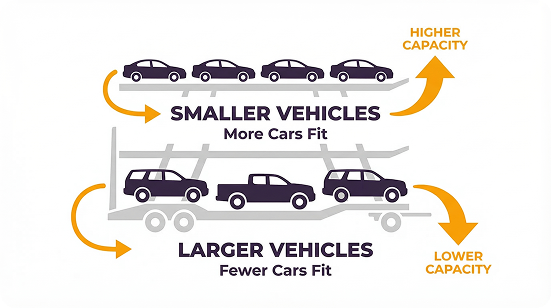
Size decides how much deck space your vehicle takes and how many other cars fit alongside it. A standard sedan is the cheapest thing to move because it slots almost anywhere on the trailer. SUVs, pickups and vans take more room and usually cost more on the same lane.


Is Shipping the Car Smarter Than Driving 2,594 Miles to Phoenix?
Putting it on a carrier
A carrier takes on the 2,594 miles from Burlington to Phoenix, which spares the car about 48 hours of highway and spares you the better part of a week at the wheel.
It suits a household that is flying to Arizona, a second car with nobody free to drive it, or an owner who would sooner keep that mileage off the odometer.
Taking the wheel yourself
Burlington to Phoenix is about 48 hours of driving. At nine hours a day that fills five full days and part of a sixth, with five nights in motels on the way.
The drive can be worth it as a trip in its own right. Price the fuel, the meals and the five motel nights, count the days away from work, and set that sum beside a shipping quote before choosing.
How Many Days Does a Carrier Need Between Vermont and Arizona?
From the day the car is loaded, the trip typically takes 6 to 8 days. That window fits inside both long-haul rows: the Vermont page typically lists 4 to 12 days for runs past 1,500 miles, and the Arizona page typically lists 5 to 8 days.
Before any of that, expect one to three working days to pass, as a rule, while the booking is matched with a carrier. Tracking is live from the moment the car is on the trailer. Pickup and delivery dates are estimates for your shipment, because weather and the other cars sharing the trailer can move them.
How Far Ahead Should a Vermont to Arizona Shipment Be Booked?
Published rate data for this lane leans the same way in three places. One broker prices September through December above its yearly average and March through May below it. A second says demand peaks from October through December. A third names summer and the fall and spring snowbird seasons as its busiest times. None of the three offers a single date that suits every move.
Reserving a spot one to two weeks before pickup generally keeps several carriers in play. For a pickup between September and December, two to three weeks is the safer margin.
Does a Car Headed for Arizona Need an Enclosed Trailer?
An open carrier is the usual choice on this lane and the less expensive one. The car rides in the open air for 2,422 to 2,616 miles, so plan on road film and dust when it arrives.
Enclosed car transport swaps the open deck for a hard-sided, roofed trailer. That is worth paying for with a collector piece, a recent respray or a sports car that sits low. For that protection the quote rises by 40 to 60 percent against open.
Enclosed Car Transport
Enclosed demand rises for high-value, specialty and seasonal vehicles, and enclosed trailers protect against road debris and weather, which matters most on longer hauls. Enclosed rigs are a small fraction of the trailers working any given lane, and that scarcity is what drives both the higher price and the longer booking lead time.
Open Car Transport
Most vehicles move on open trailers, and for most routes that is the more cost-effective way to ship a car.
Open transport works well for standard vehicles and keeps costs predictable. It also offers the widest carrier availability.
Which Arizona Permit Covers a Vermont Car While Its Paperwork Catches Up?
To give a Vermont car an Arizona title, registration and plate, ADOT asks for the Title and Registration Application, filled in and signed, the Vermont title (or the Vermont registration when a lienholder holds the title), a lien clearance where one applies, and, when the car is leased, a power of attorney issued by the lessor. It also lists an emissions compliance form, which ADOT limits to the Phoenix and Tucson areas, and the title and registration fees. Of the four delivery cities here, Phoenix and Tempe sit in the Phoenix area and Tucson in the Tucson area, while Flagstaff is in neither.
The harder question is what happens between delivery day and that finished application. ADOT describes three permits on its vehicle permits page, and each one covers a different gap:
- Documents still missing. An Arizona resident without complete documentation for a title or registration may apply for a 90-Day Resident Permit, which allows the car to be driven while the rest is gathered. It costs $15 at an MVD or Authorized Third Party office, and vehicle license tax is later calculated for the full year back to the date the permit was issued.
- No registration, a few necessary trips. A Restricted Use 3-Day Permit covers an unregistered car from where it sits to emissions testing, a vehicle inspection, the title or registration application, or a repair needed to comply. The fee is $1.
- No registration, ordinary driving. A 30-Day General Use Permit lets an unregistered car be driven for 30 days with no movement restrictions. It costs $15 and can be issued only once in a 12 month period.
Canceling the Vermont registration before the car ships means it arrives with no registration at all, which is the case the last two permits exist for. Vermont cancels a registration on form VD-170, sent to the Vermont DMV with the plates or the registration certificate, so that step can wait until the Arizona plates are on the car. The liability policy Arizona requires starts at $25,000 of bodily injury cover for a single person, rises to $50,000 where two or more people are involved, and adds $15,000 for property damage.
What Does the Car Pass Between the Vermont Pickup and the Arizona Delivery?
Each of the 16 pairs crosses from Vermont into New York and picks up I-90 there, for 422 miles from Burlington, Montpelier and Rutland and 448 from Bennington, past Syracuse, Buffalo and Erie. The route then bends southwest: I-71 for 110 miles to Columbus, Ohio, I-70 for 409 miles past Indianapolis to St. Louis, and I-44 for 485 miles through Springfield, Missouri and Tulsa. The Burlington to Phoenix run reaches its halfway mark on I-44 near Lebanon, Missouri.
I-40 takes over in Oklahoma, and at Amarillo the pairs divide. The 12 Phoenix, Tempe and Flagstaff pairs stay on I-40 through Albuquerque, 761 miles of it for Phoenix and Tempe and 850 for Flagstaff. The four Tucson pairs leave I-40 after 245 miles and finish on I-10 for 267.
On pickup day, have the driver point out every existing mark and see each one written on the condition report. Take a dated photo of every side, clear out the cabin and trunk, run the tank down to roughly a quarter and give the driver a single key. At the Arizona end, do the same check in daylight and write down anything new before you sign.

What Should a Vermont Owner Know Before Booking?
Rivalane brokers this lane from Melville, New York and has no office, yard or truck in Vermont or Arizona. Each booking goes to a licensed carrier, and that carrier does the hauling. A match is usually found in one to three working days; tracking begins at loading. Further down, the Arizona section explains which state permit applies when the car arrives ahead of complete registration papers.
Frequently Asked Questions