Rivalane arranges car shipping to and from Arizona with licensed carriers working the I-10, I-17, I-40 and I-8 corridors. We also reach the high country, the tribal lands and the rural county addresses that sit well off them. Every shipment moves under the carrier's cargo insurance, and your quote is built on your actual route rather than a flat statewide rate.





5-Star Average Rating
Fully Insured
Top Rated Service
Nationwide Coverage
Vetted Carriers
Transporting a vehicle in or out of Arizona takes planning around the state's geography rather than around a map. Summer heat runs across the I-10 desert stretches, winter storms cross I-40 at Flagstaff, and plenty of delivery addresses sit a long way off either corridor. Rivalane coordinates the route and matches the carrier to the job. Pickup and delivery windows are set around your dates rather than the truck's, and one point of contact stays with you from the quote through to the drop-off.


Cost and timing depend on your route, trailer type, vehicle size, and the time of year. The ranges below reflect typical market pricing and transit windows by distance, not a commitment on either. Your actual quote is based on real carrier availability on your specific route at the time of booking.
Arizona prices the way it does because of what sits inside it and what runs past it at the same time. The Phoenix metro is one of the largest in the country, and Tucson, Flagstaff and Yuma all sit within a few hours of it. That means a good share of demand is met without a carrier leaving the state.
I-10 then carries constant freight between southern California and Texas, straight through Phoenix and Tucson. Los Angeles sits around 370 miles west, with Las Vegas and San Diego closer still. Carriers cross Arizona whether or not they planned to stop. A short move is usually a car added to a load already running rather than a truck sent out to collect one.
Where the vehicle starts or lands matters as much as how far it travels. Addresses across the Phoenix metro and along I-10 through Tucson price near the low end, and so do Flagstaff on I-40 and Yuma on I-8. Each one sits on a corridor carriers already run.
The exceptions are the parts of the state that sit well off those routes. The White Mountains in the east, the tribal lands across the northeast, Page and the Arizona Strip in the far north, and the smaller towns of rural Mohave and Cochise counties all sit away from the through lanes. Reaching them takes a carrier off its route, and the price reflects that. Long unpaved driveways and narrow desert roads can also mean meeting the truck at a wider spot nearby rather than directly at the door.
Vehicle size, whether the car runs, and trailer type all move the number. Enclosed transport runs roughly fifty percent above open, because fewer vehicles fit on the trailer. The factor most within your control is lead time.
Booking a week or two ahead puts your vehicle on a truck already running I-10, I-17 or I-40, rather than one routed out to collect it. That gap is widest for addresses in the high country and the rural corners of the state. Winter is the busiest season for vehicles arriving into Phoenix and Tucson, so a wider pickup window helps most between January and March.
Get your Arizona quoteCar shipping to Arizona, or out of it to another state, comes down to matching the route to a carrier already working it. Here is how a Rivalane shipment runs, from the first quote through to the delivery inspection.





Begin by submitting your pickup and delivery ZIP codes through our instant quote form. We’ll calculate a rate based on mileage, carrier type, and current market conditions. Once we review your request, our dispatch team assigns a licensed carrier who best matches your preferred schedule and route.

After reviewing your quote, you can select a pickup date that fits your plans. We share the carrier's contact details so you can stay in touch directly about timing. If the pickup sits away from I-10, I-17 or I-40, we allow more room in the window, because reaching a rural or high-country address usually means routing a truck off its through lane.

A few steps make pickup easier: clean the car, remove personal items, and photograph its condition. Check the battery, tires and fluids, and leave about a quarter tank of fuel for loading. The driver completes a written inspection before departure to record the car's condition, and that record is what the delivery inspection is checked against.

Once loaded, the car is secured to the trailer for the route it is taking, whether that is a short run down I-10 or a cross-country lane. Every shipment moves under the carrier's cargo insurance. You get status updates as the shipment moves, and the support team stays reachable while the vehicle is on the road.
At delivery the vehicle is inspected again against the pickup record before you sign for it. If you are moving to Arizona, keep the out-of-state title with your paperwork rather than packing it. ADOT needs that title surrendered before it will issue an Arizona one, and nothing starts without it.

Most Arizona moves come down to a few choices: open or enclosed, standard or expedited, and how far each address sits from a main corridor. Every option below changes what the shipment costs and how quickly it can be scheduled. It is worth reading them against your own route rather than picking one by name.
From Phoenix to Flagstaff, or cross-country from either coast, Rivalane arranges car transport in and out of Arizona with licensed, insured carriers. The same network handles a single vehicle and a multi-car move. The route is priced on the two addresses you give us rather than on a flat rate for the state.
You get a quote built on your actual route and the carrier's details confirmed before pickup day.
For everyday vehicles, open transport is the practical choice and the cheaper of the two. Your car travels on a multi-car trailer, secured for the route and inspected at both pickup and drop-off. It is the same arrangement dealerships and rental fleets use to move stock, which is why open capacity on Arizona's main corridors is straightforward to find.
If the vehicle needs more protection, enclosed transport puts it inside a covered trailer, away from the dust, sun and road debris that an open deck is exposed to on Arizona's desert routes. It suits luxury, classic, low-clearance and specialty vehicles. Enclosed capacity is thinner than open, so it is worth booking further ahead, and the difference in cost is set out in the pricing table.
When the date is fixed, expedited shipping narrows the pickup window by matching your vehicle to the soonest carrier working your lane rather than waiting for the best-priced one. It costs more, and it earns that when a closing date, a start date or a dealership transfer will not move. Tell us the deadline when you book so we know what we are working to.
Plenty of Arizona addresses sit well away from I-10, I-17, I-40 and I-8, and reaching them is a scheduling question rather than a refusal. For the White Mountains, the Arizona Strip, the tribal lands and rural Mohave and Cochise counties we widen the pickup window. Where a full-size transporter cannot get down the road, we agree a meeting point nearby. Flag a remote address when you ask for a quote rather than after a carrier is assigned.
Every shipper claims to be reliable, and that is hard to test from the outside. Here is what separates a well-run Arizona move from a risky one.
Ask whether the company can name a real Arizona constraint before you raise it, such as whether your delivery address sits inside an emissions testing area, or how they reach a Flagstaff address after a winter storm.
Ask whether the price you are quoted is based on your actual route and vehicle, or a generic distance estimate that gets revised once a carrier is assigned.
Ask what happens if no carrier is available on your exact date. A shipper working from an existing carrier network can usually offer options faster than one starting from scratch, and that gap is widest for pickups away from the main corridors.
Get your Arizona quoteArizona's corridors carry vehicles in and out all year. Here is who ships, and what each one needs ready.
.svg)
Much of our inbound Arizona demand comes from people who bought a car sight unseen elsewhere. We collect from the seller or dealership and deliver to your Arizona address, so nobody flies out to drive it back.
What matters after delivery is where you register. Arizona runs no periodic safety inspection, and emissions testing applies only inside the Phoenix or Tucson control areas, so the answer differs by address. Check Arizona's titling and registration requirements before you buy, not after.
Estimate your shipment →.svg)
There is no day count for a car you already own and bring with you, which catches out people from states that set one.
You register once you become an Arizona resident: a job here, an Arizona license, in-state tuition, voter registration, or seven months in a calendar year. Arizona's registration requirements are worth reading before the vehicle lands. Tell us your arrival dates and we will plan the drop-off around them.
Vehicle transport services →
A vehicle that does not start needs a winch and the right loading setup, and that carrier pool is smaller. Tell us up front whether it rolls, steers and brakes, so we match the right truck rather than finding out at pickup. Same for project cars and long-stored vehicles.
Quote a non-running vehicle →
Direction matters more than people expect. The Texas and southern California lanes run constantly along I-10, while moves to the Midwest, Southeast and Northeast depend on what is running that week. The same pair of cities can schedule differently each way.
We arrange pickup across Phoenix, Tucson, Mesa, Chandler, Scottsdale, Glendale, Flagstaff and Yuma, then hand the vehicle to a carrier already working your direction. Booking earlier widens your choice of dates, most of all on the quieter return legs.
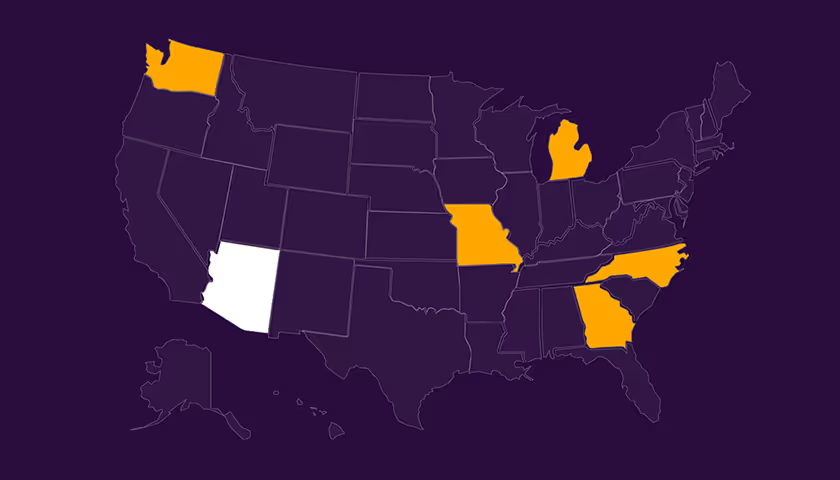
Estimate a long-distance move →Looking to ship your car to another state or across the country? Rivalane ships between Arizona and all 50 states. Select a state to see what shipping to or from it involves.
Arizona concentrates its population more tightly than almost any other state. The Phoenix metro alone accounts for about two thirds of it, with Tucson a distant second and the rest spread thinly across a very large area. Pickup availability follows that shape closely, so a Mesa or Chandler address schedules quite differently from one in Yuma or Lake Havasu City. The cities below are where we arrange the most pickups and deliveries, with the ZIP codes each one covers.