How Do You Register an Out-of-State Car in Texas?
At your county tax assessor-collector office, within 30 days of moving to Texas. The Texas Department of Motor Vehicles (TxDMV) sets the rules on its New to Texas page, but the county office handles the application, so there is no state DMV counter to visit.
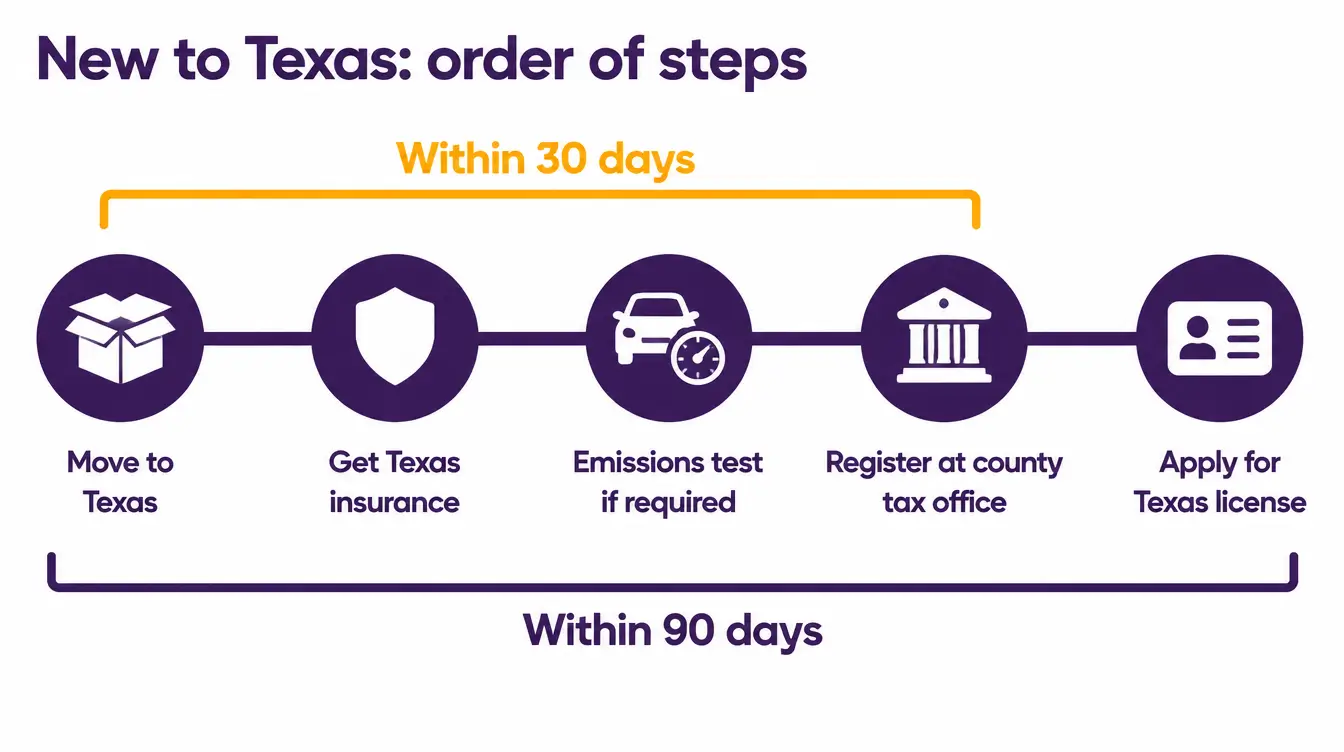
The order of the steps matters. Get insurance that meets the Texas minimums, pass an emissions inspection if your county requires one, then take Form 130-U and your proof of ownership to the county office. You do not need a Texas title to register the car.
This guide covers a car you already own arriving from another state, using a car shipped from Illinois as the example. It explains what each deadline applies to, which counties test emissions and what changes when the car arrives after you do.
How Long Do You Have After Moving to Texas?
Thirty days from the day you move, not from the day the car reaches you. The TxDMV checklist for new Texans warns that penalty fees may apply after that.
Two other clocks run alongside it. The $90 new resident tax is due within 30 calendar days of the car's first use in Texas, which is a different starting point, and your driver license has 90 days. Both are covered below.
TxDMV adds two exemptions: active-duty members of the U.S. Armed Forces and non-resident, full-time students at a Texas college or university are not required to register or title their vehicles in Texas.
What Order Do the Steps Go In?
TxDMV says the steps must be followed in this order:
- Get insurance that meets the Texas minimums.
- Pass an emissions inspection in your new county, if it is an emissions county. The station asks for proof of insurance.
- Apply at your county tax office with Form 130-U.
- Apply for a Texas driver license with the Department of Public Safety (DPS).
The last two do not swap. DPS asks new residents to register all their vehicles before applying for a license, according to its Moving to Texas page.
Does Your County Require an Emissions Test?
Only if you live in an emissions county. Under House Bill 3297, Texas ended the safety inspection for non-commercial vehicles on January 1, 2025, so most cars in most counties need no inspection before registration.
Through October 31, 2026, TxDMV lists 17 emissions counties: Brazoria, Collin, Dallas, Denton, El Paso, Ellis, Fort Bend, Galveston, Harris, Johnson, Kaufman, Montgomery, Parker, Rockwall, Tarrant, Travis and Williamson. From November 1, 2026, Bexar County, which includes San Antonio, is the 18th. A TxDMV notice from September 2026 puts the Bexar test fee at $18.50, paid at the station.
The Texas Commission on Environmental Quality applies the annual test to gasoline vehicles 2 to 24 years old, and TxDMV says electric vehicles and classic cars stay exempt. Take the car to a DPS certified station in your new county of residence and keep the Vehicle Inspection Report for the tax office.
Every non-commercial vehicle still pays a $7.50 inspection program replacement fee at registration, according to DPS.
What Insurance Do You Need Before You Register?
Liability coverage of at least $30,000 for each injured person, $60,000 per accident for injuries and $25,000 for property damage, often written as 30/60/25. You show proof at the emissions station and again at the county office.
TxDMV says some out-of-state policies may be acceptable and sends you to your insurance agent for the answer. Ask before the move. If your current policy does not qualify, switch to a Texas policy first, because the inspection and the registration both wait on it.
What Happens at the County Tax Office?
County tax offices process registrations for TxDMV but are staffed independently, so hours differ and some require appointments. Bring:
- A completed Form 130-U, the Application for Texas Title and/or Registration
- The out-of-state title, or your current out-of-state registration receipt
- Your current driver license or another government-issued photo ID
- Proof of insurance that meets the Texas minimums
- The Vehicle Inspection Report, if your county requires an emissions test
Form 130-U lets you choose Registration Purposes Only. You keep the out-of-state title, which the form tells you not to surrender, and Texas issues plates and a registration sticker without a Texas title. If a lender holds the title, call the county office first to confirm what it will accept.
If your county does not require an emissions inspection, the TxDMV checklist says you self-certify the vehicle identification number (VIN) on Form 130-U.
On fees, the TxDMV out-of-state vehicles page lists a base registration fee of $50.75 for passenger cars and light trucks, a $1 insurance verification fee and a $4.75 processing and handling fee, plus the inspection replacement fee and any emissions fee. Applying for a Texas title adds a title application fee of $28 or $33, depending on the county, and counties can add local fees.
How Much Tax Do New Residents Pay on a Car?
Usually $90, if the car was already registered in your name in another state, such as Illinois. The Texas Comptroller's Motor Vehicle Tax Guide charges this flat new resident tax in place of motor vehicle use tax. You pay it to the county tax office within 30 calendar days of the car's first use in Texas, or 60 days for active-duty military.
It does not cover every car. A vehicle that was never registered in your name, such as one bought just before the move, owes 6.25 percent motor vehicle use tax instead, with credit for sales or use tax you paid to another state. When the $90 tax applies, there is no credit for tax paid elsewhere.
By Comptroller policy, a qualifying car brought into Texas within 30 days of becoming a resident gets the $90 rate. A car that arrives after you have lived in Texas for 30 days is presumed to have come in after you became a resident and owes motor vehicle use tax instead, unless it was documented as in transit.
What If the Car Arrives After You Do?
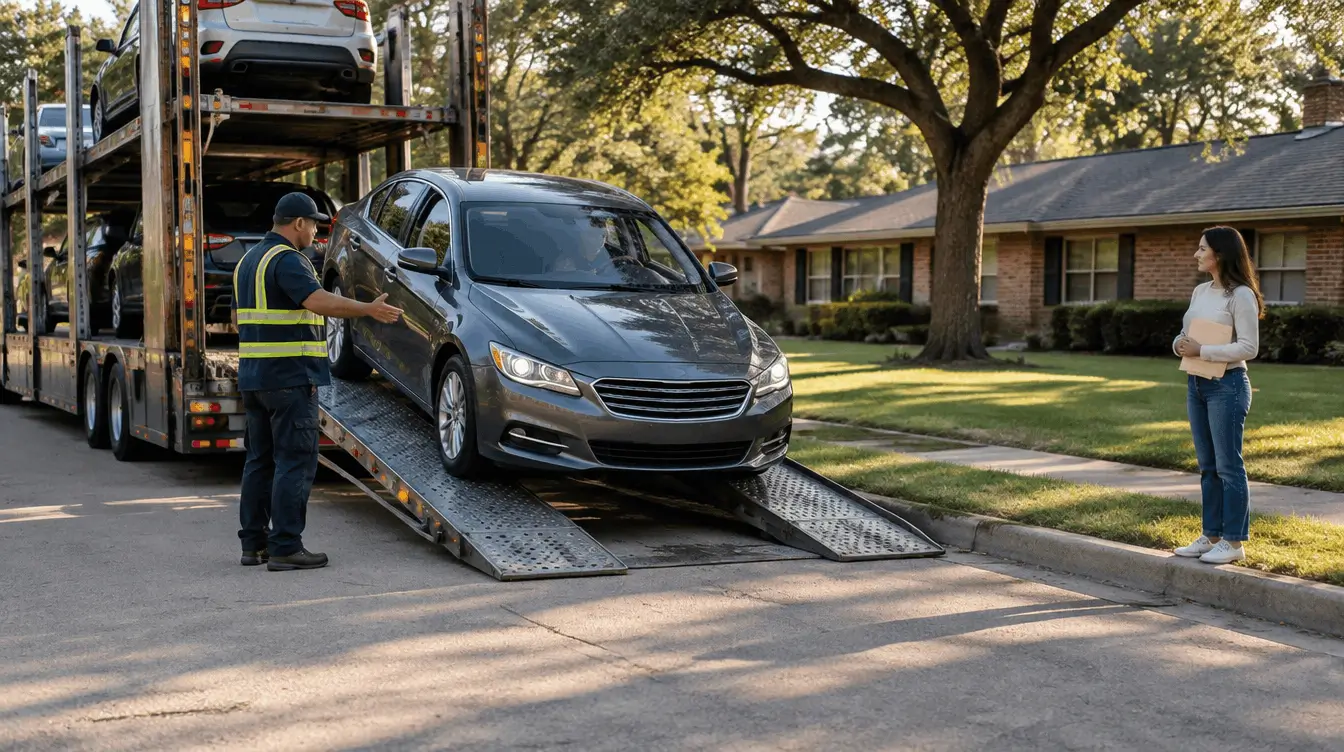
The registration clock still starts on your move date. If you fly in from Chicago and the car follows on a truck, the days it spends in transit count against the 30. In an emissions county, the car cannot pass its inspection until it is in Texas, and the county will not register it before that, so a late delivery uses up part of the 30 days.
The tax rule is more forgiving. The Comptroller says a vehicle documented to be in transit still qualifies for the $90 tax even if it arrives after your first 30 days. Keep the bill of lading and your shipping confirmation with the title paperwork, because they show when the car was on its way.
Rivalane coordinates door to door transport into Texas with licensed, insured carriers. We typically assign a carrier within one to three working days after you book, and pickup and delivery dates are estimates, not guarantees, so book early and line up the Texas insurance before the car leaves.
Our route pages cover each lane, including Illinois to Texas car shipping, New York to Texas, Montana to Texas, New Hampshire to Texas and Rhode Island to Texas, and our page on car shipping in Texas covers pickups and deliveries across the state. To price your move, use the car shipping calculator.
Frequently Asked Questions
How long do I have to register my car after moving to Texas?
Do I need a Texas title to register an out-of-state car?
Does Bexar County require an emissions test?
When do I need a Texas driver license after moving?
Does my E-ZPass or I-PASS work on Texas toll roads?