If you live outside New Jersey and buy a car from a New Jersey dealer, the sale can be exempt from the state's 6.625 percent sales tax, but the exemption does not apply by itself. It runs on a form, Form ST-10, which the dealer completes and keeps, and on statements you make about where you live and where the car will be used. The car also needs a legal way to leave the state, which for most dealer sales means a temporary tag issued on the lot.
This guide follows a dealer purchase in the order you meet it: the tax question, the nonresident test, the two routes to a temporary registration, what the dealer needs from you, whether to drive or ship, and a worked example for a Washington State buyer. It stays on dealer sales to nonresidents. For the tag, title and tax questions that apply in every state, our guide to the general tag, title and tax rules for out-of-state dealer purchases is the companion piece.
Two other readers may want a different starting point. If you live in New York, what New York asks of a resident who buys in New Jersey covers your side of the purchase. If you are going the other direction, buying a car in New York while living in another state works through the New York version of this process.
Do You Pay New Jersey Sales Tax If You Live in Another State?
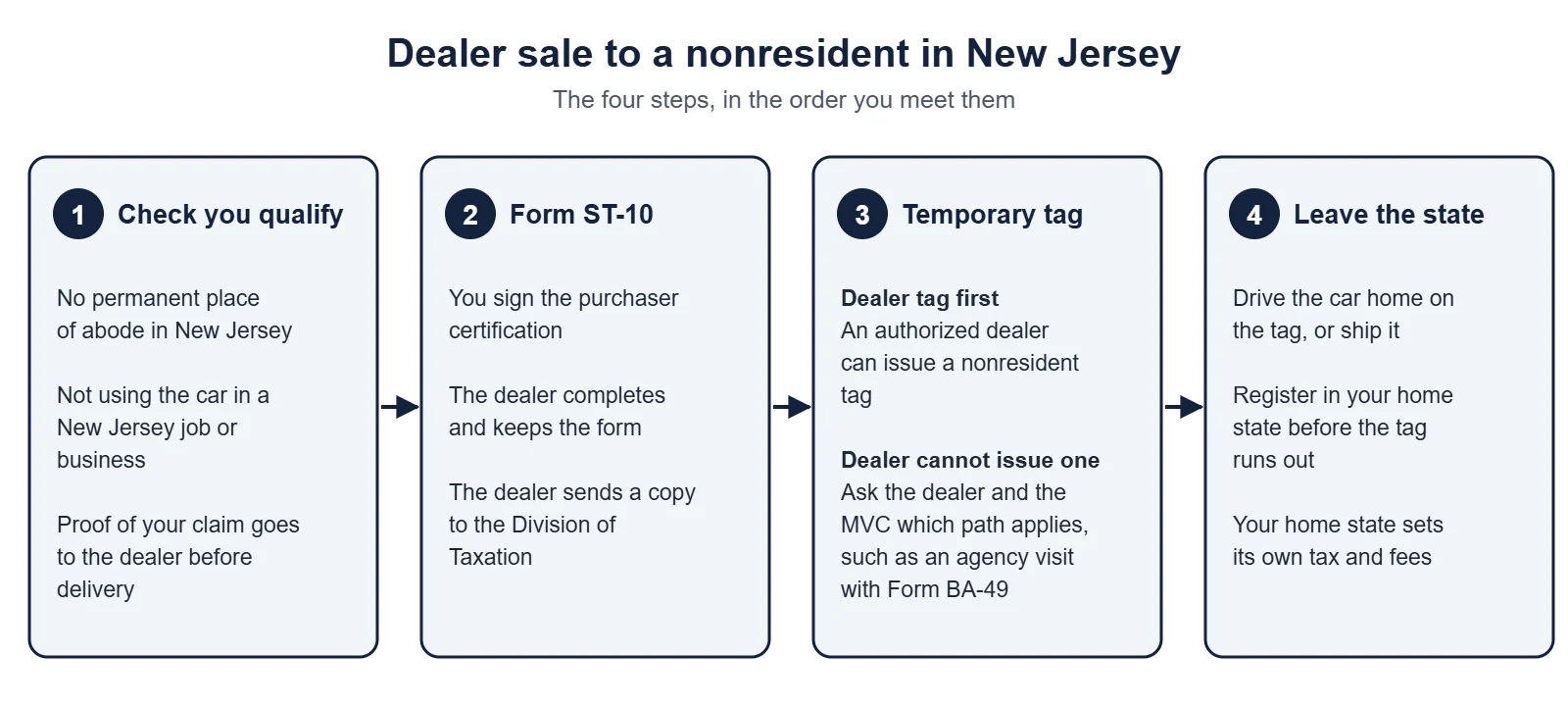
Not if you qualify as a nonresident and the paperwork is done at the sale. New Jersey's sales tax rule for vehicles, N.J.A.C. 18:24-7.8(b), exempts a sale to a nonresident on three conditions. At the time of delivery you must have no permanent place of abode in New Jersey. You must not be carrying on a job, trade, business or profession in New Jersey in which the car will be used in the state. And you must give the seller proof of your claim before delivery. The test is applied at delivery and the proof has to reach the dealer first, so the time to gather it is before you sign, not on pickup day.
The Division of Taxation's sales tax guide, publication ANJ-10, puts the practical point in one line: a nonresident who buys a motor vehicle in New Jersey completes Form ST-10 in order not to be charged New Jersey sales tax. Its general rule is that sales tax belongs to the state where the buyer takes possession or delivery, so a car handed over on a New Jersey lot is taxed here unless the exemption applies.
The dealer carries the other half of the process. N.J.A.C. 18:24-7.10 requires a New Jersey motor vehicle dealer to complete and keep a Motor Vehicle Sales and Use Tax Exemption Report, which is Form ST-10, for a qualifying nonresident, and to send a completed copy to the Division of Taxation on every sale to a nonresident. You do not mail anything yourself. Your part is the purchaser certification on the form itself, which the state publishes, so read it before the day you buy rather than at the desk.
Without the exemption in place, the sale is taxed at New Jersey's rate. The Division of Taxation's questions and answers on vehicle sales tax give it as 6.625 percent of the purchase price of a new or used vehicle since January 1, 2018. The dealer rule also says a warranty sold with an exempt vehicle is not subject to sales tax, so the exemption reaches that add-on as well.
Form ST-10 is about New Jersey's tax only. A buyer who meets the test pays no New Jersey sales tax, which means there is no New Jersey tax to claim as a credit later, and what your home state charges when you register is that state's decision. The Washington State example further down shows one version of how that plays out.
Who Counts as a Nonresident on Form ST-10?
On the purchaser side, the form asks you to certify three things: that you are a nonresident of New Jersey, that you have no permanent place of abode in the state, and that you are not engaged in New Jersey employment or business in which the car will be used. A company buying the car signs through an authorized officer. The dealer files the form, and the certifications on it are your statements.
Place of abode is where buyers most often get caught. The tax rule treats anyone who maintains a place of abode in New Jersey as a resident individual. The form describes an abode as a dwelling kept on other than a temporary or transient basis, and its examples include a house, an apartment, a hotel or club room, a trailer and a houseboat. A second home, an apartment you keep for work or a room held for you year round can therefore count against you even when your license and your mailing address are somewhere else. A few nights in a hotel while you shop for a car are temporary by nature, but the wording turns on how the dwelling is kept, so if you keep any New Jersey dwelling year round, raise it with the dealer before you sign.
Work in New Jersey is the second trap. Under the tax rule, a person carrying on an employment, trade, business or profession in New Jersey is treated as a resident for the use of a car in that work, and an entity doing business or keeping a place of business in the state is a resident. The New Jersey rules and agency pages we reviewed do not say whether commuting to a New Jersey job counts as using the car in that employment. A buyer in that position should ask the dealer, and the Division of Taxation if the answer is unclear, before signing anything.
The certification carries a cost if it turns out to be wrong. According to the form, a buyer who was a New Jersey resident at the time of the purchase owes sales tax on the purchase price along with penalty and interest, and tax paid to another state does not remove that obligation. Tax you paid somewhere else on the same car does not cancel the New Jersey bill.
The tax rule says you must give the dealer proof of your claim before delivery, but it does not list which documents count. The temporary tag rule is more specific. It names a valid out-of-state driver license showing an out-of-state address as proof of nonresidency, and it separately asks for proof of your out-of-state residence, with the dealer keeping copies for three years. Bring the license and one more document that shows your home address, since the same dealer file serves both the tax form and the tag.
Dealer Temporary Registration or MVC Agency Registration: Which Fits a Dealer Sale?
A nonresident who buys a car in New Jersey has two ways to get a temporary New Jersey registration, and they come from different parts of the rulebook. For a car bought from a dealer, the one written for the situation is the dealer tag.
Under N.J.A.C. 13:21-15.10, a dealer authorized by the Motor Vehicle Commission can issue a nonresident temporary registration for a new or used vehicle to a buyer who bought it from that dealer while on the way to another state, as long as the vehicle will not be permanently registered in New Jersey. A real sale is a prerequisite. The tag serves as both the registration and the plate, and the rule covers passenger vehicles, noncommercial trucks and motorcycles, among others. The authority behind it is state law, N.J.S.A. 39:3-4b, together with the Commission's rule.
Not every dealer can issue one. The rule withholds the authority from a dealer that sold or leased fewer than four vehicles permanently registered in New Jersey in a 12 month period, with room for dealers in their first year of operation. Ask at the start whether the dealership issues nonresident tags. A car you cannot legally drive off the lot changes the whole plan.
The second route is on the Motor Vehicle Commission's temporary nonresident registration page. It applies to a nonresident who buys a vehicle in New Jersey and plans to move it to the home state, and it sends you to a motor vehicle agency with a Vehicle Registration Application, Form BA-49. The list of what to bring starts with an original New Jersey title assigned to you that shows your out-of-state address. It continues with proof of your out-of-state address, proof of insurance on the vehicle, and identification such as an out-of-state driver license. The page says the result is a 30 day registration that cannot be renewed and is valid only in the continental United States.
For a car bought on a dealer lot, start with the dealer tag. The dealer rule asks the dealer to hold the title or manufacturer's statement of origin, while the agency list asks you to bring a New Jersey title already assigned to you. The MVC page does not explain how a buyer who has just purchased from a dealer would have that title in hand. If your dealer cannot issue the tag, ask the dealer and the MVC which path applies before you leave the lot.
Both routes run 30 days. The dealer version ends sooner if your home state's permanent registration reaches you first, and the dealer may issue a second 30 day tag only when permanent registration is delayed because the original title was lost or the lienholder was slow to deliver it. An MVC advisory on the law change that took effect in August 2018 describes the same two reasons. The dealer rule also bars a nonresident tag on a car titled in the dealer's own name or covered only by the dealer's insurance, and a tag cannot be moved from one vehicle to another.
What Does the Dealer Need Before the Car Leaves?
Most of the work happens at the desk, and most of it depends on documents you bring. The dealer rule sets the list, and it is worth walking through it before purchase day so nothing is missing when you are ready to leave.
First, the dealer has to hold the title or manufacturer's statement of origin for the car, and a dealer reassignment certificate where one applies. Without a valid one, the rule does not allow a nonresident tag to be issued. That is the dealer's side of the paperwork, but it is fair to ask early whether the car's title is already in the dealer's hands.
Second, the dealer needs proof that you live out of state: the out-of-state driver license discussed above and proof of your home address. Third, the dealer needs the name of the insurance company covering the car and the policy or binder number. State law also bars a dealer from issuing a temporary registration until it has confirmed the car is insured. Call your insurer before purchase day and ask for a binder or policy number for the car, because the tag rule asks for both the insurer's name and that number.
Fourth, the tax paperwork. Expect to sign the purchaser certification on Form ST-10 and to hand over your proof of nonresidency before you take delivery. The dealer keeps the form and sends a copy to the Division of Taxation.
Fifth, count the days. The tag expires 30 days after issue, or when your home state's permanent registration reaches you, whichever comes first, and you are expected to destroy the tag when it expires. Plan to start your home registration right away rather than at the end of the month. If a lender will hold the title, ask how long it takes to reach you, because a slow lienholder is one of the two reasons the rule allows a second tag. The dealer attaches the tag to the rear plate holder with nothing covering it, so check that the printed information matches the car and your insurance details before you drive off.
Last, ask what you will leave with. The New Jersey rules and agency pages we reviewed do not say how a dealer hands over the title or manufacturer's statement of origin on a nonresident sale, and your home state will need that document to register the car. Ask the dealer what you will receive, and when, before you sign. The general version of this checklist, for any state, is in the out-of-state dealer purchase guide.
Should You Drive the Car Home or Ship It?
Driving works when the trip fits comfortably inside the tag's 30 days and you want the car right away. Weigh the limits before you commit. The tag is not renewable except for a lost title or a lienholder delay, it ends early once your home state registers the car, and the dealer will not issue it until the car's insurance is confirmed. A long drive also means nights on the road, fuel and miles on a car you just bought.
Shipping takes the drive out of it. Rivalane coordinates door to door transport from New Jersey with licensed, insured carriers. We typically assign a carrier within one to three working days after you book, and pickup and delivery dates are estimates, not guarantees. Our guide to getting an out-of-state purchase delivered covers what to plan between the seller's lot and your driveway, and the car shipping calculator prices the move.
Two points on the tax and tag side are worth settling with the dealer before you book. The first is delivery. The dealer rule describes an alternative to the New Jersey business-use condition: the buyer certifies that the car has been contracted for delivery out of state, names the state, and the dealer affirms that the car has been delivered to the purchaser there. The New Jersey rules and agency pages we reviewed do not say how a carrier you hire yourself fits that wording, so ask the dealer how it documents a shipped car and what it needs from the carrier.
The second is the tag. The MVC page ties the temporary registration to driving the vehicle in New Jersey or moving it across state lines, and the dealer rule issues it to a nonresident on the way to another state. Whether a car loaded on a carrier at the dealership needs the tag is something those pages do not answer. Ask the dealer what it does with a shipped car and whether a tag on that car changes any of its own paperwork.
The nonresident conditions for the tax exemption are the same whether the car drives away or rides away, so give the dealer your proof before delivery either way.
Example: Buying in New Jersey and Registering in Washington State
Say you live in Washington State and buy a used SUV from a New Jersey dealer. You are not a New Jersey resident, you keep no dwelling in the state and the car will not be used in a New Jersey job, so you meet the conditions in the tax rule. You give the dealer your Washington driver license and proof of your address, sign the purchaser certification on Form ST-10, and the dealer does not charge New Jersey sales tax. The dealer also issues a 30 day nonresident tag after confirming your insurance.
The New Jersey side of the sale is finished, but the tax question is not. The Washington Department of Revenue says Washington State residents who buy a vehicle outside the state and bring it in owe use tax on its value. The department's guidance on vehicles brought into the state says the use tax is paid when the vehicle is licensed and registered in Washington State. The rate depends on where the owner lives, and the value is the fair market value, which cannot be less than the amount paid to the seller.
The department allows a credit against Washington use tax for sales or use tax the owner can show was paid in another state. Because the ST-10 exemption meant you paid no New Jersey sales tax, there is nothing to credit, and Washington use tax applies at registration on the full amount. Keep the bill of sale, since the value Washington uses cannot be less than the amount you paid. Our guide on what the Washington licensing office needs for a car bought elsewhere walks through the documents, the use tax and the fees at the licensing office.
If you drive, the 30 day tag is the deadline to plan around. If you ship, plan the licensing visit around the carrier's delivery estimate. For a buyer who ships, our page on shipping a car from New Jersey to Washington covers the lane, the transit window and the Washington State paperwork.
If You Register the Car in California Instead
A California resident buying from a New Jersey dealer follows the same New Jersey steps as the Washington example: you qualify as a nonresident, the ST-10 exemption means no New Jersey sales tax, and the dealer handles the temporary tag if you drive the car home. The tax question then moves to California.
California use tax applies to a vehicle bought for use in California without paying California sales tax. The California Department of Tax and Fee Administration says the rate matches the sales tax rate at the address where you register the car, and that tax paid to another state may earn a credit. Because the ST-10 exemption meant you paid no New Jersey sales tax, there is nothing to credit, and California use tax applies at registration.
For a car bought outside California, registration fees become due on the date the car enters California, and the California DMV gives you 20 days from then to submit the application and fees. A nearly new car adds one more check, since California residents cannot bring in or register a vehicle younger than 2 years and showing fewer than 7,500 miles unless it left the factory meeting California emission standards or an exemption fits. Our guide to California's 7,500 mile rule and the other checks for a car bought out of state covers that rule, and our guide to registering the car at the California DMV walks through the documents, smog check and VIN verification. For a buyer who ships, our page on shipping a car from New Jersey to California covers the lane, the transit window and the California paperwork.
Frequently Asked Questions
How long is a New Jersey temporary tag good for if you live in another state?
Do you pay New Jersey sales tax on a car if you live in another state?
Can you skip New Jersey sales tax by buying from a private seller?
Does a second home in New Jersey change anything?
What happens if you sign Form ST-10 and are later treated as a New Jersey resident?
Do you need the New Jersey temporary tag if the car is shipped?