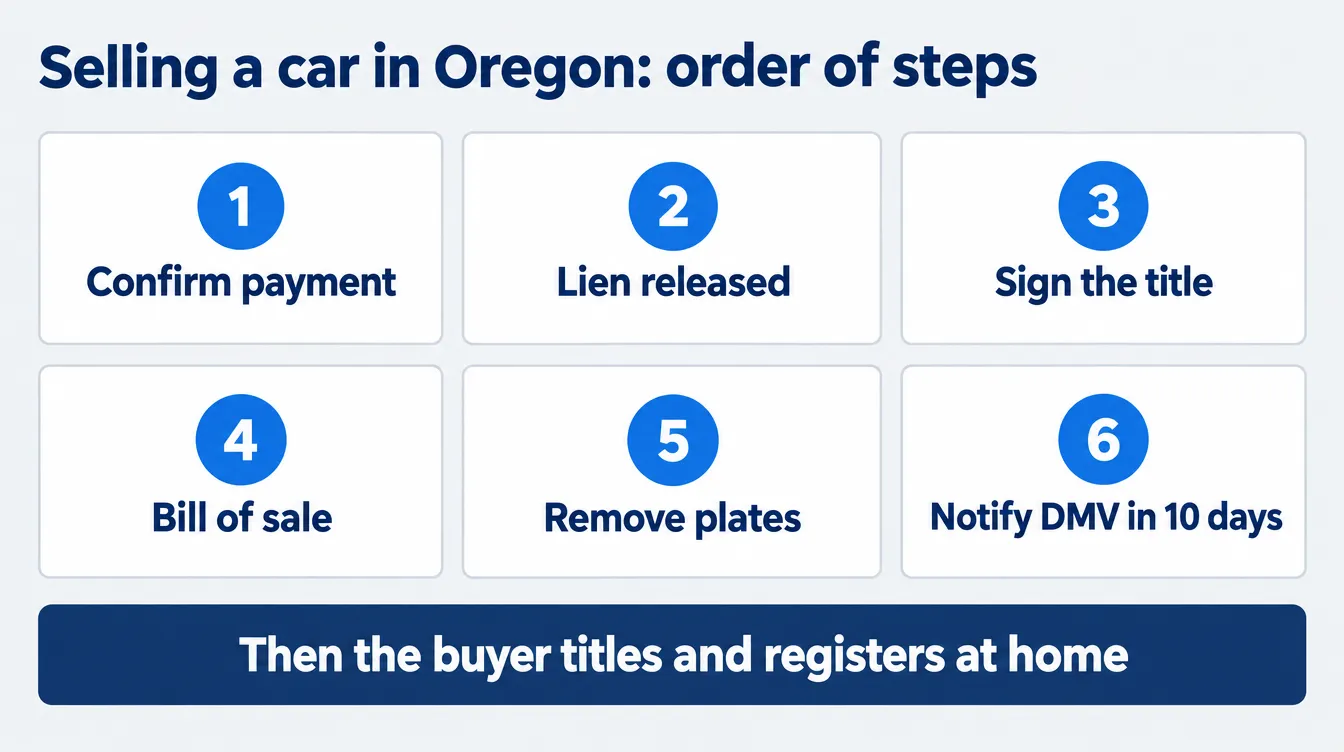
To sell a car in Oregon, you sign and date the back of the title or a bill of sale, get any lender released, complete an odometer disclosure if the car needs one, and tell Oregon DMV about the sale within 10 days. You may also take your plates off before the car leaves. Oregon DMV sets out the steps on its buying or selling a vehicle page, and OAR 735-020-0080 sets the notice requirements.
Each step below gets its own section, followed by one sale traced from Salem to Tampa. Payment checks and the handover to a carrier go deeper in our national guide to selling a car to an out-of-state buyer.
What Do You Need Before You Sell a Car in Oregon?
Start with the title. It has to match the vehicle identification number (VIN) on the car, and Oregon DMV tells buyers to confirm that every owner shown on it, including any lienholder, has released interest.
Get the buyer's full name and address in writing before the car leaves, because the notice of sale you file with DMV needs both. Settle the price, how you will be paid and who handles pickup, and hold the car and the signed title until your bank confirms the funds have cleared.
How Do You Sign Over an Oregon Title?
The DMV selling page tells you to sign and date either the back of the title or a bill of sale. Because every owner shown on the title has to have released interest, make sure each named owner signs. The buyer then applies for a title in the buyer's name, and DMV's buying tips give the buyer 30 days to do it. That deadline is the buyer's, not yours.
The DMV pages we reviewed do not mention notarizing the title in a private sale. Our national guide answers the general notarization question for sales across state lines in its out-of-state buyer guide. For anything specific to your title, ask Oregon DMV before you sign.
Do You Need a Bill of Sale in Oregon?
DMV's buying tips say a buyer needs a bill of sale when the seller's name is not on the title. The selling page lets you sign either the title or a bill of sale, so a signed title can be enough, but a bill of sale is still worth writing as your record of who bought the car and when.
DMV says a bill of sale needs at least the VIN, a statement releasing your interest, the printed name of the seller, the seller's signature and the date of sale, and it cannot process one without them. You can use DMV's Vehicle Bill of Sale or your own document with the same information.
What If a Lender Still Holds the Title?
If you had a loan, the lienholder has to sign the front of the title or give you a separate signed statement releasing its interest. DMV also says you cannot sell, donate or gift a vehicle with a loan that is not paid off, and it tells you to contact the lienholder about its payoff process. Ask the lender what it needs from you to release the lien and how long that takes, and resolve it before you set a pickup date.
What If the Title Is Lost?
For a car of model year 2011 or newer and under 20 years old, DMV says to get a replacement title before you sell, and the odometer reading can be disclosed on the back of the new title. The DMV pages we reviewed do not address older cars, so call Oregon DMV about those instead of guessing.
Who Must Complete an Odometer Disclosure?
A car of model year 2011 or newer and under 20 years old needs one. You write the reading on the back of the title or on a Secure Odometer Disclosure form, and both seller and buyer sign. DMV's odometer disclosure page lists what is exempt: vehicles without an odometer, model year 2010 or older, vehicles that are not self-propelled such as trailers or campers, vehicles over 16,000 pounds gross vehicle weight rating, Class I ATVs, snowmobiles, and title transfers where at least one owner stays on the title.
The same page covers the odd cases. DMV converts kilometers to miles, a blank display is noted "not readable", a stuck odometer is noted "not actual" and a rolled-over reading is marked "rolled over". A secure power of attorney can disclose the odometer only when the title is lost, destroyed, mutilated or held by a lienholder.
How Do You Report the Sale to Oregon DMV Within 10 Days?
Notify DMV within 10 days of selling or gifting the vehicle. The DMV vehicle information page gives two ways: online through DMV2U, or on the Notice of Sale or Transfer, Form 735-6890. The rule counts the 10 days from the date of the transfer.
The rule requires the VIN, your full name and the buyer's full name. The DMV selling page also asks for the buyer's name and address, so give both. The rule accepts other written notice with the same details, delivered to any DMV office or mailed to DMV headquarters.
DMV provides a receipt for a notice filed online once the submission completes, and for one filed in person at a field office if you ask. It provides none for a notice that is mailed, faxed or phoned in, so file online when you want proof. DMV notes the sale on your record, but you stay listed as the owner until the buyer transfers the title, and the form says it is not a bill of sale.
What Happens to Your Plates After the Sale?
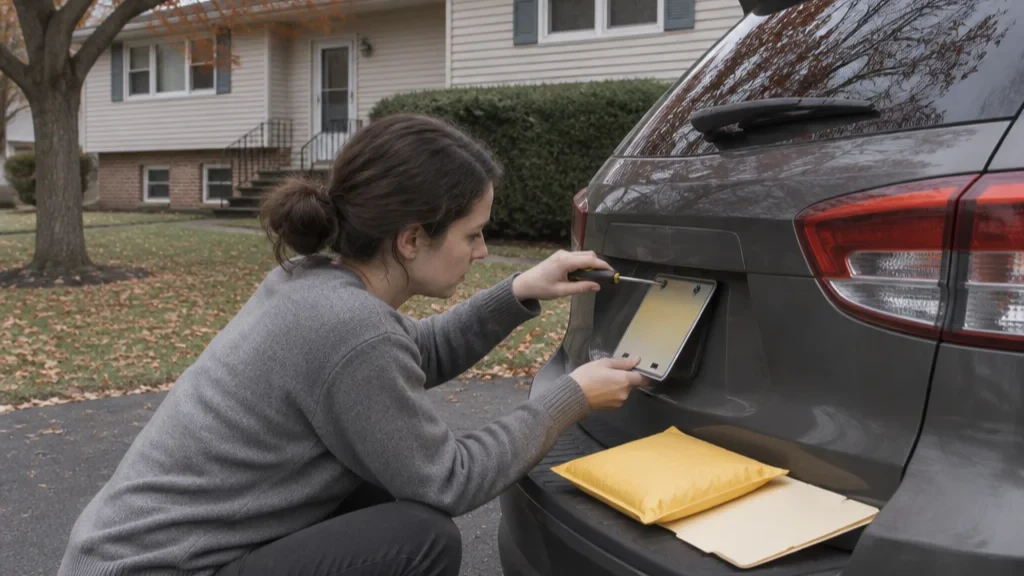
DMV's selling page says you may remove your license plates before selling your vehicle. Form 735-6890 gives the reason: removing the plates is one way to avoid tickets or towing charges after you sell. If a carrier will pick up the car, take the plates off before the driver loads it. Moving them to another vehicle you own is a DMV transaction, and the DMV Title and Registration Handbook lists a $30 plate transfer fee. The DMV pages we reviewed do not say what else to do with plates you will not reuse, so ask DMV before you discard or mail them.
What Changes When the Buyer Lives in Another State?
Your Oregon steps stay the same. The title, bill of sale, odometer disclosure, plates and notice of sale all follow Oregon's rules, and neither the DMV selling page nor the notice rule says anything different for an out-of-state buyer. The buyer takes the car through titling and registration at home, under that state's rules, so point the buyer to its motor vehicle agency.
What changes is the handover. The buyer is not at the curb, so agree in writing before pickup how the signed title reaches the buyer, who books the transport and what the carrier will sign. Our out-of-state seller guide covers payment, title shipping and carrier pickup, and the auto transport bill of lading guide shows what the carrier signs. If the buyer is arranging transport, our guide to auto transport scams explains what to check first.
On tax, the Oregon Department of Revenue says Oregon has no general sales tax. Its vehicle privilege tax is a dealer tax that exempts dealer sales to buyers who are not Oregon residents, so neither is a step for a private seller. The buyer's own state may tax the car at titling.
Rivalane is a licensed broker, not a carrier. We coordinate transport with licensed carriers, and any pickup or delivery date is an estimate, not a guarantee. For a quote, use the car shipping calculator. Our pages on car shipping in Oregon and car shipping in Florida cover each end of a sale like this one. Buyers elsewhere can start with the lanes for Oregon cars going to Arizona and Oregon cars going to Texas.
Example: An Oregon Seller With a Florida Buyer
A seller in Salem sells a used car privately to a buyer in Tampa, Florida, who has booked the transport. The steps run in this order.
- Payment. You settle the price and payment method, and the car stays put until your bank confirms the funds have cleared.
- Loan. If there was a loan, the lienholder signs the front of the title or gives you a signed release.
- Title and odometer. You sign and date the back of the title. If the car is model year 2011 or newer and under 20 years old, you and the buyer both sign the odometer disclosure, so agree beforehand how the title reaches the buyer for that signature.
- Bill of sale. You write one, because DMV calls for one when your name is not on the title and it is a useful record when it is.
- Plates. You may take your plates off before the carrier loads the car.
- Notice of sale. Within 10 days of the sale, you file it through DMV2U with the VIN, both full names and the buyer's address, and keep the receipt.
- The Florida side. The buyer finishes in Florida. The Florida new resident page puts Florida insurance from a Florida licensed agent first, then VIN verification on form HSMV 82040 or 82042, and asks for the original out-of-state title. It counts its deadlines, 10 days for insurance, title and registration and 30 days for the license, from establishing Florida residency, so a buyer who already lives in Florida should confirm the timing that applies with the state or a county tax collector. Our guides to registering an out-of-state car in Florida and Florida VIN verification cover the buyer's steps.
- Tax. Oregon has no general sales tax. According to Florida Department of Revenue TIP 26A01-01, Florida generally charges use tax on a car bought elsewhere and then titled in Florida, with a credit for a like tax paid to another state. Our Florida car sales tax guide has the detail.
- Shipping. Rivalane coordinates the transport with licensed carriers and is not a carrier, with no price or date promised here. The lane is covered on our page for moving an Oregon car to Florida.
Frequently Asked Questions
How do I sign over a title when selling a car in Oregon?
Do I need a bill of sale to sell a car in Oregon?
How do I notify Oregon DMV that I sold my car?
Do I keep my license plates when I sell a car in Oregon?
Do I need an odometer disclosure to sell a car in Oregon?
Can I sell my Oregon car to a buyer in another state?