Virginia DMV expects your license plates back when you sell or trade the car, stop driving it or move out of the state. A move needs the most care, because the plates, your insurance and your new state's registration have to be handled in the right order, and the way you return the plates decides if a partial refund is possible.
This guide covers the surrender rule, the order DMV gives for movers, the three ways to return plates, the FMS 210 refund, selling the car, personal property tax after a move and how shipping the car fits around it. The rules come from Virginia DMV, the Code of Virginia and local tax offices.
Do You Have to Return Virginia License Plates?
Yes. Virginia DMV's page on what to do with your license plates says that if you have sold or traded the vehicle, no longer operate it or have moved out of Virginia, Virginia law requires you to surrender your plates, your registration or both to DMV immediately.
In the Code of Virginia, the immediate surrender duty sits in section 46.2-707. It applies to the owner of an uninsured vehicle that is licensed or subject to registration in Virginia: the plates go back to DMV immediately unless the registration has been deactivated, and failing to surrender them is a Class 3 misdemeanor. The same section makes driving an uninsured Virginia vehicle, or letting someone else drive it, a Class 3 misdemeanor.
DMV's guidance for people leaving Virginia covers the practical side for movers. It says never to cancel your Virginia insurance before the Virginia plates are surrendered. It also notes that plates can be surrendered online but encourages you to return them by mail once the vehicle is registered in your new state. That step is not required, but DMV says it prevents fraudulent use of the plates and lets it recycle them.
When Should You Surrender Your Plates After Moving?
After the car is registered in your new state, and before the Virginia insurance ends. Following DMV's guidance for movers, the order runs like this:
- Buy a policy that meets your new state's requirements, and keep the Virginia policy in force.
- Title and register the car in your new state. The Virginia plates stay on the car until this is done.
- Return the Virginia plates to DMV, by mail with form FMS 210 if you qualify for a refund.
- End the Virginia policy only once the plates are surrendered.
- Tell the Commissioner of the Revenue or Director of Finance in the Virginia locality you left that you have moved.
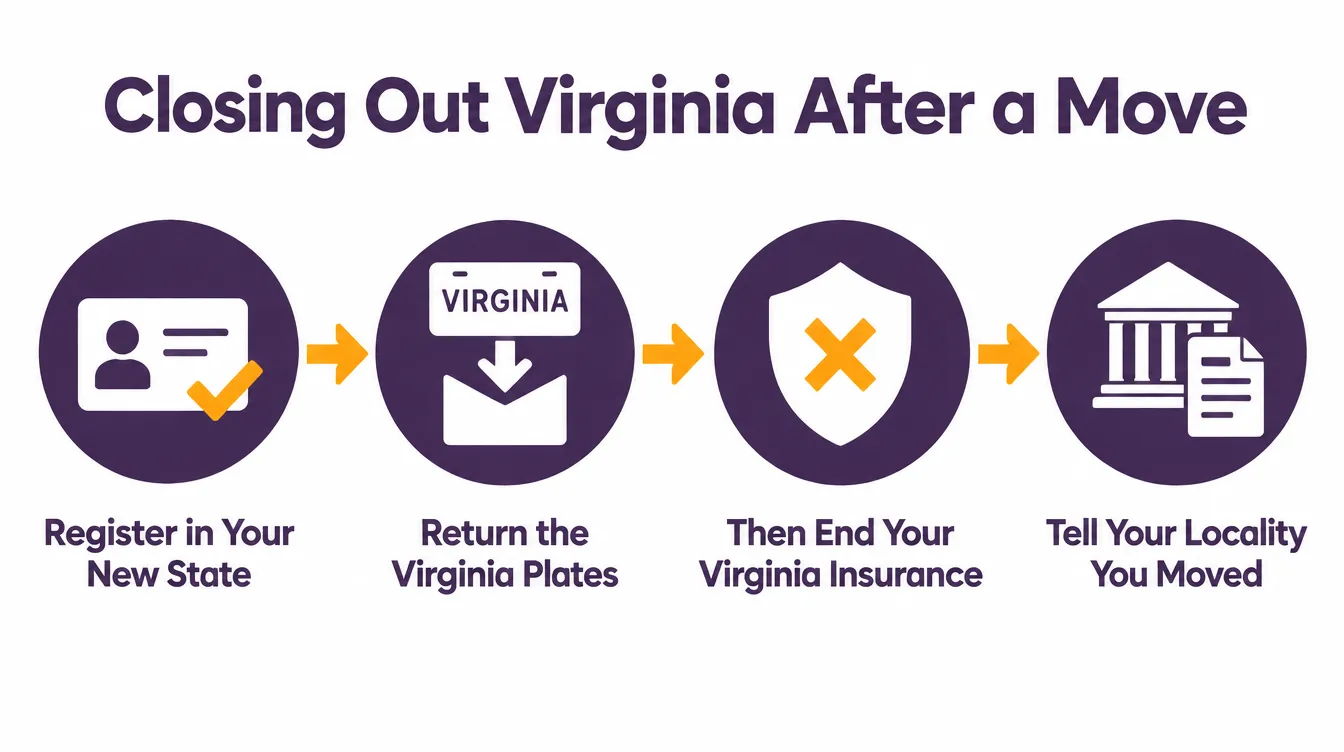
Canceling first is the step to avoid. DMV warns that if you cancel your insurance while the plates and registration are still active, your driving and vehicle registration privileges could be suspended.
If you need to cancel the Virginia liability coverage but want to keep the plates, DMV lets you deactivate the plates and registration online, and it says not to cancel the insurance until the deactivation is complete. Reactivating later, online or by phone at (804) 497-7100, requires no outstanding tax obligations on the vehicle, your insurance policy information and a $10 reactivation fee if the registration has not expired.
Mileage Choice participants are the exception. DMV says a vehicle leaving that program must go through plate surrender, not deactivation, so that you do not pay the remaining balance of the highway use fee.
How Do You Surrender Virginia License Plates?
DMV gives three ways to surrender plates permanently, and they differ on refunds:
- Online. Online Plate Surrender is the fastest route, but it makes you ineligible for a refund of the registration fees on that vehicle.
- In person. Take the plates to any DMV customer service center. No appointment is needed, standard lines apply, and you may be eligible for a refund.
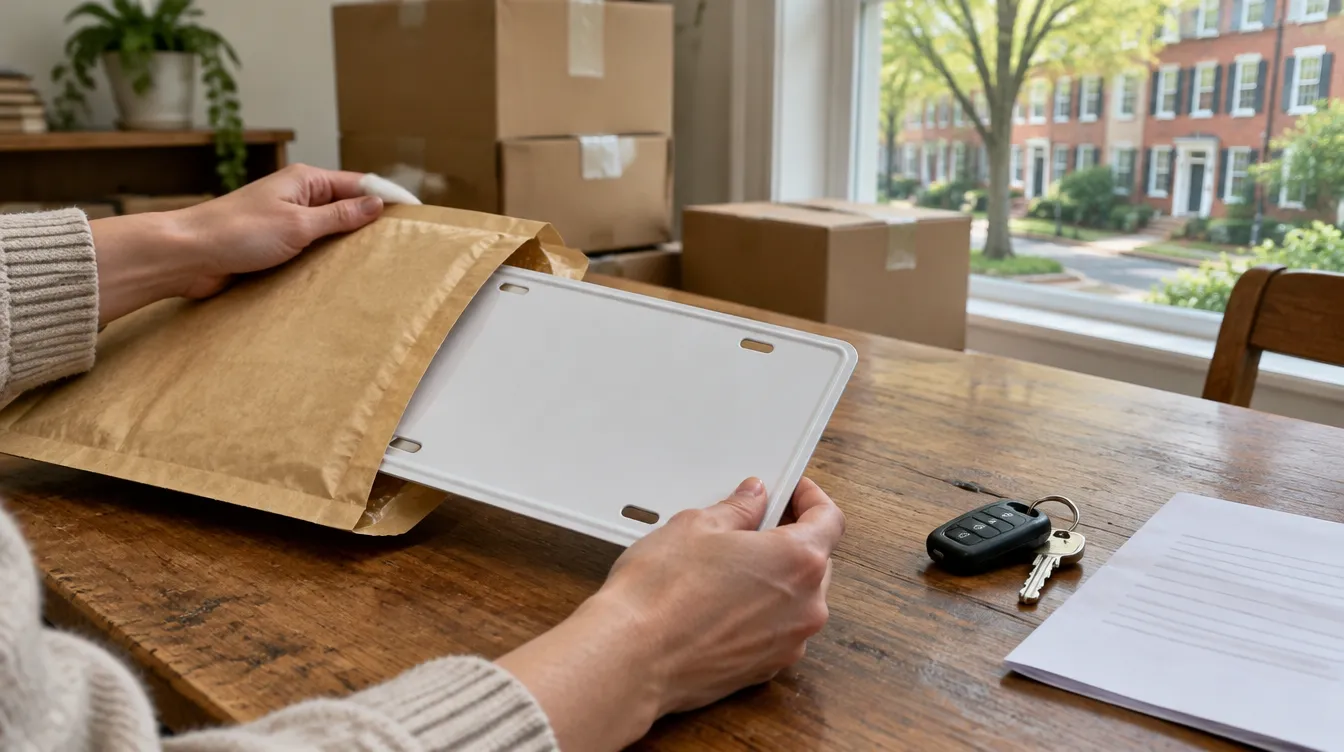
- By mail. Complete the Vehicle Registration Refund Application, form FMS 210, and mail it with the plates to Virginia Department of Motor Vehicles, 2300 West Broad St, Richmond, VA 23269.
For a move, mail is usually the practical choice, and it is the one DMV's moving guidance encourages once the car is registered in your new state. A tracked mail service gives you your own record of when the plates left.
Can You Get a Refund on Your Virginia Registration?
Sometimes. Form FMS 210 is for a refund of the DMV registration fee when the plates are returned with at least six full months left on the registration. DMV's plate page says you may qualify for a partial refund when the registration expires six months or more out and you surrender the plates to DMV, and that the refund does not apply if you used Online Plate Surrender. On the form, you certify that the vehicle has been sold, disposed of or will not be used on Virginia roads without proper registration.
The form explains how the amount works. Refunds are based on each six full months remaining in the registration period, so nothing is refunded with less than six full months left, and a $5.00 processing fee comes off the refund if none of the registration period has passed. DMV's plate page lists fees that are not refunded, including one-time plate reservation fees, Virginia Road Tax for heavy trucks and late fees.
Refunds generally take about 30 days. DMV mails the check to the address it has on file, so the form asks you to update your address with DMV first if it has recently changed. If the check has not arrived within 30 days of your application, the form says to write to DMV Refund Section, Financial Management Services, P.O. Box 25700, Richmond, Virginia 23260.
The DMV refund covers the state registration fee only. FMS 210 tells owners to keep a copy and contact their county, city or town about refunds of local license fees, which is a separate conversation with your locality.
What If You Sold or Traded the Car?
Selling or trading the car is one of the events DMV lists for surrendering the plates, but you have a second option if the plates are going on another vehicle:
- Surrender them. Use any of the three methods above. FMS 210 covers a sold car too, under the same six-month rule.
- Transfer them. To put the plates on another vehicle, complete a License Plate Application, form VSA 10, and take it to a customer service center to complete the transfer.
The insurance warning applies here as well. If you are not transferring the plates, surrender them before you end the coverage on the sold car, because canceling insurance while the plates and registration are active can lead to a suspension. Deactivation, covered above, is DMV's option when you need to cancel the liability coverage but want to keep the plates.
What Happens to Virginia Personal Property Tax When You Move?
Your old locality needs to hear from you. Virginia's car tax is a local personal property tax assessed by the county or city, and DMV's moving guidance tells departing residents to notify the Commissioner of the Revenue or Director of Finance in the locality they are leaving so it stops assessing personal property tax on their vehicles.
What you still owe for the year depends on the locality, and some do not prorate at all. Three official examples show how far they differ:
- Fairfax County. The county prorates its vehicle tax for the time the car was normally garaged there and asks you to notify it when a vehicle is moved out or sold, online, by email, by phone or in person, after which it adjusts your account. Its vehicle tax guidance also says a vehicle with an active Virginia registration is taxable in the locality where it is registered, even if it is garaged in another state.
- Roanoke County. For a move out of state, the county prorates using the dates on your documents. Its moving page asks for a legible copy of the new state's registration card for each vehicle, showing the date it was first issued there, or DMV documentation of the re-title date if no date is listed.
- Bristol. The city does not prorate. Its Commissioner of the Revenue's frequently asked questions say a city resident on January 1 owes personal property tax for the whole year, even after moving away.
Under Fairfax County's guidance, a car with an active Virginia registration stays taxable where it is registered, which is one more reason to finish the order above. Ask the locality you are leaving what proof it wants and whether it will prorate or refund what you have already paid.
What Else Should You Close Out in Virginia?
A few loose ends from DMV's guidance for people leaving the state:
- A leased car. Notify the leasing company about the move.
- Your driver license. When you surrender your Virginia license to get one in your new state, that state's licensing authority notifies Virginia DMV. You remain responsible for any outstanding suspensions on your Virginia record.
- Your address. DMV warns that changing your mailing or residence address to one outside Virginia may cancel your Virginia driver license or ID card.
- A disabled parking placard. Return it in person or by mail, before or immediately after the move.
How Does Shipping the Car Fit the Move?
Ship the car on its Virginia plates with the Virginia policy in force. It arrives registered and insured, ready for whatever your new state asks before it issues plates, and nothing changes on your Virginia record while it travels. The plates come off only after the new registration is done.
Take a move to Ohio as the example. Ohio gives new residents 30 days to move their license, title and registration, and the county Clerk of Courts titles the car before a deputy registrar registers it, as our guide to transferring an out-of-state title to Ohio explains. The Virginia plates stay on through those steps. Once the Ohio registration is done, mail the Virginia plates back, with FMS 210 if six full months or more remain, then end the Virginia policy and tell your old locality you moved. Our page on Virginia to Ohio car shipping covers the lane itself.
Rivalane coordinates door to door transport out of Virginia with licensed, insured carriers, and a carrier is typically assigned within one to three working days after you book. On the Virginia to Ohio lane, most cars arrive two to three days after loading. These are estimates, not guarantees, so leave room before your new state's deadline. Keep the title, registration and insurance papers with you rather than in the car, and note any damage on the bill of lading before you sign at delivery. You can also read about car shipping in Virginia or price your move with the car shipping calculator.
Frequently Asked Questions
Do I have to return my Virginia license plates when I move out of state?
When can I cancel my Virginia car insurance after moving?
Can I get a refund when I return Virginia license plates?
Where do I mail Virginia license plates?
Do I still owe Virginia personal property tax after moving out of state?