Virginia charges a 4.15 percent motor vehicle sales and use tax when a car is titled in the state after a sale or change of ownership, on the gross sales price or $75, whichever is greater. A dealer works out the tax for you. On a private sale, the buyer pays it to the Department of Motor Vehicles (DMV) when titling the car.
This guide covers what counts in the taxable price, private sales, the transfers that are exempt and how the tax differs from Virginia's annual car tax. It then takes the cases that matter for a buyer from another state, with an Ohio buyer worked through. The rules come from Virginia DMV, the Code of Virginia, rulings of the Virginia Tax Commissioner and the Ohio Department of Taxation.
What Is the Sales Tax on a Car in Virginia?
4.15 percent of the gross sales price, with a $75 minimum. Virginia DMV's page on the Motor Vehicle Sales and Use Tax says the tax is collected at the time of titling whenever a vehicle is sold or its ownership changes, and the amount due is based on the gross sales price or $75, whichever is greater. Section 58.1-2402 of the Code of Virginia sets the same rate and minimum.
The tax follows the Virginia title. Under section 58.1-2404, the purchaser pays it, DMV collects it when the owner applies for a Virginia certificate of title, and none is levied on a vehicle for which Virginia requires no title. That last point is why a buyer who titles the car in another state is treated differently, as the sections below explain.
What Counts in the Taxable Price?
The gross sales price, which DMV defines as the cost of the vehicle after any rebates or incentives are applied. It includes the dealer processing fee, which section 58.1-2402 also makes taxable, but it is not reduced by credit for a trade-in, unpaid liens or other unpaid credits.
A trade-in does not lower the tax. DMV's example is a $40,000 car bought from a dealer with a $5,000 trade-in: you pay $35,000, but the gross sales price is still $40,000. Section 58.1-2405 allows no credit for a trade-in, a prior rental or a similar transaction.
How Are Private Car Sales Taxed in Virginia?
At the same 4.15 percent, paid by the buyer at DMV when the car is titled. DMV treats the sales price the seller enters on the title as a bill of sale, and it can ask for more depending on the car's age:
- More than 5 years old. If the seller left the price off the title or entered an incorrect one, you can submit a Vehicle Price Certification (SUT 1) or a handwritten bill of sale signed by both seller and buyer, showing the purchase price, year, make, model, vehicle identification number and date of sale.
- Less than 5 years old by model year. You submit an Affidavit for Procurement of Title (SUT-1A) at titling when the sales price is not within $1,500 of the current trade-in value in the NADA Official Used Car Guide.
Write down the real price. Section 58.1-2402 makes it a Class 3 misdemeanor to falsely state a vehicle's selling price on a bill of sale, a title assignment, a title application or another document submitted for titling, with intent to evade the tax.
If you are the Virginia seller and the buyer lives in another state, our guide to selling a car to an out-of-state buyer covers payment, the title and the carrier handoff.
Which Vehicle Transfers Are Exempt?
Section 58.1-2403 lists the exemptions, and DMV says some require proof and a completed Purchaser's Statement of Tax Exemption (SUT 3). The ones car owners meet most often:
- Family gifts. A gift to the transferor's spouse, son, daughter or parent. DMV's exempt transaction guidelines limit this to biological and adoptive relationships, so step-parents and step-children do not qualify, and for a son, daughter or parent no lien can be assumed and no payment made. Siblings and grandparents are not covered.
- Inheritance. A transfer to the spouse or an heir of a deceased owner, or under the owner's will.
- Revocable trusts. Transfers into or out of a revocable trust with the same owners and beneficiaries, and from the trust to its beneficiaries after the grantor's death.
- Lease buyouts. A lessee buying the leased vehicle at the end of the lease, when the tax was already paid.
- Lien-only titles. A Virginia title issued to a nonresident solely to record a lien on a vehicle registered in another state.
- Disabled veterans. DMV says certain veterans of the U.S. Armed Forces or the Virginia National Guard may be eligible on a vehicle owned and used primarily by or for them, when the U.S. Department of Veterans Affairs has determined a 100 percent service-connected, permanent and total disability.
Is Virginia's Car Tax the Same as Sales Tax?
No. What Virginians call the car tax is the annual local personal property tax, assessed by the county or city where the car is kept. The 4.15 percent motor vehicle sales and use tax is a state tax paid once, at titling, when a car is sold or changes hands. Buying a car in Virginia means paying the sales and use tax when you title it, then personal property tax to your locality for as long as the car is taxable there.
Moving away ends the local tax only once you tell the locality, and what you still owe for the year depends on where you lived. Our guide to returning Virginia license plates covers notifying the Commissioner of the Revenue or Director of Finance after a move, along with the plates and the FMS 210 refund.
Do Out-of-State Buyers Pay Virginia Sales Tax?
Not the motor vehicle sales and use tax, when the car is titled and registered in another state. In Ruling 18-152, the Tax Commissioner applied section 58.1-2404 and said vehicles sold to customers that are not titled and registered in Virginia are not subject to that tax. The same ruling calls the motor vehicle sales and use tax and the retail sales and use tax separate and distinct taxes, and the second one is the tax an out-of-state buyer can still meet.
Ruling 12-123 explains how. The retail sales tax exemption for motor vehicles in section 58.1-609.1 covers only a vehicle that must be titled in Virginia and on which the Virginia motor vehicle sales and use tax has been paid, and the Department's regulation 23VAC10-210-990 says any motor vehicle not subject to the motor vehicle sales and use tax is subject to the retail sales and use tax when sold. So a car sold in Virginia to a buyer who titles it elsewhere falls under the retail sales and use tax unless another exemption applies. Virginia Tax lists general retail rates from 5.3 percent in most of the state to 7 percent in the Historic Triangle.
Two exemptions in section 58.1-609.10 can apply:
- An occasional sale. Subdivision 2 exempts occasional sales, which section 58.1-602 defines as sales of property not held or used by the seller in an activity that requires a certificate of registration. An individual selling a personal car generally fits that definition.
- Delivery outside Virginia. Subdivision 4 exempts delivery of property outside Virginia for use outside Virginia. The interstate commerce regulation, 23VAC10-210-780, treats a sale as interstate only when title or possession passes to the purchaser outside Virginia and no use is made of the property in Virginia. Its examples are all arranged by the seller: delivery in the seller's vehicle, by an independent trucker or contract carrier the seller hires, or by the seller handing the property to a common carrier.
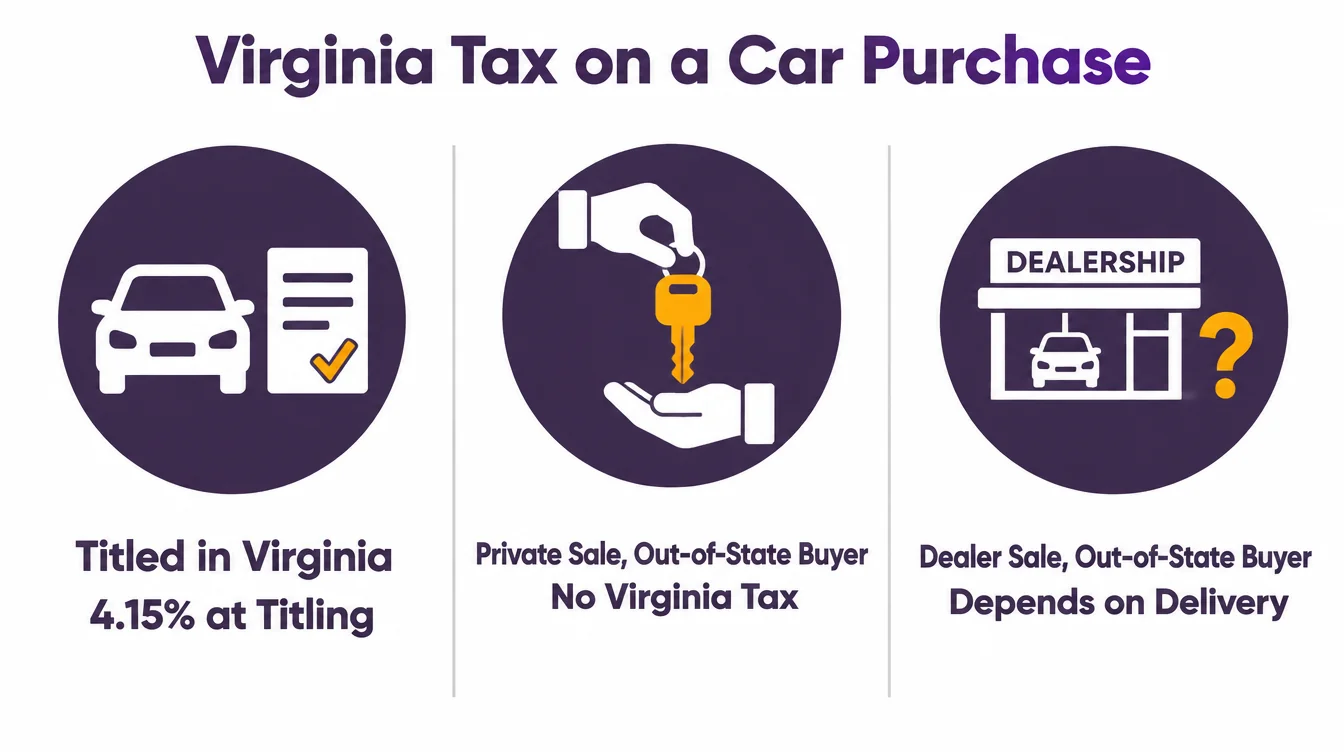
The regulation does not address a carrier hired by the buyer. In Ruling 12-123, an auditor treated a customer as taking possession in Virginia because the transport company billed the customer for delivery, and the Commissioner accepted the sale as interstate after the seller showed it had hired a freight broker to arrange the shipment. Rulings apply only to their own facts, so ask the dealer how it will treat the sale before you arrange transport, and check with Virginia Tax if the answer changes your budget.
What Does an Ohio Buyer Pay?
Ohio's tax every time, and Virginia's depending on how the car leaves the state. The Ohio Department of Taxation's page on sales tax for motor vehicles says titled motor vehicles are taxed at the rate in effect in the purchaser's county of residence, paid to the county clerk of courts when the car is titled. Ohio's state rate is 5.75 percent, and counties and transit authorities can add up to 3 percent, for a combined rate of no more than 8.75 percent. The Department's Finder gives the rate for any address.
Ohio also credits tax paid elsewhere. The same page says a credit is generally allowed for sales or use tax legally paid to another state, with proper proof given to the clerk of courts, and if that tax equals or exceeds the Ohio tax due, nothing more is owed. Here is how the Virginia side plays out:
- Private seller in Virginia. The car is never titled in Virginia, so no motor vehicle sales and use tax applies, and an individual selling a personal car makes an occasional sale under the retail tax. Expect to pay Ohio's tax in full at the title office.
- Virginia dealer, delivery taken in Virginia. If you drive the car off the lot or take delivery there, the retail sales and use tax can apply under Ruling 12-123. Ohio generally credits Virginia tax legally paid when you bring proof.
- Virginia dealer that delivers to Ohio. When the dealer delivers the car itself or through a carrier it hires, the delivery-outside-Virginia exemption can apply, and Ohio collects its tax in full.
- A carrier you book, collecting at the dealer. The regulation does not settle this case. Ask the dealer how it will treat the sale, check with Virginia Tax, and keep proof of any Virginia tax you pay for the Ohio credit.
The Ohio title office needs more than the tax. For a car titled in another state, the Ohio BMV asks for the out-of-state title, identification, the title fee, the out-of-state VIN inspection and, for a car bought from an out-of-state dealer, a bill of sale. Our guide to the Ohio out-of-state VIN inspection covers where to get one. If you are moving to Ohio with a car you already own, Ohio's six-month rule applies instead, and our guide to transferring an out-of-state title to Ohio covers it.
Do New Virginia Residents Pay Sales Tax on a Car They Bring?
Usually not. DMV calls it the most common exemption: if you are titling a vehicle in Virginia for the first time and hold a valid title or registration in your name from another state or a branch of the U.S. Armed Forces, you do not pay the sales and use tax. If you bought the vehicle within the last 12 months, DMV asks for proof that the tax was paid elsewhere before the exemption applies, and its exempt transaction guidelines charge the tax on the NADA trade-in value when that proof is missing.
How Does Shipping Fit an Out-of-State Purchase?
Settle the tax question before you book the truck. Whether the dealer delivers the car, you take it on the lot or a carrier you book collects it can change which Virginia tax applies, so agree the delivery arrangement with the seller in writing and keep the buyer's order, the bill of sale and any receipt for Virginia tax with your Ohio title paperwork.
Rivalane coordinates door to door transport out of Virginia with licensed, insured carriers. Booking transport, with Rivalane or anyone else, does not by itself change how Virginia taxes the sale; that depends on the sale and the seller's paperwork. A carrier is typically assigned within one to three working days after you book, and on the Virginia to Ohio lane most cars arrive two to three days after loading. These are estimates, not guarantees, so leave room before your title office visit, and note any damage on the bill of lading before you sign at delivery.
Our page on Virginia to Ohio car shipping covers the lane, our page on car shipping in Virginia covers pickups across the state, and the car shipping calculator prices the move.
Frequently Asked Questions
What is the sales tax on a car in Virginia?
Does a trade-in reduce Virginia car sales tax?
Is a car gifted to a family member taxed in Virginia?
Do out-of-state buyers pay Virginia sales tax on a car?
What does an Ohio resident pay on a car bought in Virginia?