Rivalane arranges Virginia car shipping and auto transport with licensed, insured carriers, covering Northern Virginia and the I-95 corridor through Richmond and Hampton Roads, the Shenandoah Valley along I-81, and the southwest. Whether the car is moving across the state, heading out to Ohio or Illinois, or coming in from another state entirely, we match it with a carrier already running that lane and keep you updated from pickup through delivery.





5-Star Average Rating
Fully Insured
Top Rated Service
Nationwide Coverage
Licensed Carriers
Rivalane works as a broker, and on a Virginia route that is the point rather than a drawback. Rather than running one fleet with a fixed set of lanes, we place your car with whichever licensed, insured carrier is already covering yours, whether that is the I-95 run through Northern Virginia and Richmond, a Hampton Roads pickup, or a long haul out to Ohio or Illinois. You get one point of contact who tells you what is actually happening with the shipment, including when the route or the season makes timing harder to pin down.

Cost and timing depend on your route, trailer type, vehicle size, and the time of year. The ranges below reflect typical market pricing and transit windows by distance, not a commitment on either. Your actual quote is based on real carrier availability on your specific route at the time of booking.
Where the car sits in Virginia moves the price more than anything except distance. An address within reach of I-95 or I-64 falls on a lane carriers already run, so it prices better than one in the Shenandoah Valley or southwest Virginia, where a truck has to leave its circuit to collect and sometimes cannot reach the door at all. Northern Virginia is the clearest case. It sits inside the Washington and Baltimore carrier market, so an Arlington or Alexandria pickup often prices closer to a short mid-Atlantic hop than the mileage alone would suggest.
Trailer type comes next, since enclosed transport uses more specialized space and there is less of it available. Season then moves the number rather than the calendar. When southbound demand peaks in the autumn, or winter weather thins out the carriers willing to work rural pickups, the same route prices higher than it would in a quiet month.
Vehicle size, whether the car runs, and how much lead time you give us all factor in. Booking one to two weeks out usually opens up more carrier options than a last-minute request.
Get your Virginia quoteThis outline shows how your shipment moves from the first details to the final handoff.





Tell us where the vehicle starts and where it needs to go. We review the route and the distance, quote the shipment, and match it with a licensed, insured carrier already covering that lane.

Once you approve the quote, we confirm the pickup date and time with you. Choose the window that suits you and we build the route around it, within what the carrier's existing run allows.

Remove personal belongings and keep a set of keys available. When the driver arrives, they walk around the car with you, record its condition in the inspection report, and confirm the delivery details before it goes on the trailer.

The driver secures your car on the trailer, open or enclosed depending on what you booked, and it joins the run toward your delivery point. You get updates as the shipment moves, so you know where it is without having to chase anyone.

Once the car is unloaded, the driver goes through the inspection notes with you so you can confirm the condition matches what was recorded at pickup. Anything noted along the way is documented before the shipment is closed out.

Here is what Rivalane arranges for customers shipping cars into and out of Virginia, from statewide corridor coverage to enclosed trailers and the long-haul lanes running west.
Coverage reaches every part of Virginia, from the Northern Virginia suburbs and the Richmond metro to Hampton Roads, the Shenandoah Valley and the southwest. Addresses off the main corridors take more planning, and we tell you that upfront rather than after you book.
Door to door works on most routes, as long as a full-size truck can safely reach both addresses. Where a street is too narrow or restricted, we agree a nearby meeting point with the driver in advance.
Enclosed carriers add protection for classic, luxury, exotic and restored vehicles.
The car travels inside a covered trailer, out of the weather and away from road debris, which suits vehicles where condition matters more than cost.
Cars leaving Virginia for Illinois travel west on the interstate network. Virginia to Ohio car shipping has its own page with distances by city pair, price factors and what Ohio asks when the car arrives. Tell us the pickup and delivery cities and we match the move to a carrier already covering that route, whether the car is leaving Virginia or heading into it. Leaving Virginia with the car? Our guide to returning Virginia license plates covers the refund form and the order to do things in.
Open transport carries most of what moves in and out of Virginia. The car rides on an open trailer alongside others, which is usually the more affordable option and has the widest carrier availability on the state's main corridors.
A car that will not start, steer or brake needs a carrier with a winch, and not every truck running the route carries one. Tell us the condition when you book, including whether it rolls and steers, so the right equipment is assigned instead of the driver turning it away at pickup.
Demand here comes from a few clear directions, and most of it moves along the same corridors. These are the four groups that ship vehicles into and out of Virginia most often.

I-95 through Virginia is the main seasonal corridor on the East Coast, and a steady flow of vehicles heads south each autumn to Florida and the Carolinas. Southbound demand builds from October into December, and the return north runs from April into May. Booking ahead of either peak gives you more choice of pickup window.
Snowbird car transport →.svg)
A large share of the cars we move into Virginia were bought in another state, and the biggest inbound lanes start in the Northeast, in Ohio and Illinois to the west, and in Florida and the Carolinas to the south. If you have bought a car out of state, we arrange pickup from the seller or the dealership and delivery to your Virginia address, so nobody has to fly out and drive it back. Titling it here? Our guide to Virginia car sales tax covers the 4.15 percent rate, what counts in the price and the exemptions.
Vehicle transport services →
Virginia holds one of the largest concentrations of military installations in the country. Naval Station Norfolk and Naval Air Station Oceana in Hampton Roads, Marine Corps Base Quantico and the Pentagon in the north, Joint Base Langley-Eustis, and Fort Gregg-Adams near Petersburg all generate PCS and training moves. Orders often arrive with short notice and fixed report dates, so the pickup window matters more than usual. Share your dates early so the route can be planned around them.
Military car shipping →
Virginia Tech in Blacksburg, the University of Virginia in Charlottesville, James Madison in Harrisonburg, VCU in Richmond and William and Mary in Williamsburg all draw heavily from out of state. Their calendars create two clear surges, arrivals in late August and departures in May. Many students ship a car home for the summer rather than pay to store it, and booking about two weeks ahead of either window usually means better carrier availability.
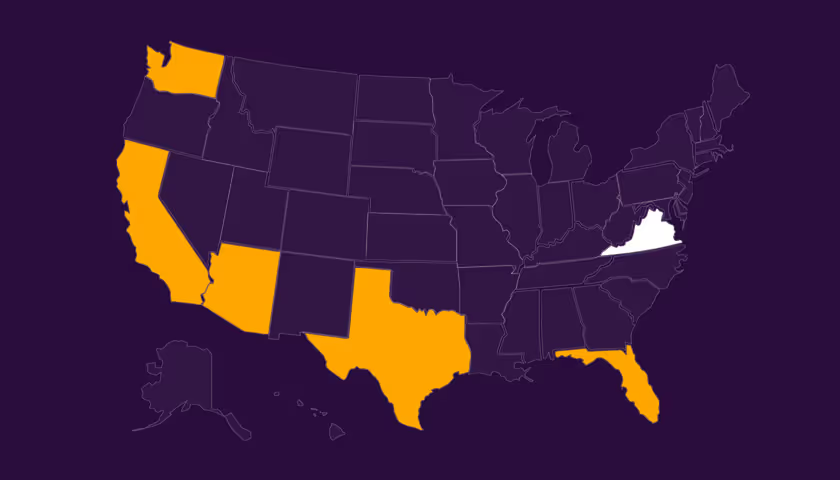
Estimate your shipment →Looking to ship your car to another state or across the country? Rivalane ships to all 50 states. Select a state to see how we handle car shipping to and from it.
Virginia's population sits in three clusters and each one reaches differently. Hampton Roads covers Virginia Beach, Norfolk, Chesapeake, Newport News and Portsmouth, where deliveries route around the bridge and tunnel crossings. In the Northern Virginia belt of Arlington, Alexandria and Fairfax the constraint is rarely distance and usually the street itself, since townhouse rows and permit parking can leave a full-size transporter nowhere to stop. Richmond sits where I-95 meets I-64, so it is served from both directions. Further out, Charlottesville, Harrisonburg, Blacksburg and Roanoke are reached off I-64 and I-81 and usually need a little more notice.