


The sixteen Alaska to Alabama pairs run 2,588 to 3,276 road miles. For a sedan on an open trailer, the two road legs come to $1,150 to $1,700 and the crossing is quoted separately. Road transit after loading typically takes 5 to 8 days. The Alaska start moves mileage up to 359 miles, the Alabama end up to 330.
Which Roads Do Cars Take Between Alaska and Alabama?
A car moving from Alaska to Alabama travels in three parts: a road leg from your Alaska town to the port in Anchorage, an ocean crossing to Washington, and a road leg from Tacoma to your Alabama town. Sixteen measured town pairs sit behind this Alaska to Alabama car shipping page. Pickups are Anchorage, Wasilla, Soldotna and Fairbanks; deliveries are Madison, Gadsden, Phenix City and Daphne. Only the two road legs are measured, and the crossing is not counted in road miles. Anchorage to Madison is the shortest pair at 2,588 miles and Fairbanks to Daphne the longest at 3,276, with twelve pairs under 3,000 miles and four past it. The core pair, Wasilla to Madison, totals 2,631: 8 on AK 3 and 34 on AK 1 in Alaska, then from Tacoma 1,386 on I-90, 355 on I-29, 208 on I-70, 179 on I-24, 114 on I-64, 111 on I-15, 98 on I-65 and 47 on I-57, with the remainder on connectors. Left alone, the routing software sent Tacoma loads across Montana on US 212, so every Alabama end was measured with ten stops that hold the run to interstates: Spokane, Missoula, Billings, Sheridan, Gillette, Rapid City, Sioux Falls, Kansas City, St. Louis and Nashville. Fairbanks starts add 320 miles of AK 3 ahead of the port, Gadsden ends finish on I-59 after 294 miles of I-24, Phenix City ends add 135 on US 280, and Daphne ends take 415 on I-65. These figures come from routing software, so a carrier can choose other roads for your load.

Does the Alaska Start or the Alabama End Move the Mileage More?
Your quote depends on your vehicle, the exact pickup and delivery addresses, the season and the trailer type, so run the calculator for a figure on your dates.
Mileage shifts more with the Alaska start than with the Alabama end. Hold one Alabama end and the four Alaska starts land 359 miles apart; hold one Alaska start and the four Alabama ends land 330 apart.
From Wasilla the Alabama ends measure 2,631 miles to Madison, 2,715 to Gadsden, 2,848 to Phenix City and 2,961 to Daphne. Toward Madison the starts measure 2,588 from Anchorage, 2,631 from Wasilla, 2,735 from Soldotna and 2,947 from Fairbanks.
Down the Alabama side from Wasilla, each end sits 84, then 133, then 113 miles beyond the one before. On the Alaska side, Wasilla sits 43 miles beyond Anchorage toward Madison, Soldotna 104 beyond Wasilla and Fairbanks 212 beyond Soldotna.
A quote needs both town names, a pickup window and an answer to which legs it covers, since the crossing is booked with the shipping line or arranged through Rivalane.

For an open trailer sedan the two road legs together run $1,150 to $1,700. The ocean freight is not in that range: it is paid to the shipping line or arranged through Rivalane, so ask which legs any quote covers. Shorter pairs such as Anchorage to Madison sit nearer the bottom and the long Fairbanks to Daphne pair nearer the top.
- Alaska start. For one Alabama end, the four Alaska starts differ by 359 miles.
- Alabama end. For one Alaska start, the four Alabama ends differ by 330 miles.
A quote well below this band is worth questioning: ask for the carrier name and for the legs it covers.

What Factors Actually
Influence Pricing on This Route?
Five things move the price on any lane: the vehicle's size, whether it runs, how easy each end is to reach, the season and the trailer type. Booking early protects your timeline, keeps pricing steady and reduces the risk of last-minute carrier changes.


Type
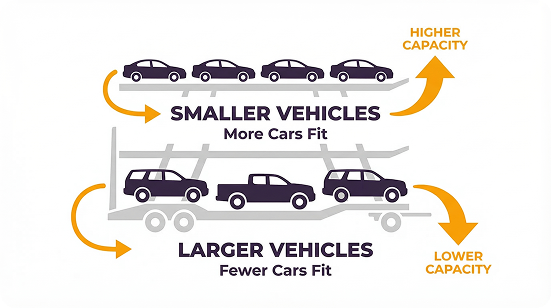
Size decides how much deck space your vehicle takes and how many other cars fit alongside it. A standard sedan is the cheapest thing to move because it slots almost anywhere on the trailer. SUVs, pickups and vans take more room and usually cost more on the same lane.


Hire a Carrier or Drive From Alaska to Alabama Yourself?
Using a Carrier
Anchorage to Madison is the short pair at 2,588 road miles over the two legs, while Fairbanks to Daphne is the long pair at 3,276. A carrier takes the road legs and the car crosses the water on a vessel.
A carrier suits a move that cannot wait for a long drive, a second car, or a vehicle that has to arrive in Alabama before you do.
Driving Yourself
Behind the wheel, Wasilla to Madison measures about 4,135 miles and 82.3 hours by routing software, sending you through Yukon on YK 1 and then across Canada and the northern states, before fuel, border waits and any stop.
Set that against the carrier route, where the two road legs total 2,631 miles and the crossing is handled by the shipping line.
How Long Does Alaska to Alabama Car Shipping Take?
After loading, the Washington to Alabama road leg typically takes 5 to 8 days. The crossing comes on top and follows the vessel timetable, so your car cannot be collected in Washington until the ship has landed.
Between booking and pickup, expect a wait of 1 to 3 working days while a carrier is assigned, and let the sailing, not the calendar, set the pickup date. The cross country timing guide is the place to go when a schedule starts to slip.
Weather on the northern interstates, a missed port cut off or a late handoff can all delay arrival; Rivalane promises no delivery date.
When Should You Book Alaska to Alabama Auto Transport?
Settle the sailing first, then the road legs around it. A looser pickup window opens the job to more carriers, among them trucks already running the Alaska road system or heading east out of Tacoma.
Your four pickup towns are far apart: Anchorage at the port, Wasilla in the Mat-Su valley, Soldotna on the Kenai Peninsula and Fairbanks 360 miles up AK 3 and AK 1. Fairbanks adds 359 miles over Anchorage toward Madison, so tell us exactly which pickup town applies.
The car prep guide is worth reading. Electric and plug-in hybrid cars are refused by the main lines at present, so ask the line to clear your car before any truck is booked.
Open or Enclosed Trailer for an Alaska to Alabama Car?
Most cars on the road legs ride the open trailer, a two level rack with no walls or roof. Over 2,588 to 3,276 miles an open load meets frost, plains wind and road grit; on the crossing the shipping line decides how the car is stowed.
An enclosed trailer covers the car on both road legs. The price is higher since each enclosed load holds fewer vehicles and fills sooner, so book it early.
Enclosed carriage suits a classic, a restored car or fresh paint; a daily driver usually does fine open.
Enclosed Car Transport
Enclosed demand rises for high-value, specialty and seasonal vehicles, and enclosed trailers protect against road debris and weather, which matters most on longer hauls. Enclosed rigs are a small fraction of the trailers working any given lane, and that scarcity is what drives both the higher price and the longer booking lead time.
Open Car Transport
Most vehicles move on open trailers, and for most routes that is the more cost-effective way to ship a car.
Open transport works well for standard vehicles and keeps costs predictable. It also offers the widest carrier availability.
Receiving Your Car in Alabama
Before the road leg leaves Tacoma, give dispatch the complete Alabama address, plus any unit number or entry code. Stay reachable on delivery day: the driver phones ahead to choose a place to meet, and if the final street cannot take a full length rig the stop moves to a broad junction or a close parking lot.
When the car is unloaded, check each panel by daylight, using your loading photos as the baseline. Sign only after any new scratch, dent or scuff is written on the delivery report, then take a photo of that page.
Where Does the Handoff Happen in Alaska and in Alabama?
A loaded hauler cannot always enter a tight residential street. Near Wasilla a gravel lane, in Anchorage a busy block, in Soldotna a narrow road or outside Fairbanks a long private drive may mean meeting in a parking lot or beside a main road instead. More pickup areas are listed on the Alaska car shipping page.
At the other end, a gated street in Madison, a hillside road in Gadsden, a subdivision gate in Phenix City or a narrow lane in Daphne may end at a lot close by, and you can also collect at the Washington terminal yourself. More drop areas are listed on the Alabama car shipping page.
Before you sign, compare the car with the condition report and with your pickup photos, and store that report alongside the bill of lading.

Which Details Should an Alaska to Alabama Quote Request Include?
Rivalane is a broker, so it has no drivers on payroll and owns no trucks. Each road leg is hauled by a licensed carrier, and a shipping line takes the car over the water. Alaska starts add up to 359 miles and Alabama ends up to 330, so tell us the Alaska town and the Alabama town up front.
Frequently Asked Questions