


Shipping a running sedan from Miami to Seattle on an open trailer costs about $1,300 to $1,850. Across our 64 routed town pairs the road distance runs roughly 2,541 to 3,387 miles, mostly on I-75 and I-90, and the typical trip after pickup lasts 7 to 9 days. Reserve a spot two to three weeks before the pickup you want.
How Does a Car Get From Florida to Washington State?
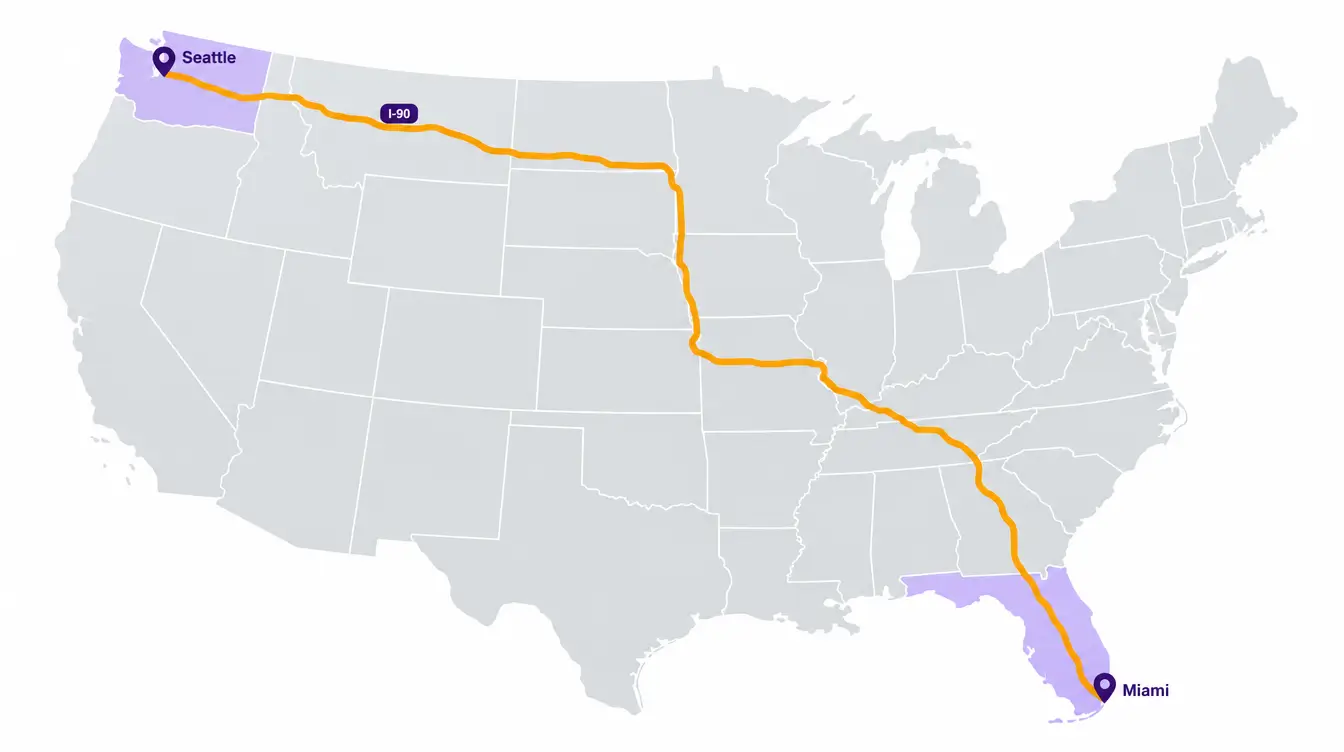
Florida to Washington car shipping covers roughly 2,541 to 3,387 road miles across the 64 Florida and Washington State town pairs we routed, and all but the Tallahassee pickups leave the peninsula on I-75. That shared northbound line passes Lake City, Valdosta, Macon and Atlanta, picks up I-24 for Chattanooga and Nashville, crosses southern Illinois to St Louis and reaches Kansas City. From there the load splits by destination. Cars bound for Seattle, Tacoma, Everett, Bellingham or Spokane turn north on I-29 past Omaha and Sioux Falls, then follow I-90 by Rapid City, Billings and Missoula, and the four Puget Sound deliveries cross the Cascades by Ellensburg. Olympia, Vancouver and Yakima cars head across Wyoming on I-80 by Cheyenne and finish on I-84 through Boise and Pendleton. Tallahassee pickups take their own line west by Montgomery, Birmingham and Memphis, and Jacksonville cars join I-75 at Lake City rather than climbing the length of the state.
How Much Does Florida to Washington Car Shipping Cost?
Your quote depends on your vehicle, the exact pickup and delivery addresses, the season and the trailer type, so run the calculator for a figure on your dates.
Where in Florida the car is collected shifts the mileage more than anything else. To Seattle, Tallahassee and Jacksonville each run less than 3,000 road miles, Orlando and Tampa sit near 3,090, and the Atlantic side from West Palm Beach south to Miami passes 3,230. For a Florida town not named here, see the Florida car shipping overview.
The Washington State destination counts as well. Measured from Miami, Spokane comes in close to 280 miles short of Seattle, Yakima a little over 120 short, and Bellingham, up near the border, just over 80 beyond it. More delivery towns sit on our Washington State car shipping page.
The vehicle and the season explain most of what remains. Bigger SUVs and pickups use up extra trailer space, and between November and spring the northern part of the run can lose time. For how long-haul quotes are built, read what it costs to ship a car across the country, or get a starting number from two ZIP codes in the car shipping calculator.
For a running sedan loaded in Miami and dropped in Seattle on an open trailer, the quote typically falls between $1,300 and $1,850. Exactly where it lands depends on the two towns, and the shortest and longest pairs we routed differ by about 846 miles.
A three-row SUV, minivan or full-size pickup takes extra deck space and usually costs about $150 to $250 more. An enclosed trailer tends to cost 40 to 60 percent over the open price.
Three things shape a quote on this lane:
- Where in Florida the car starts. Tallahassee and Jacksonville sit closest to Washington State, and the South Florida coast from West Palm Beach down to Miami sits farthest.
- Which Washington State city receives it. Spokane is the nearest major delivery point, and Bellingham near the Canadian border is the farthest.
- The month. Snow in South Dakota and Montana and chain rules for heavy trucks over the Cascades can slow the second half of the trip in winter.
A quote well under the others deserves a call to learn what is missing from it.

What Factors Actually
Influence Pricing on This Route?
Five things move the price on any lane: the vehicle's size, whether it runs, how easy each end is to reach, the season and the trailer type. Booking early protects your timeline, keeps pricing steady and reduces the risk of last-minute carrier changes.


Type
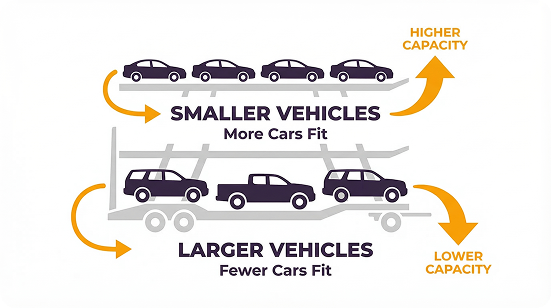
Size decides how much deck space your vehicle takes and how many other cars fit alongside it. A standard sedan is the cheapest thing to move because it slots almost anywhere on the trailer. SUVs, pickups and vans take more room and usually cost more on the same lane.


Should You Ship or Drive From Florida to Washington State?
Reasons to Ship
Shipping suits a household moving from Florida to the Puget Sound area or Spokane, a Washington State buyer who tracked down the right car in Florida, and anyone who prefers a flight to most of a week on interstates.
It also spares the car around 3,300 miles of wear, along with the fuel, tires, meals and motel bills a long drive runs up.
Reasons to Drive
When two people can split the driving and no arrival date is fixed, the drive can cost less than shipping, and we will tell you if that is the case. Our routing puts Miami to Seattle near 59 hours at the wheel, typically six or seven long days once stops are counted.
A solo driver on a deadline has a tougher case: even the shortest pair we routed, Tallahassee to Spokane, is about 2,541 miles.
How Long Does Car Shipping From Florida to Washington Take?
Most cars reach Washington State within 7 to 9 days of pickup. The shortest pair, Tallahassee to Spokane at about 2,541 miles, tends to come in at the early end, and the longest, Miami to Bellingham at about 3,387, generally needs most of the window.
Assigning a carrier comes first, usually one to three working days after you order. A flexible pickup window lets dispatch choose among more trucks already bound for the Northwest.
On the core pair, Miami to Seattle, the halfway point falls near Omaha. Winter weather in South Dakota, Montana and the Cascades can add a day or two to the second half.
When Should You Book a Florida to Washington Car Shipment?
Allow two to three weeks between booking and pickup on this lane. That window lets Rivalane line up a licensed carrier with a Northwest trip already scheduled and an open slot on its trailer, rather than accepting the first truck that replies.
Allow extra slack from November through March. Washington State makes heavy trucks carry chains on I-90 over the Cascades from November 1 to April 1, and Plains storms can delay the westbound run.
Heading the other way later? Our Washington to Florida car shipping page covers the same lane in reverse.
Is Open or Enclosed Transport Better From Florida to Washington?
Cars on this lane mostly ship by open transport, loaded on standard two-level car haulers. Over about 3,300 miles they meet Florida sun and summer storms, winter road salt across the Plains and Northwest rain at the far end, roughly what a car faces on a long road trip.
Enclosed transport carries the car in a trailer with solid walls the whole way, out of the weather, salt and road grit. Fewer cars fit in each trailer, so it costs more and late bookings can take longer to place.
Owners of classics, exotics and newly painted cars usually choose enclosed, and everyday vehicles mostly go open.
Enclosed Car Transport
Enclosed demand rises for high-value, specialty and seasonal vehicles, and enclosed trailers protect against road debris and weather, which matters most on longer hauls. Enclosed rigs are a small fraction of the trailers working any given lane, and that scarcity is what drives both the higher price and the longer booking lead time.
Open Car Transport
Most vehicles move on open trailers, and for most routes that is the more cost-effective way to ship a car.
Open transport works well for standard vehicles and keeps costs predictable. It also offers the widest carrier availability.
Which Agencies Handle Your Car After It Reaches Washington State?
Three offices take part once a Florida car arrives in Washington State, and each one handles a different piece.
Washington State Department of Licensing (DOL). The move starts a 30 day clock covering a Washington driver license first and then the car registration, and the license and vehicle sides work out of different offices. For the vehicle visit, bring the current title and note the mileage on the odometer first. When a bank holds the title, phone a vehicle licensing office to get a fax number and have the bank send the title copy to it. An in-person visit ends with plates in hand, while a mail application can take up to 3 weeks, and some offices do not take debit or credit cards.
Washington State Department of Revenue. Use tax is due at licensing, and the rate depends on where you live. Owners are exempt when a personal vehicle was acquired out of state and used there for over 90 days ahead of the move and gets licensed within 30 days of arrival, while a car purchased within those 90 days does not qualify.
FLHSMV in Florida. Florida tells former residents who still carry Florida tags to register the car in their new state, and any car that keeps a Florida registration needs Florida insurance, apart from cars of active-duty members stationed in another state. Hand in the plate and decal before the Florida policy ends, at a driver license office, a license plate agent or a county tax collector office, either in person with photo ID or by mail with a signed written statement giving the reason and a copy of your photo ID. Our Florida license plate surrender guide walks through both ways.
The DOL steps above follow its page on vehicle registration and plates for new residents.
What Happens at Pickup in Florida and Delivery in Washington State?
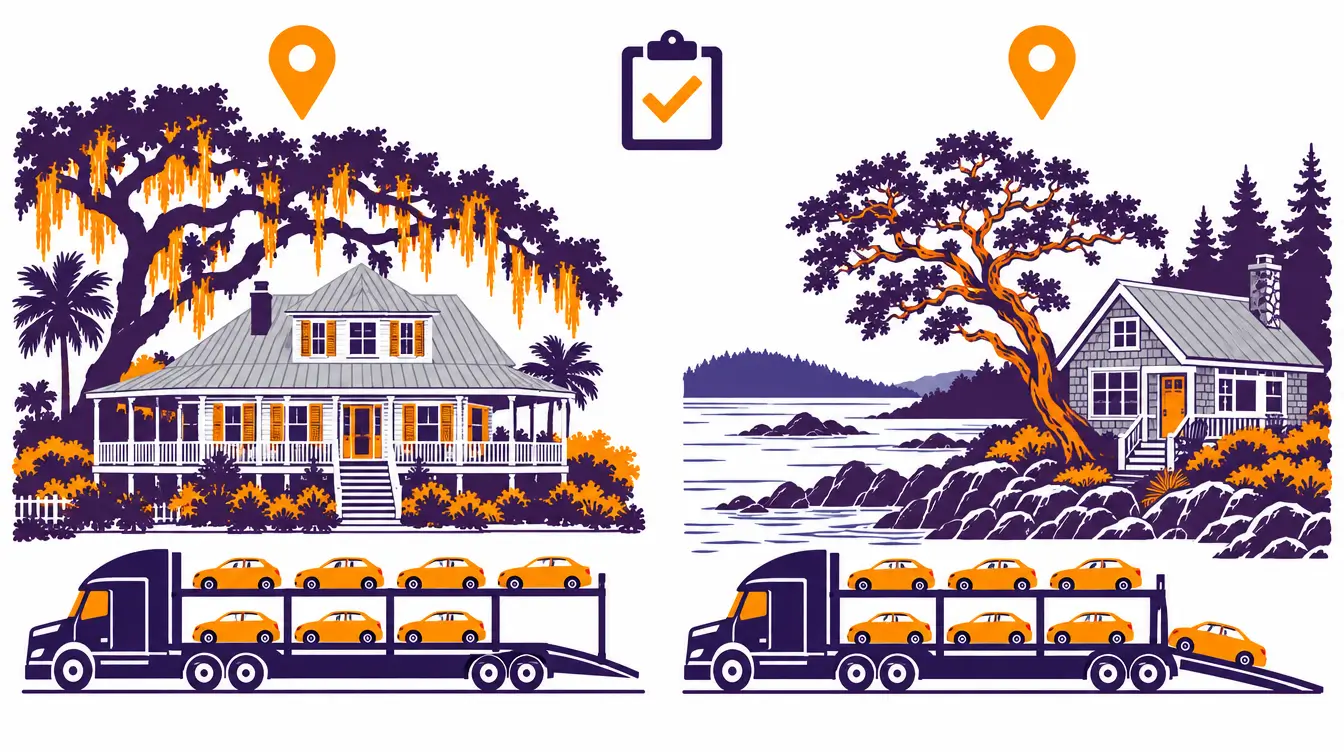
Settle where the truck will meet you at both ends before anyone is dispatched. A full hauler needs a long, flat place to stop, put its ramps down and pull away again, and many streets have no room for that.
In Florida, open suburban streets often work. Guard gates, condo garages, low oak limbs over older neighborhoods and tight streets on the barrier islands frequently move pickup to a large lot close to the highway.
Washington State deliveries have their own limits. Steep Seattle hills, homes reached by ferry and winding country roads in the foothills can push the handoff to a shopping center or park-and-ride lot, while wider streets around Spokane, Vancouver and Yakima more often allow delivery at the door.
Before the car leaves Florida, check each panel together with the driver and confirm the condition report notes every existing scratch or dent. In Washington State the car is compared against that report, and your own dated photos of all four sides back it up.
Key Things to Know Before Shipping a Car From Florida to Washington
Rivalane manages each Florida to Washington State shipment out of Melville, New York, normally assigning a licensed carrier bound for the Northwest in one to three working days. Real-time tracking follows the car to delivery. Washington State allows new residents 30 days to get a license and then register the car, and the Florida policy should stay active until the Florida plate is turned in.
Frequently Asked Questions