Rivalane arranges car shipping to and from Washington along the corridors carriers already run, from I-5 at the Oregon border up through Tacoma, Seattle and Everett, to I-90 east over Snoqualmie Pass toward Spokane. Share your pickup and delivery points and we match the vehicle with a licensed, insured carrier working that lane, on an open or enclosed trailer. Addresses east of the Cascades, on the Olympic Peninsula, or out on the islands take more planning, so send your dates early and we will route around them.




5-Star Average Rating
Fully Insured
Top Rated Service
Nationwide Coverage
Licensed Carriers
Rivalane is a broker, not a trucking company, and on a state like Washington that works in your favor. Rather than one fleet with a fixed set of routes, we place your vehicle with licensed, insured carriers already running the lane you need, whether that is the I-5 corridor through the Puget Sound metros or a run east over the passes toward Spokane and the Tri-Cities. We check a carrier's operating authority, insurance and safety record before we assign it. You get one point of contact from quote to delivery, a pickup window agreed up front, and straight answers while the vehicle is moving.

Cost and timing depend on your route, trailer type, vehicle size, and the time of year. The ranges below reflect typical market pricing and transit windows by distance, not a commitment on either. Your actual quote is based on real carrier availability on your specific route at the time of booking.
Distance and carrier density set the price more than anything else. The I-5 corridor from the Oregon border north through Olympia, Tacoma, Seattle and Everett carries the heaviest carrier traffic in the state, so pickups near it usually price better than addresses in the Okanogan, the Columbia Basin or the far northeast corner, where a truck has to leave its circuit and sometimes cannot reach the door at all.
Crossing the Cascades matters too. I-90 over Snoqualmie Pass and I-82 toward Yakima and the Tri-Cities are the main east to west routes, and snow and chain requirements on the passes from November into March thin out the carriers willing to commit to a fixed date. Washington also sits a long way from the rest of the country, since almost every major market east of the Rockies is more than 1,500 miles out, which is why the cross-country band starts higher here than it does in the middle of the map.
Trailer type comes next, because enclosed transport uses more specialized space and there is less of it available. Vehicle size, whether the car runs, and how much lead time you give us all factor in. Booking one to two weeks out usually opens up more carrier options than a last-minute request.
Get your Washington quoteFive steps run from your first message to the final inspection at delivery. Here is what happens at each one, and what we need from you.





Share where the car starts and where it needs to go, along with the year, make and model. We check the route and how much carrier traffic runs on it, then price that specific lane rather than a generic average.

Choose the window that works for you. We match the vehicle with a carrier already running that route and confirm the plan before anything moves. On routes crossing the Cascades between November and March we build extra room into the window.

Take out personal items, keep the fuel low, and have the keys ready. When the driver arrives you both walk around the car and record its condition before it goes on the trailer.
Your car travels with the carrier assigned to your route, and you get updates as it moves. Long hauls leaving Washington run south on I-5 or east over the passes, and we tell you if weather on the route changes the plan.
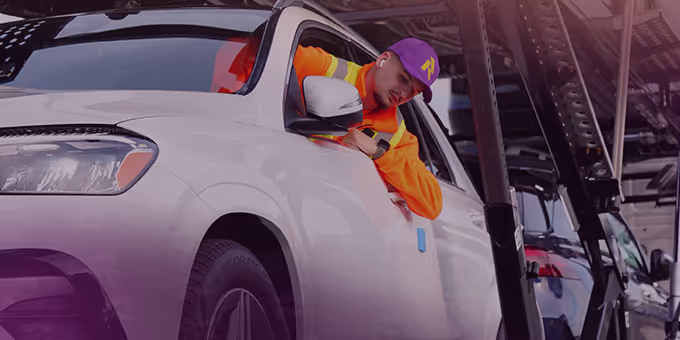
At delivery you and the driver walk around the car again and compare it against the inspection notes from pickup. Once you both agree the condition matches, the shipment is complete.
Five ways we move vehicles to, from and around Washington. Each one draws on the same carrier network, so the choice comes down to your route, the vehicle, and how much protection it needs.
Coverage runs the whole state, not only the easy parts of it. Alongside the Puget Sound metros we arrange pickups in Spokane, Yakima, the Tri-Cities, Bellingham and out on the coast, including rural addresses where a carrier has to leave its usual circuit to reach you. Tell us both ends of the route and we will tell you what is realistic.
Open carriers work well for most everyday vehicles such as sedans, SUVs, and light trucks.
Your car rides on a standard trailer alongside other vehicles. It is the most common choice on Washington routes and the easiest to schedule, because most carriers working the state run open equipment. Learn more about open auto transport.
Enclosed carriers give added protection for classic, luxury, and specialty vehicles.
The car travels inside a covered trailer, out of the weather and away from road debris. That matters on winter runs over the passes and on long hauls where the vehicle spends several days on the road. Read more about enclosed auto transport.
Most Washington routes qualify for door to door transport when the truck can safely reach both addresses. On narrow streets, out in the islands, or on tight peninsula roads, we arrange a nearby meeting point instead. See how door to door car shipping works.
Long-haul work is a large share of what we arrange here, and most of it runs on a handful of lanes rather than spreading evenly across the map.
The busiest lanes run south on I-5 toward California and east toward Texas and the Midwest. Booking one to two weeks ahead usually opens up more carrier options on these routes.
Vehicles moving between Washington and Alaska travel by sea from the Seattle and Tacoma terminals, and we handle the road leg at this end. Outbound, we collect the car and deliver it to the terminal ahead of the sailing. Inbound, we pick it up once the vessel is offloaded and run it to your address. Send us the sailing date and we build the schedule around it. See car shipping to and from Alaska.
Demand here comes from a few clear directions, and most of it moves along the same corridors. These are the four groups that ship vehicles into and out of Washington most often.
.svg)
Boeing's plants at Everett and Renton, Microsoft in Redmond and Amazon in Seattle pull people into the region from across the country, and arrivals cluster between June and September. Most of those moves start on the far side of the Rockies, which is a long drive to take on alone, so the car travels on a carrier instead. Tell us your start date and we work the schedule back from it.
Vehicle transport services →.svg)
Plenty of vehicles reach Washington from another state, and the largest inbound lanes start in California, the Northeast and Florida. If you have bought a car in Los Angeles, New York or Miami, we arrange pickup from the seller or the dealership and delivery to your address here, so nobody has to fly out and drive it back. Send us the pickup contact and the vehicle details and we will handle the coordination.
Door to door delivery →
Joint Base Lewis-McChord south of Tacoma, Naval Base Kitsap across the Sound, Naval Station Everett and Fairchild Air Force Base at Spokane all generate steady PCS and deployment vehicle moves, along with Washington National Guard units statewide. Orders often arrive with short notice and fixed report dates, so the pickup window matters more than usual. Share your dates early so the route can be planned around them.
Military car shipping →
The University of Washington in Seattle, Washington State in Pullman, Gonzaga in Spokane and Western Washington in Bellingham all draw heavily from out of state. Pullman sits far from any major metro, so it is the one worth booking early. The calendars create two clear surges, arrivals in late August and departures in May, and about two weeks of lead time usually means better carrier availability.
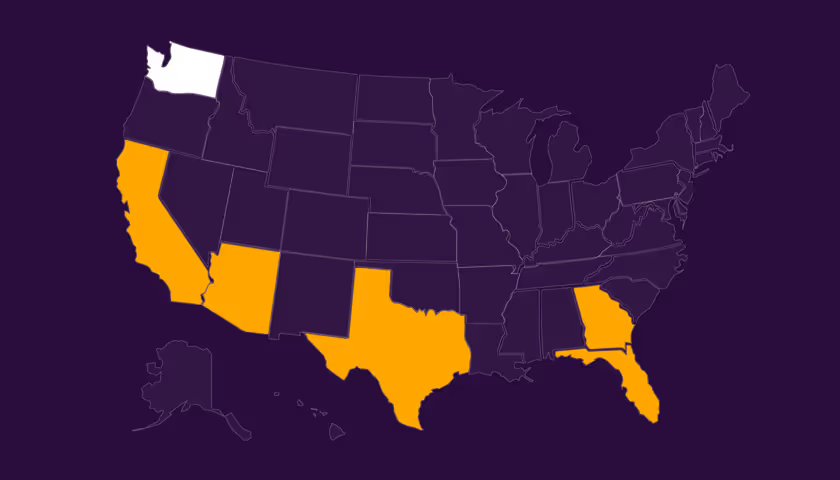
Estimate your shipment →Looking to ship your car to another state or across the country? Rivalane ships to all 50 states. Select a state to see how we move cars to and from it.
Washington's shipping map splits at the Cascades. Seattle, Tacoma, Bellevue, Everett and Olympia sit close together in the Puget Sound belt. Spokane, Yakima, Kennewick and Richland sit out east and route through the passes. Bellingham runs north toward the border and Vancouver sits at the Oregon line. Pick a city below to see the ZIP codes we cover there.