


Open transport for a sedan between Chicago and Miami costs $750 to $1,200 in most cases. The trip usually takes 2 to 5 days across 688 to 1,463 road miles, with I-75 the longest stretch. Fall pickups are best booked two to three weeks early, and Florida insurance should be in place before the title visit.
How Car Shipping From Illinois to Florida Works
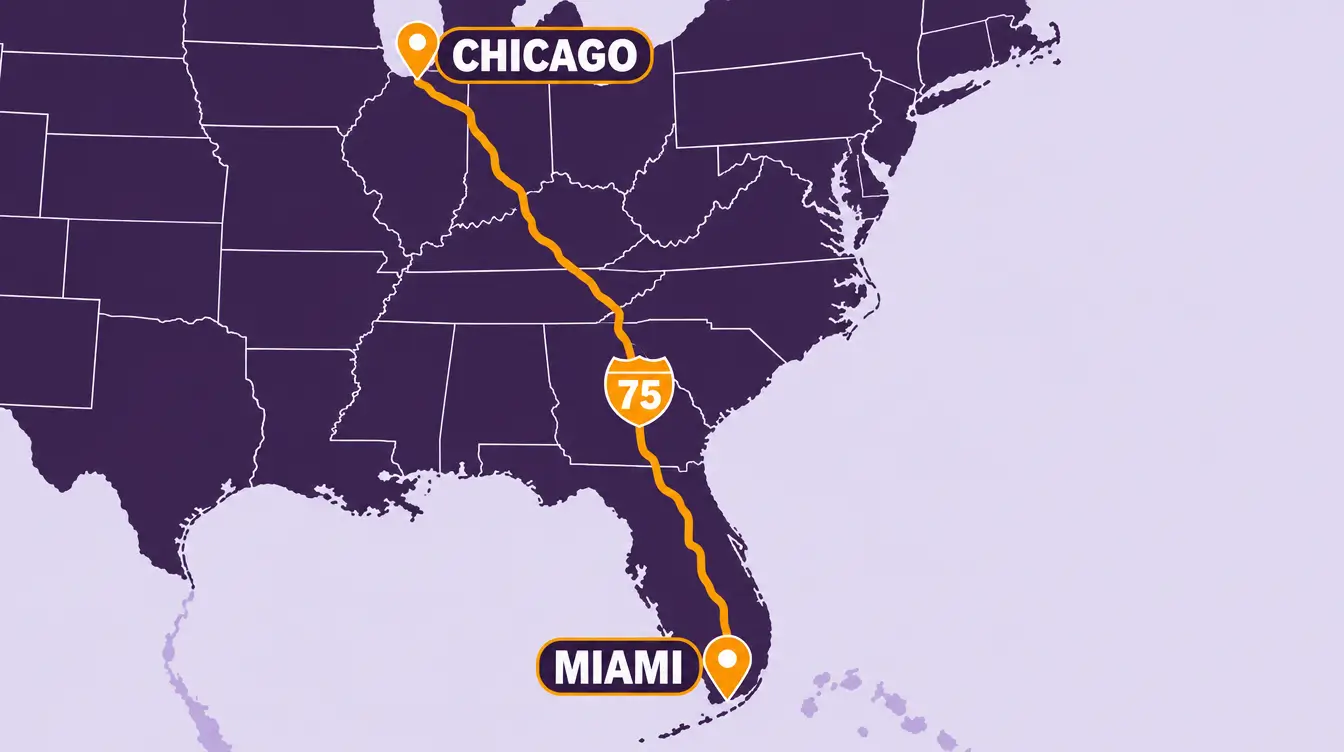
Illinois to Florida car shipping starts on one of two paths, depending on which part of the state the car leaves from. Chicago and Naperville loads head out on I-65 through Lafayette, Indianapolis and Louisville. Rockford, the Quad Cities, Peoria, Champaign, Springfield and Carbondale drop south through the downstate prairie instead and pick up I-24 at Paducah, Kentucky. For every Florida city except Tallahassee, the two paths meet at Chattanooga and run I-75 through Atlanta, Macon and Valdosta into Florida at Lake City. A Chicago to Miami trip reaches the halfway point of its mileage around Atlanta. Jacksonville loads leave I-75 for I-10 at Lake City, cars for Orlando, Tampa, Fort Myers and the southeast coast stay south past Gainesville and Ocala, and Tallahassee runs split off earlier and cross Alabama on I-65 by way of Birmingham and Montgomery. Every hauler carries several vehicles, so a pickup near a highway and some slack in the dates help an Illinois car land a spot on a trailer already headed for Florida.
How Much Does It Cost to Ship a Car From Illinois to Florida?
Your quote depends on your vehicle, the exact pickup and delivery addresses, the season and the trailer type, so run the calculator for a figure on your dates.
Distance sets most of the price, and both the Illinois pickup and the Florida delivery can move it. We measured 64 pairs between eight Illinois towns and eight Florida cities with two routing sources. Carbondale to Tallahassee came out shortest at about 688 road miles, and Rockford to Miami longest at roughly 1,463.
From Chicago, Tallahassee is the nearest Florida stop at about 950 miles, Jacksonville follows at roughly 1,030 to 1,060, Orlando and Tampa land between about 1,120 and 1,170, and Miami comes in between about 1,350 and 1,380. Our page on car shipping in Florida lists Florida delivery areas statewide.
The starting point in Illinois can shift the Miami mileage by about 350 miles. Carbondale sits nearest to Florida, Champaign and Springfield come next, Chicago, Naperville and Peoria sit in the middle, and Rockford and the Quad Cities are farthest away.
The vehicle and the calendar count too. A long van or full-size pickup claims more trailer space than a compact sedan does, and fall loads heading south generally price above spring and summer ones. For a starting figure, put both addresses into the car shipping calculator.

A running sedan leaving Chicago for Miami on an open trailer usually runs $750 to $1,200. Shorter runs, such as Carbondale or Champaign to Jacksonville, tend to price under the middle of that range, and Rockford or Quad Cities cars bound for Miami sit nearer the top.
Full-size SUVs, pickups and vans generally add $100 to $200. Covered transport lifts the open price by somewhere around 40 to 60 percent.
Three things shift an Illinois to Florida quote the most:
- Snowbird season. In the fall, Illinois retirees and other Midwest snowbirds book cars south at the same time, which fills southbound trailers and lifts rates. Spring and summer usually leave more open space heading south.
- How far the house is from a main highway. An address near I-55, I-57 or I-90 is quick for a southbound driver to reach. A farm road downstate or a tight city block can add time to the pickup.
- Which part of Florida. Tallahassee and Jacksonville are the shortest runs from most of Illinois and the southeast coast the longest, and a gated community or condo tower may mean meeting the truck on a nearby public street.
A quote that lands well under this range deserves a second look until a carrier has actually committed to the load.

What Factors Actually
Influence Pricing on This Route?
Five things move the price on any lane: the vehicle's size, whether it runs, how easy each end is to reach, the season and the trailer type. Booking early protects your timeline, keeps pricing steady and reduces the risk of last-minute carrier changes.


Type
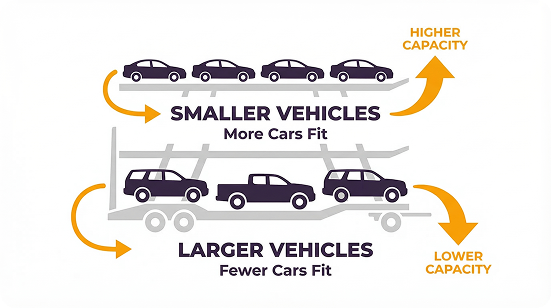
Size decides how much deck space your vehicle takes and how many other cars fit alongside it. A standard sedan is the cheapest thing to move because it slots almost anywhere on the trailer. SUVs, pickups and vans take more room and usually cost more on the same lane.


Is It Cheaper to Drive or Ship a Car From Illinois to Florida?
When Shipping Makes Sense
Shipping fits a snowbird planning to fly south and meet the car in Florida, a couple moving to the Sunshine State for good, or a household moving two cars with just one person ready to drive.
It also removes the trip back. Driving from Chicago to Miami leaves you roughly 1,350 to 1,380 miles from home, usually after three days or so at the wheel, with a one way flight north still to book.
Driving It Yourself
For two people traveling south together with luggage in the trunk, driving can still cost less, and we will tell you when it does. Our routing estimate puts Chicago to Miami at roughly 25 hours behind the wheel, usually spread over three days once fuel, meals and two hotel nights are added in.
Shipping makes more sense when no one actually needs to make the drive. Rockford to Miami stretches to about 1,463 miles, and someone still has to travel back to Illinois afterward.
How Long Does It Take to Ship a Car From Illinois to Florida?
Once loaded, most Illinois cars typically spend 2 to 5 days on the truck. Carbondale loads heading to Tallahassee or Jacksonville tend to land at the short end, Chicago to Miami usually sits in the middle, and Rockford or Quad Cities loads for Miami and Fort Lauderdale may need the full window.
Lining up the truck is often the longer part of the wait. The dispatch side typically needs one to three working days to match the car with a truck, and that can run a little longer during the fall rush.
A full hauler drops its cars one by one on the way south, so a Miami delivery may follow a few stops in Georgia or north Florida. A window of several possible pickup days, not one firm date, generally gets the car loaded sooner.
When Is the Best Time to Book Auto Transport From Illinois to Florida?
Southbound trailers fill up in the fall, when Chicago-area retirees and other Midwest snowbirds move their cars south ahead of winter. Our guide to snowbird shipping walks through that season.
If you want a pickup between October and early December, book about two to three weeks ahead of your preferred date. In the rest of the year, ten days to two weeks of notice usually works, and a flexible pickup window lets dispatch take the first Florida-bound carrier with an open spot.
Winter weather in northern Illinois can cost a day or two. A snowstorm around Chicago or Rockford can push back a December to February pickup, while downstate loads near Carbondale are held up less often.
Open vs Enclosed Auto Transport on an Illinois to Florida Route
Open transport moves most Illinois cars to Florida, on two-deck carriers working the I-65, I-24 and I-75 corridors. Over roughly 1,350 to 1,380 miles from Chicago to Miami, the paint gets the same exposure as a long road trip in your own car, and cars picked up in winter often reach Florida carrying a film of road salt.
On enclosed transport the car travels inside a covered trailer, shielded from rain, sun, salt and road grit all the way from Illinois to the Florida curb. Covered trailers carry only a handful of vehicles, so a spot on one costs more and is often gone sooner in the fall.
The extra spend fits collector cars, exotics, show cars and cars with fresh paint. Daily drivers, crossovers and most snowbird sedans go open.
Enclosed Car Transport
Enclosed demand rises for high-value, specialty and seasonal vehicles, and enclosed trailers protect against road debris and weather, which matters most on longer hauls. Enclosed rigs are a small fraction of the trailers working any given lane, and that scarcity is what drives both the higher price and the longer booking lead time.
Open Car Transport
Most vehicles move on open trailers, and for most routes that is the more cost-effective way to ship a car.
Open transport works well for standard vehicles and keeps costs predictable. It also offers the widest carrier availability.
What Florida Requires When Your Car Arrives
Florida treats a winter stay and a permanent move differently, and these four questions sort out which rules apply to an Illinois car.
Do you count as a Florida resident yet? FLHSMV may consider you a resident after you take a job or start a trade, profession or occupation in Florida, enroll your children in its public schools, sign up to vote in Florida, apply for a homestead exemption on Florida property, or stay in Florida for over six straight months. Spending only the winter there, with none of those ties, does not meet that test.
What goes into the Florida title packet? Each owner needs proof of identity, and the packet also takes proof of a Florida policy sold by a Florida-licensed agent, the original Illinois title and form HSMV 82040 signed by each owner. When a lender holds the title, contact the lender about moving it to Florida. Someone authorized must inspect the VIN and record it on form HSMV 82042 or within HSMV 82040: a police officer or military police officer, a Florida-licensed car dealer, someone working for the county tax collector, or a compliance examiner from the Division of Motorist Services. Our Florida VIN verification guide explains how to arrange it.
Where does registration happen, and when is the license due? Registration happens at the same titling appointment, at a local service center and in person, with an initial registration fee of $225 when no Florida plate is being transferred. That appointment is described in our walkthrough on registering an out-of-state car in Florida. You have 30 days from the start of residency to obtain a Florida driver license, which you apply for in person too.
What about the Illinois paperwork? Plates, registration and insurance on the Illinois side are handled by the Illinois Secretary of State and your insurer, so confirm with both what to do with the Illinois plates and policy before the car leaves.
Sources: FLHSMV, through its new resident page and the registrations page for motor vehicles. Rules change from time to time, so check the current requirements before the car ships.
What to Expect at Pickup and Delivery
Agree on both meeting spots early, while the carrier is still being lined up, because a loaded car hauler needs a long straight stretch of road to stop on and room to merge back into traffic.
In Illinois, suburban streets in Naperville, Schaumburg and around Peoria usually have room near the driveway. Narrow Chicago side streets lined with parked cars, alley-only garages and long rural lanes downstate often shift the handover to a nearby parking lot or a broader street.
In Florida, many gated communities and high-rise condo buildings keep large trucks outside the entrance, so the car changes hands on a public street or lot nearby. Most neighborhoods in Orlando, Tampa and Jacksonville have curb space.
At pickup, read every mark the driver puts on the condition report before you sign it, because the car is checked against that report at delivery. Before the truck pulls away in Illinois, photograph the front, rear and both sides with the date showing, and compare the car with them at the Florida curb before you sign for it.
Key Things to Know Before Shipping a Car From Illinois to Florida
Rivalane is based in Melville, New York, and books each Illinois car onto a Florida-bound carrier with room on the trailer, and real-time tracking shows where the car is until delivery. If the car keeps its Illinois plates for the winter, check the registration renewal date and confirm the insurance policy before it heads south.
Frequently Asked Questions