




A running sedan shipped from Richmond to Dallas by open carrier costs $850 to $1,250. The routing covers 16 pairs of 1,102 to 1,606 miles, and I-40 is the top road on 12 of them. Loaded cars typically reach Texas in 3 to 6 days on most pairs, and registration there starts with proof of liability insurance.
How Far Is It to Ship a Car From Virginia to Texas?
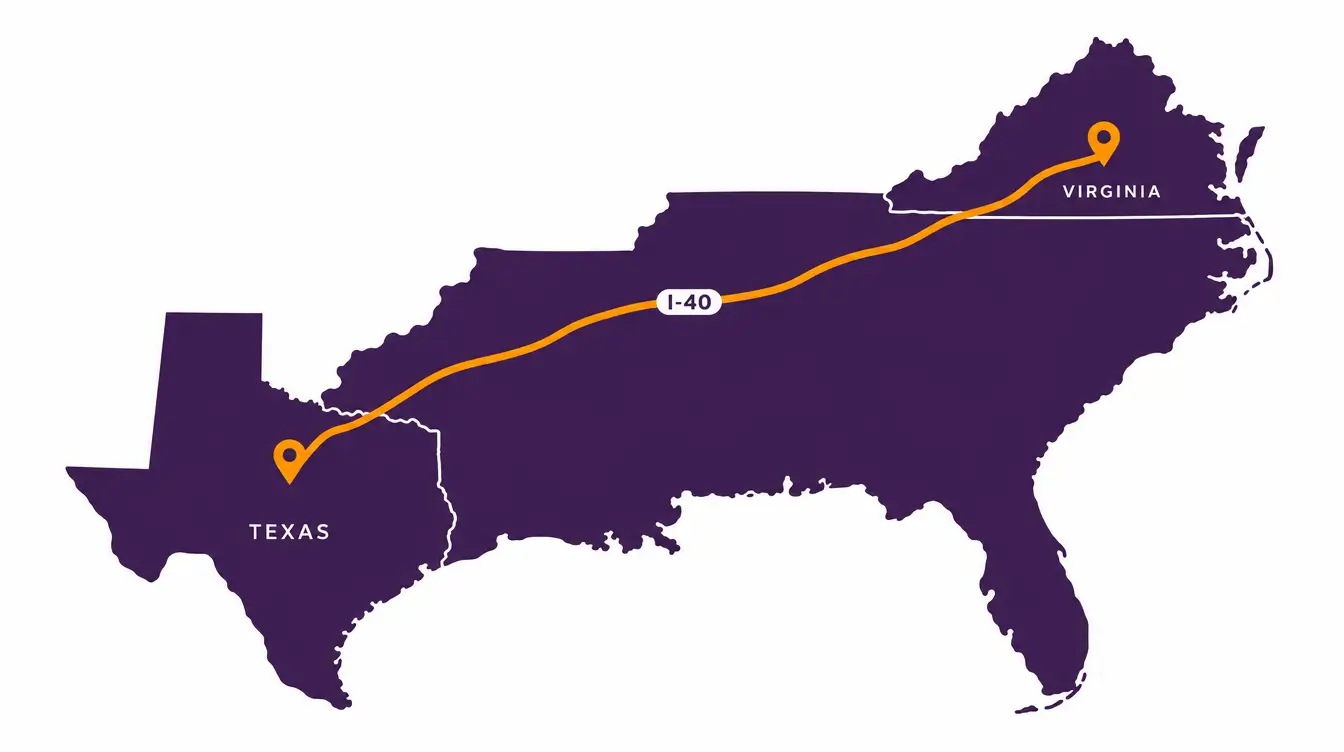
Pickup towns on this page are Richmond, Roanoke, Alexandria and Charlottesville in Virginia, and the Texas drop-offs are Dallas, Houston, Austin and San Antonio, for 16 routed pairs in all. Together, Virginia to Texas car shipping covers 1,102 to 1,606 road miles, from Roanoke to Dallas at the short end to Alexandria to San Antonio at the long end. Thirteen pairs fall between 500 and 1,500 miles, and three pass 1,500. The core pair, Richmond to Dallas, is 1,278 miles and about 23 hours at the wheel, with 550 of those miles on I-40, 315 on I-30 and 266 on I-81. I-40 is the top road on 12 of the 16 pairs, and each of those 12 runs through Knoxville, Nashville, Memphis, Little Rock and Texarkana. The four Houston pairs turn south instead, led by I-59 from Roanoke, Alexandria and Charlottesville and by I-85 from Richmond.
What Drives the Cost of Shipping a Car From Virginia to Texas?
Your quote depends on your vehicle, the exact pickup and delivery addresses, the season and the trailer type, so run the calculator for a figure on your dates.
For any one Texas city, the pickup town shifts the mileage by 230 to 231 miles. Roanoke sits nearest to all four cities and Alexandria farthest, so Dallas reads 1,102 miles from Roanoke and 1,333 from Alexandria. The Texas city shifts it a bit more: from every start, San Antonio lies 272 to 273 miles beyond Dallas, the nearest stop.
Thirteen of the 16 pairs run under 1,500 miles, which puts them on the mid-range rows of the Virginia car shipping page and the Texas car shipping page. Alexandria to Austin, Richmond to San Antonio and Alexandria to San Antonio run past 1,500 miles and fall on the long-haul rows. For the price, the mid-range rows serve as the fairest yardstick.

Richmond to Dallas runs $850 to $1,250 for a running sedan loaded on an open carrier. Pickups in Alexandria and deliveries to San Antonio add the most miles and sit nearer the top; pickups in Roanoke and deliveries to Dallas add the fewest and sit nearer the bottom. The car shipping calculator gives a quote for your pickup town, Texas city and date.
Bigger vehicles such as an SUV, a pickup or a minivan add $100 to $200 as a rule. An inoperable car needs a winch for loading, which costs extra, and enclosed transport pushes the price up 40 to 60 percent.

What Factors Actually
Influence Pricing on This Route?
Five things move the price on any lane: the vehicle's size, whether it runs, how easy each end is to reach, the season and the trailer type. Booking early protects your timeline, keeps pricing steady and reduces the risk of last-minute carrier changes.


Type
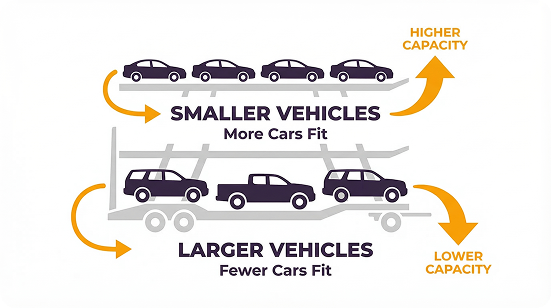
Size decides how much deck space your vehicle takes and how many other cars fit alongside it. A standard sedan is the cheapest thing to move because it slots almost anywhere on the trailer. SUVs, pickups and vans take more room and usually cost more on the same lane.


Should You Ship a Car to Texas or Drive It From Virginia?
Shipping the car
A carrier covers the 1,278 miles between Richmond and Dallas, so the car skips about 23 hours of highway and the three days of driving that usually fill.
Shipping fits best when household chores keep one driver busy and the second car has to travel on its own, or when it is not needed in Texas right away.
Driving it yourself
Richmond to Dallas means about 23 hours behind the wheel, which fits three days with two nights in motels. Fuel, meals and lodging all add to the total.
A road trip across Tennessee and Arkansas can justify it. Add up fuel, meals and the nights on the road, then weigh that total against a shipping quote.
How Long Does It Take to Move a Car From Virginia to Texas?
Loaded cars on the 13 pairs under 1,500 miles typically arrive in 3 to 6 days. That span is where the two mid-range rows overlap, with the Virginia page typically listing 3 to 6 days and the Texas page typically listing 2 to 7 days. The three pairs over 1,500 miles fall on the long-haul rows, where the overlap typically comes to 6 to 8 days, from a Virginia row of typically 6 to 10 days and a Texas row of 4 to 8 days. Roanoke to Dallas, the shortest pair at 1,102 miles, might land early in its span, and Alexandria to San Antonio, the longest at 1,606 miles, could use all of its span.
Dispatch comes first: once the booking is in, a licensed carrier is typically assigned in one to three working days; until then the car stays where it is parked. Tracking begins at loading.
When Should You Book a Virginia to Texas Car Shipment?
Two brokers describe the seasons on this lane in different ways. One calls May through July the pricier stretch and August through October the cheapest, and the other says summer raises demand for southbound loads. Neither points to one date that suits every move.
A booking one to two weeks ahead normally leaves enough carrier choice, while anyone leaving between May and July should book two to three weeks out.
Open or Enclosed: Which Trailer Suits a Car Bound for Texas?
Most cars here travel by open carrier, the lower-priced option. Across 1,102 to 1,606 miles the car faces sun, rain and road grit, much of it on I-40.
A show car, an exotic or any vehicle with a delicate finish is better served by enclosed car transport, which shelters the paint behind walls and a roof. Enclosed space is limited and costs more.
Enclosed Car Transport
Enclosed demand rises for high-value, specialty and seasonal vehicles, and enclosed trailers protect against road debris and weather, which matters most on longer hauls. Enclosed rigs are a small fraction of the trailers working any given lane, and that scarcity is what drives both the higher price and the longer booking lead time.
Open Car Transport
Most vehicles move on open trailers, and for most routes that is the more cost-effective way to ship a car.
Open transport works well for standard vehicles and keeps costs predictable. It also offers the widest carrier availability.
Which Common Assumptions About Texas Paperwork Hold Up for a Virginia Car?
Four common assumptions are worth testing before a Virginia car is registered in Texas, and the TxDMV page on out of state and imported vehicles speaks to each one. Registration happens at the county tax office, so the office for the delivery city is the one that matters.
- Assumption: Texas wants a safety inspection. The page says a non-commercial car registered in one of 18 listed counties needs a passing emissions inspection and no safety inspection. Dallas, Harris, Travis and Bexar counties, which hold Dallas, Houston, Austin and San Antonio, are all on that list.
- Assumption: only the Virginia title proves ownership. The page accepts the original out of state title or other valid ownership evidence, and the county office also asks for proof of sales tax payment.
- Assumption: one 30 day clock covers everything. The page runs two. Registration comes within 30 days of bringing the car to Texas, and for a car that was bought rather than moved, the title comes within 30 days of the sale.
- Assumption: the Virginia policy will do. The page asks for proof of liability insurance that meets the State of Texas minimum, so check the policy with the insurer before the visit.
The page names Form 130-U as the form to complete for the county visit. The Texas registration guide walks through the full process.
What Happens on Each Leg of a Virginia to Texas Haul?
The first leg is I-81, which runs 218 miles for a car loaded in Roanoke, 266 for Richmond and Charlottesville and 375 for Alexandria, before I-40 takes over near Knoxville. The middle leg is I-40 for 550 miles on each of the 12 pairs that use it, through Nashville and Memphis, followed by I-30 for 315 miles from Little Rock past Texarkana. Houston loads leave that pattern, heading south on I-59 or I-85 and then onto I-10.
A carrier needs room to turn, so on a tight residential street the driver may suggest meeting in a nearby lot or on a wider road, and Texas deliveries can bring the same request.
At loading, inspect the car with the driver and match each mark to the condition report. Photograph every side, clear out loose items, leave roughly a quarter tank and hand over a single key. At delivery in Texas, inspect it again in good light if you can, and record any new damage on the condition report prior to signing.

What to Know Before You Ship a Car From Virginia to Texas
Rivalane is a Melville, New York broker, so each Virginia to Texas booking is passed to a licensed carrier, the company that does the hauling, with no Rivalane truck involved. Tracking opens at loading, and finding a carrier usually runs one to three working days beforehand. The Texas section below covers what the county tax office asks for, from insurance to the emissions test.
Frequently Asked Questions