


Charleston to Phoenix costs $1,150 to $1,600 when the sedan runs and rides an open carrier. The 24 West Virginia to Arizona pairs we routed span 1,869 to 2,479 miles, mostly on I-40, with delivery typically 5 to 8 days after loading. Arizona wants an emissions test first where one applies, then an MVD visit, then proof of insurance.
How Many Miles Does a Car Travel From West Virginia to Arizona?
We routed four West Virginia pickup towns, Charleston, Morgantown, Beckley and Martinsburg, against six Arizona delivery cities, Phoenix, Mesa, Tucson, Flagstaff, Prescott and Yuma, which makes 24 pairs. Across them, west virginia to arizona car shipping covers 1,869 to 2,479 road miles, from Charleston to Flagstaff at the short end to Martinsburg to Yuma at the long end, and 18 of the 24 pairs run past 2,000 miles. Every pair sits well beyond 1,500 miles, where both state pages move to their long-haul rows. The core run, Charleston to Phoenix, is 1,964 miles, and I-40 carries 761 of them. Fifteen pairs cross St. Louis on I-64 or I-70 and follow I-44 through Tulsa to reach I-40 near Amarillo; Tucson loads from Charleston, Beckley and Martinsburg, and Yuma loads from Beckley and Martinsburg, take a southern line through Nashville, Memphis and Dallas, while the Martinsburg loads for Phoenix, Mesa, Flagstaff and Prescott take I-81 to Knoxville and then I-40 the whole way.

What Changes the Price of Shipping a Car From West Virginia to Arizona?
Your quote depends on your vehicle, the exact pickup and delivery addresses, the season and the trailer type, so run the calculator for a figure on your dates.
For any one Arizona city, the West Virginia pickup town changes the distance by 240 to 299 miles. Charleston is the nearest start to all six cities and Martinsburg, in the eastern panhandle, the farthest: Phoenix is 1,964 miles from Charleston and 2,263 from Martinsburg. The Arizona end moves the figure as well. Flagstaff is the shortest delivery from every start, while Yuma, tucked into the southwestern corner of the state, is the longest.
All 24 pairs fall in the long-haul bands of both state pages, West Virginia car shipping and Arizona car shipping. Read the range here against those rows, not the regional or mid-range ones.

For a sedan in running condition riding an open trailer, Charleston to Phoenix usually runs $1,150 to $1,600. Martinsburg pickups and Yuma drop-offs stretch the mileage and tend to sit high in that span. Enter your own town, Arizona city and date in the car shipping calculator for an estimate that fits your move.
Larger vehicles like pickups, SUVs and minivans cost somewhat more, commonly $100 to $200. A vehicle that will not start can still be moved with a winch, which adds a fee. Covered transport costs 40 to 60 percent more.

What Factors Actually
Influence Pricing on This Route?
Five things move the price on any lane: the vehicle's size, whether it runs, how easy each end is to reach, the season and the trailer type. Booking early protects your timeline, keeps pricing steady and reduces the risk of last-minute carrier changes.


Type
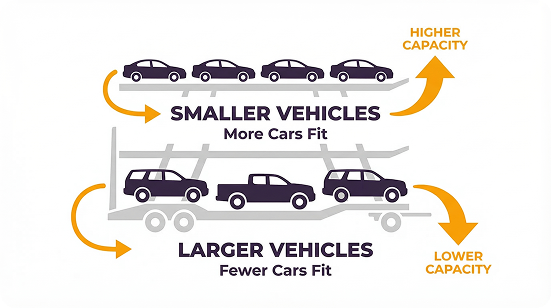
Size decides how much deck space your vehicle takes and how many other cars fit alongside it. A standard sedan is the cheapest thing to move because it slots almost anywhere on the trailer. SUVs, pickups and vans take more room and usually cost more on the same lane.


Is It Worth Shipping a Car to Arizona, or Should You Drive It?
Putting it on a carrier
The carrier takes on all 1,964 miles between Charleston and Phoenix, so you can fly or follow later while the car arrives without about 35 hours of driving added to its odometer, tires and oil.
That suits a move where one car waits in West Virginia until the house sells, or a household that has two cars to relocate and a single driver.
Making the drive yourself
Charleston to Phoenix is about 35 hours at the wheel. At nine hours a day that is four days, with fuel, meals and three nights in motels added to the bill.
Driving can still make sense if the car is coming along on a longer trip. Price those days and nights before you set the total beside a shipping quote.
How Long Does the Car Take to Get From West Virginia to Arizona?
Once loaded, a car typically needs 5 to 8 days to reach Arizona, which is the long-haul window on the Arizona page; the West Virginia page typically allows 5 to 10 days. Charleston to Flagstaff, which at 1,869 miles is the shortest pair, can arrive near the front of that window, while Yuma deliveries, above all from Martinsburg at 2,479 miles, tend to need the whole window.
Before the trip begins, a carrier is typically named within three working days of booking. A snowy morning on a mountain pickup can add a day, so leave some slack in the plan.
When Should You Book a Car Shipment From West Virginia to Arizona?
Published rate data for this lane shows prices edging up in May, June and July, when moving season peaks, and easing in August, September and October. The remaining months track close to the average, so no month forces the schedule.
For most departures, reserve one to two weeks out. For June or July, allow two to three weeks while carriers are busiest.
Should the Car Ride Open or Enclosed on a Trip This Long?
Most West Virginia to Arizona cars ride on an open carrier, a two-level trailer that costs less and fits everyday vehicles. Over 1,869 to 2,479 miles the car faces whatever weather the route brings, from mountain rain to desert sun.
For a collector car, a high-end exotic or a new paint job, enclosed car transport shuts out that exposure for the whole trip. Covered space is scarcer and costs more, which matters on a run this long.
Enclosed Car Transport
Enclosed demand rises for high-value, specialty and seasonal vehicles, and enclosed trailers protect against road debris and weather, which matters most on longer hauls. Enclosed rigs are a small fraction of the trailers working any given lane, and that scarcity is what drives both the higher price and the longer booking lead time.
Open Car Transport
Most vehicles move on open trailers, and for most routes that is the more cost-effective way to ship a car.
Open transport works well for standard vehicles and keeps costs predictable. It also offers the widest carrier availability.
Which Comes First in Arizona: Emissions, the MVD Office or Insurance?
Arizona expects three things from a newly arrived car, and the order matters: an emissions test where the address calls for one, a visit to an MVD office, then Arizona insurance on record. These steps begin once you count as a resident, which ADOT ties to a job in the state outside seasonal farm work, a voter registration, children enrolled at the resident school rate or a stay of seven months or more in a calendar year.
- Step one, emissions: The test follows the address where the car will live, not the delivery city. Greater Phoenix and Tucson are covered, so addresses there usually need a test before registration, while Flagstaff, Prescott and Yuma sit outside the testing areas. Bring the current title or registration and the Arizona address to the station. Hybrids are tested and fully electric cars are exempt. The ADEQ address locator checks one street at a time.
- Step two, the MVD office: The ADOT Out-of-State Vehicles page lists what to carry: a signed Title and Registration Application, the West Virginia title (or the West Virginia registration if a lender has the title), the emissions compliance form for the Phoenix and Tucson areas, and a lien clearance if one applies.
- Step three, insurance: Minimum liability coverage is $25,000 per person injured, $50,000 for several people injured and $15,000 for property damage, written by an insurer approved to operate in Arizona. ADOT allows 30 days after registration to submit proof, yet the registration is not valid until the insurer tells ADOT the policy is active.
What Happens at the West Virginia Pickup and the Arizona Delivery?
Before loading, the driver goes around the car with you and logs every scratch or dent already present on the inspection report. Keep the tank near a quarter full, clear out personal items and leave one set of keys.
A full-size carrier can struggle on a steep Beckley street or a Morgantown block with no room to turn, so it may ask you to meet at a wide parking lot nearby. Arizona has its own versions: gated communities in Mesa and Tucson, where the truck may stop at the entrance. At delivery, compare the car with the pickup report and note any new mark before you sign.

Key Things to Know Before Shipping a Car From West Virginia to Arizona
Melville, New York is where Rivalane operates as a broker, finding a licensed carrier for each car on the West Virginia to Arizona run instead of hauling it. A carrier is typically lined up within three working days of booking, and tracking starts at loading. The Arizona section below covers the first week after delivery.
Frequently Asked Questions