To cancel a Connecticut vehicle registration after you move, use the Connecticut Department of Motor Vehicles (DMV) online service, mail the DMV's form to its Registry Record Section in Wethersfield, or cancel at a DMV office. Do it once the car is registered in your new state, keep the plate disposition receipt as proof, and end your Connecticut insurance only after the cancellation, because Connecticut requires continuous insurance on any registered vehicle. You do not have to send the plates back: the DMV says they can be discarded at your discretion.
This guide is for owners whose car is leaving Connecticut with them, with New York as the worked example. It covers when to cancel, the order that keeps insurance and registration in step, each cancellation method, the plates, the receipt, your town's car tax, refunds and the problems that catch movers out. If the car is heading to New York, our page on Connecticut to New York car shipping covers the lane itself.
When Should You Cancel a Connecticut Registration After Moving?
Once the car is registered in your new state. The DMV's insurance and registration compliance page tells movers to cancel the Connecticut registration after the vehicle is registered with the new state and to get a receipt. Doing so keeps insurers from reporting you to the DMV and stops taxes from accruing.
Both reasons matter. The DMV's Cancel your registration and plates page says the car stays subject to property tax in your town of record until the registration is canceled. Canceling before the new registration has the opposite problem: the car would travel to your new state without a valid registration.
Why Register the Car in Your New State First?
A car that is shipped or driven out of Connecticut still travels on its Connecticut plates, registration and insurance, so all three need to stay valid until the new plates go on. Your new state's rules decide how long that takes.
New York shows how the order works. New York expects you to register the car within 30 days of becoming a resident, with a New York insurance policy in place first. Our guide to registering an out-of-state car in New York covers the documents and the DMV visit, and New York's inspection deadlines run from the registration date, as our guide to New York inspection rules for new residents explains. Once the New York plates are on, the Connecticut registration has done its job and can be canceled.
How Do You Keep Insurance and Registration in Step?
Connecticut state law requires continuous insurance coverage on any registered vehicle, and your insurer notifies the DMV when you cancel a policy. If a registered car goes more than 14 days without insurance, the DMV mails a suspension notice and charges a $200 uninsured motorist civil penalty for each lapse. The penalty can be rescinded if you prove continuous coverage, but a warning notice left unanswered leads to the suspension of the registration and of your registration privileges.
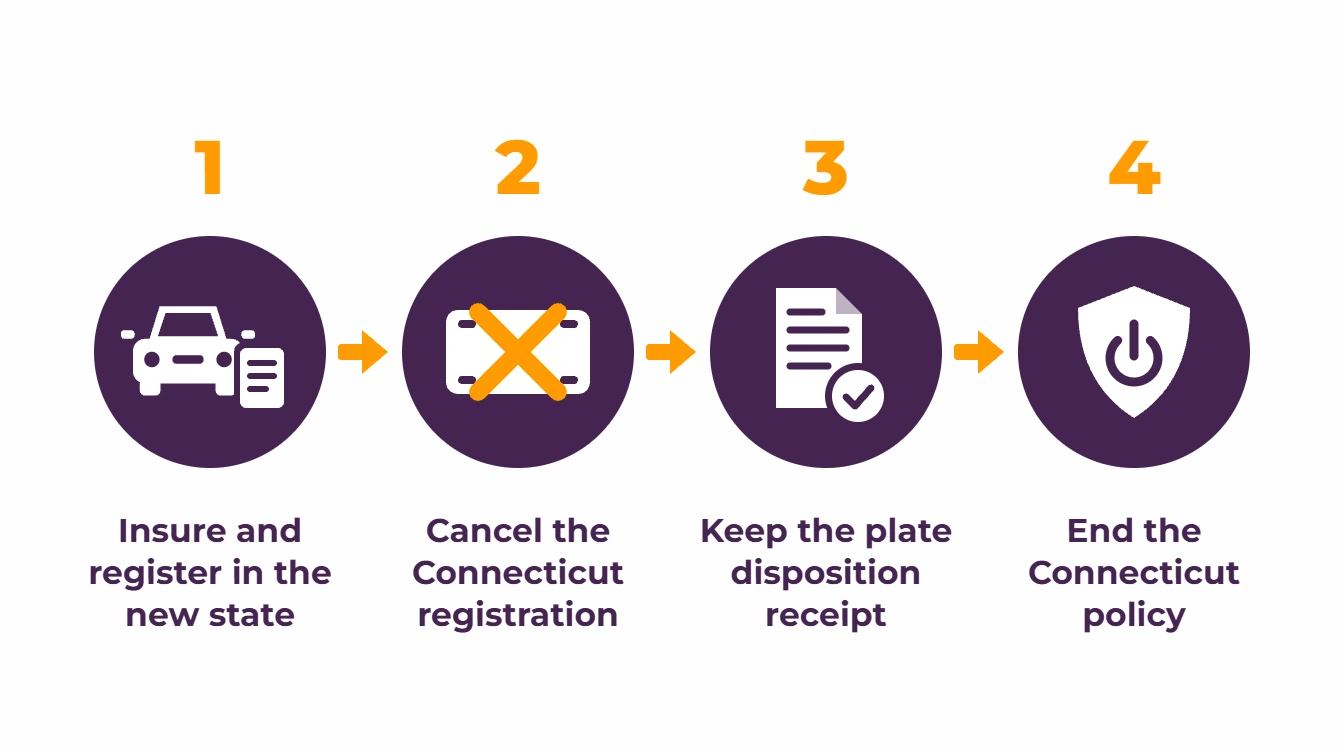
The order that avoids all of this is short:
- Insure and register the car in your new state. In New York, the New York policy comes first, then the registration.
- Cancel the Connecticut registration. Online, by mail or in person, and keep the plate disposition receipt.
- End the Connecticut policy. Only once the cancellation has gone through.
If a warning letter arrives after the move anyway, the DMV's compliance page covers it. When you registered the car in your new state before the insurance cancellation date shown on the letter, cancel the Connecticut registration and plates, then mail a copy of your current registration and insurance card from the new state to the Insurance Compliance Unit, 60 State Street, Wethersfield, CT 06161, within 14 days of the lapse. Temporary insurance cards, bills and binders are not accepted as proof.
How Do You Cancel a Connecticut Registration Online?
Individuals cancel through the DMV's online service, which is free and which the DMV estimates takes about 7 minutes. Start from the Cancel your registration and plates page and have your name exactly as it appears on your driver's license or ID card, the license or ID number, your date of birth, the plate number, the street address on your license or ID and your Social Security number ready.
The same page suggests checking the registration's current status first and links a status check for it. Two limits apply: a registration with a Revoked or Suspended status cannot be canceled online, and organizations use a separate online termination page. If you qualify for a refund, you can request it during the online process; the refund section below covers who qualifies.
The service ends with a plate disposition receipt, the DMV's proof that the registration was terminated. Save or print it before you close the page.
How Do You Cancel by Mail or in Person?
By mail. The DMV's mail route uses Form E-159, the Marker Plate Notice, sent to DMV Registry Record Section, 60 State Street, Wethersfield, CT 06161-5057. The form asks how many plates you are returning, whether any were lost or stolen, whether the vehicle was sold, junked or moved out of state, and whether to cancel the registration, and you sign it under penalty of false statement. The DMV lists Form F-82, its registration refund application, alongside it; the refund section below explains when a refund applies.
The DMV mails a receipt to the address on file. If you have already moved out of state, include a self-addressed stamped envelope so the receipt reaches you.
In person. The DMV also cancels registrations at its offices, and Form E-159 can be handed in at the nearest DMV office. Walk-in service is limited at some offices, so check the DMV's appointment information before you go. This only works while you can still reach a Connecticut office, so after the move, online or mail is the practical choice.
What Do You Do With Your Connecticut License Plates?
The DMV leaves that to you. Its cancellation page says plates can be discarded at your discretion, so you do not need to mail them back to cancel. Returning the plates is not what ends the registration; the cancellation and its receipt are.
On a move, leave the Connecticut plates on the car for the trip and take them off when the new state's plates go on. The DMV's compliance page also describes placing plates on hold, for example for a car that is off the road, at any DMV office or online by choosing the Customer held option in the cancellation steps.
How Do You Get and Keep the Plate Disposition Receipt?
The plate disposition receipt is the DMV's proof that the registration was terminated, and you may need it more than once. Town assessors ask for it before adjusting a car tax bill, and the Insurance Compliance Unit lists a plate receipt among the documents that settle an insurance notice.
For online terminations made on or after October 31, 2022, the DMV lets you locate and reprint the receipt through its online services, and earlier terminations can be confirmed online. A mail cancellation produces a receipt sent to the address on file, or in the self-addressed stamped envelope you included. Keep a copy with the new state's registration, since town assessors ask for both.
What Happens to Your Connecticut Car Tax?
Connecticut towns tax registered cars, and the DMV says a car stays subject to property tax in your town of record until the registration is canceled. After you cancel, the car comes off the next cancellation list the DMV provides to towns on October 1.
For the part of the year after you leave, state law provides a credit. Under section 12-71c of the Connecticut General Statutes, an owner who removes a car from Connecticut and registers it in another state while ceasing to be a Connecticut resident can claim a pro rata credit on that car's tax. It covers the full months from the date the car was removed and registered to the next October 1, and the claim goes to the assessor in the town where the tax is owed, with documentation that assessor accepts.
Towns publish their own requirements. Manchester, for example, asks for a copy of the Connecticut DMV plate cancellation receipt and a copy of the out-of-state registration or title showing the year, make, model, vehicle identification number (VIN) and effective date. Documents and deadlines differ from town to town, so check with your own assessor before you send anything.
Can You Get a Refund When You Cancel?
Sometimes, and only for the registration fee. Form F-82, the DMV's application for a one-year or two-year refund on a registration, allows a refund when, from the date of cancellation, at least one full year remains on a two-year registration, or one to two years remain on a three-year registration. The application has to be submitted before the registration period expires.
When you cancel online, you can request an eligible refund during the process, and the Office of the State Comptroller mails the check. By mail, send F-82 with the cancellation. In its guidance for owners selling a car, the DMV's compliance page adds that a one-year refund must be requested before the liability insurance on the vehicle is canceled, one more reason to cancel the registration before the policy.
What Problems Come Up When You Cancel?
A Revoked or Suspended registration. Registrations with either status cannot use the online service. If an insurance case is behind it, the compliance page sets out how to close it: an owner who no longer insures the car and has an outstanding fine sends the signed consent agreement, the plate receipt and a $200 check or money order payable to DMV.
An insurance warning notice after the move. Answer it rather than setting it aside. Proof that settles a notice includes your insurer's declaration page, a letter of experience on the insurer's letterhead or a permanent Connecticut insurance ID card, and a mover who registered elsewhere in time can use the new state's registration and insurance card as described above. Processing can take up to 10 days.
Lost or stolen plates. You can still cancel online. If an insurance compliance notice has arrived, the DMV also lets you sign the consent agreement on it, check lost or stolen and mail it to the Insurance Compliance Unit.
A deceased owner's car. The executor or a family member cancels by mail, returning the plates with the original probate court document that names the executor or administrator. If the plates are lost or stolen, Form E-159 goes with the probate document. The cancellation page lists the probate forms it accepts.
A receipt that never arrived. A mail cancellation sent without a self-addressed stamped envelope is answered at the address on file, which may still be your old Connecticut address. Online cancellations avoid this, and their receipts can be reprinted.
How Does Shipping Fit Around the Cancellation?
A car shipped out of Connecticut travels on its Connecticut plates and registration, so keep both, and the insurance behind them, current until the new state's registration is done. Keep the title, the registration certificate and your insurance papers with you during transport rather than in the car, since the registration visit in your new state depends on them.
Rivalane coordinates door to door transport from Connecticut with licensed, insured carriers, including the lane to New York. Pickup and delivery dates are estimates, not guarantees, so leave room inside New York's 30-day window and wait for the New York registration before you cancel the Connecticut one. Our pages on shipping a car from Connecticut to New York and car shipping in Connecticut cover the lane and pickups across the state, and the car shipping calculator gives an estimate for the move.
Frequently Asked Questions