Selling a car privately in Maine comes down to a few jobs that fall on the seller: confirm the car needs a title and that the title is clear, fill in the odometer disclosure and assign the title, deliver the certificate, and deal with the registration and plates once the car changes hands. The order matters, because the signing sequence on the title is set by law and a loan on the car has to be released on the certificate.
This guide is written for Maine private sellers in general. It follows one example throughout: a seller in Portland, Maine selling to a buyer in Los Angeles who will ship the car. The example shows that the Maine steps do not change when the buyer is far away, and where the California side takes over. The rules come from the Maine Bureau of Motor Vehicles (BMV) and Title 29-A of the Maine Revised Statutes.
This guide covers a private sale only. A sale to a licensed dealer follows different Maine rules, which are not covered here.
What Do You Need Before You Sell a Car in Maine?
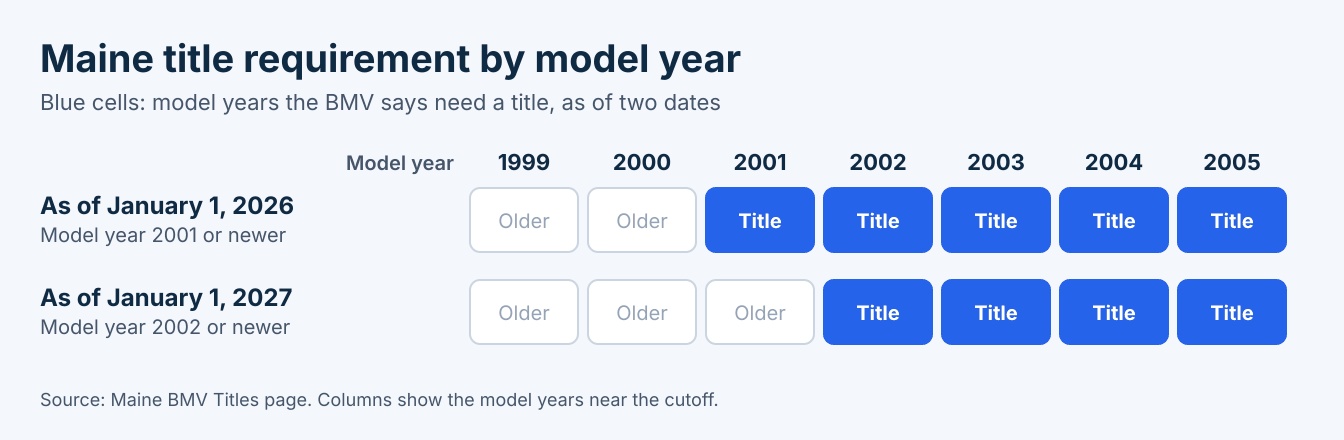
Start with the certificate of title. The BMV Titles page says Maine requires a title for vehicles with a model year within the last 25 years. As of January 1, 2026, that means model year 2001 or newer, and as of January 1, 2027 it means model year 2002 or newer. The cutoff moves each January, so check the BMV page on the day you list the car. If your car is older than the range, confirm with the BMV how a sale works before you list it.
If the title is lost or damaged, the BMV title FAQ says you can request a duplicate through the Online Duplicate Title service, or complete form MVT-8 and mail it in. The BMV forms page lists MVT-8 as a Request to Re-issue a Certificate of Title. Do this before you agree a hand over date, because you cannot sign over a title you do not have.
Once the title is in hand, a typical Maine private sale runs in four steps:

What If You Still Owe Money on the Car?
Section 705 of Title 29-A deals with the release of a lien. Once the lender is paid, the lienholder has 14 days from receiving the funds to sign a release in the space provided on the certificate. When the loan is paid off in connection with the sale and no second lienholder is named, the lienholder releases the certificate and delivers it to the owner, or to a person who brings the lienholder an authorization from the owner. Read the full text of section 705.
The BMV title FAQ adds that a title received from a bank, with a signature and date showing the lien has been released, is a free and clear title. Section 662 also says an owner must provide the buyer with a properly released certificate of lien if one was issued to a lienholder. For a seller, that means paying off the loan, collecting the release and only then setting the hand over.
How Do You Sign Over a Maine Title?
Section 662 of Title 29-A tells a selling owner to sign an assignment and warranty of title to the buyer at the time the vehicle is delivered, in the space provided on the certificate. The owner then delivers the certificate and the assignment to the buyer or to the Secretary of State. The warranty includes the odometer information that section 752 requires.
Section 752 lists what the seller gives the buyer: the date of the transfer, the odometer reading at the time of transfer in whole miles with no tenths, the printed name and current address of the seller, the printed name and current address of the buyer, the make, model, year and body type of the vehicle, and the seller certification about the reading.
That certification says one of three things: to the best of the seller knowledge the reading reflects the actual mileage, the reading reflects mileage in excess of the odometer mechanical limit, or the reading is not the actual mileage. If it is not the actual mileage, the seller gives the reasons on a form prescribed by the Secretary of State.
The information goes on the reverse of a title that meets the federal Truth in Mileage requirements, and on a transfer form prescribed by the Secretary of State if the reverse of the title is filled or does not comply.
The signing order is fixed. The seller signs the title or transfer document first, to certify the odometer information. The buyer signs to acknowledge the disclosure only after the required information is completed and the seller has signed. One person may not sign as both seller and buyer in the same transaction.
Section 752-A lists vehicles that do not need an odometer disclosure: a vehicle that is not self-propelled, and a vehicle, beginning with model year 2011, that is 20 years old or older.
The federal rule that section 752 follows, 49 CFR 580.17, also exempts a vehicle of model year 2010 or older that is transferred at least 10 years after January 1 of the calendar year of its model year. Section 752-A does not repeat that older group, so if your car is a model year 2010 or older, confirm with the BMV before you skip the odometer line. For a newer car that is not yet 20 years old, fill in the odometer line.
Maine BMV guidance for buyers who register a car bought in a private sale lists a signed bill of sale among the documents the buyer brings, and the page links a bill of sale form (PDF). That is guidance for a buyer registering in Maine, not a rule stated for sellers, and a buyer in another state follows that state rules. If the buyer wants a bill of sale, sign it at the hand over and keep a copy with your copy of the signed title.
What Happens to Your Maine Registration and Plates After the Sale?
Section 463 of Title 29-A covers the plates, and each rule stands on its own. Registration plates issued by the Secretary of State continue to be the property of the State, except plates of a design no longer issued, which belong to the person they were issued to. The registration expires when the owner transfers or assigns title or interest in the vehicle.
Once a registration is suspended, revoked, canceled or expired and the owner has no intention to renew or transfer within 6 months, the owner removes the plates and forwards them, with the registration certificate, to the Secretary of State. The registrant may also request that the plates and the registration number be assigned in the registrant name to another vehicle. Read the full text of section 463.
This guide does not walk through the BMV steps for canceling a registration or returning plates, so use the BMV for those steps.
Subsection 4 of section 662 adds a protection for the seller. An owner who has delivered possession of the vehicle and has complied with that section and section 665 is not liable afterward as owner for damages resulting from operation of the vehicle. Complete the title steps at the hand over so the record shows the sale.
Worked Example: A Portland Seller and a Los Angeles Buyer
Say a seller in Portland, Maine agrees to sell a car to a buyer in Los Angeles who plans to ship it. This is an illustration of how the Maine steps and the California side divide, and it says nothing about how many sellers sell on this route.
The Maine seller starts by checking that the model year falls inside the title range on the BMV Titles page, and orders a duplicate title if the original is missing. The seller then pays off any loan and waits for the signed and dated release on the title, or a released certificate of lien. At the hand over, the seller fills in the odometer disclosure, signs the title before the buyer does, delivers the certificate and, if the buyer wants one, signs a bill of sale. Afterward, the seller handles the registration and plates under the section 463 rules above.
Payment is the part to settle before the car leaves. How to get paid safely, how to spot a scam and how a carrier pickup works for a seller are covered in our guide on how to get paid and hand over a car sold out of state, so this guide does not repeat them.
The California side belongs to the buyer. A buyer in Los Angeles registers the car under California rules, which our guide on how a California buyer registers a car from another state covers, and our guide on what a California buyer checks before buying a car out of state covers the checks to make before the purchase.
How Does Shipping the Car From Maine to California Fit?
If the buyer wants the car moved instead of driven, the buyer or the seller can arrange the transport. Rivalane is a licensed property broker, so it arranges transport with carriers and does not move cars itself. Our page on shipping a car from Maine to California covers the route, and the car shipping calculator gives an estimate for the move.
Frequently Asked Questions
Do you need a title to sell a car in Maine?
Do you have to write the odometer reading on the title when you sell a car in Maine?
What happens to your Maine registration and plates when you sell the car?
What do you do if there is still a loan on the car?
How do you replace a lost Maine title before you sell?
Can you sell a Maine car to a buyer in California?