How Do You Register an Out-of-State Car in California?
You register it in person at a California DMV office within 20 days of the date registration becomes due. For most new residents, that is the day they establish residency. You will need an Application for Title or Registration (REG 343), your out-of-state title and last registration card, and a Verification of Vehicle (REG 31). Add a California smog certificate if the car needs one, proof of California insurance, and payment for fees and any use tax.

The smog test and the VIN verification both need the car itself. That is the step cross-country movers tend to miss. Arrange California insurance first, book the smog test for the days after the car lands, then take the car and the paperwork to the DMV. The DMV checklist for nonresident vehicles has the full list.
When Does the 20-Day Deadline Start?
It runs from the date registration fees become due, not from the day your car arrives. For a car still registered in your old state, that is whichever comes first: the day you establish California residency or the day the old registration expires. You then have 20 days to apply before penalties under California Vehicle Code section 4152.5.
Six months in the state within a 12-month period makes you a resident. So does working, voting or leasing your home here, among other triggers in the DMV residency guidance. Start a job on Monday while the car is still on a trailer in Texas, and your 20 days started on Monday. Your driver license runs on a separate 10-day clock.
Active duty service members are treated differently. A nonresident service member can generally keep the car registered in their home state, and our military PCS car shipping guide covers the move itself.
What Documents Does the California DMV Need?
Every registered owner on the out-of-state title or registration signs the REG 343. If the car is leased, the leasing company signs too. Bring the last title your old state issued, if it issued one, and the last registration card or renewal notice.
Some states never titled older cars, and New Hampshire is one: its DMV says New Hampshire does not title most cars of model year 1999 or older. For a car with no title, the DMV's evidence of ownership rule asks for a REG 256 statement that the car is free and clear of any liens other than those shown on the application, plus one of the proofs the rule lists, such as a bill of sale or dealer invoice to the registered owner named on the out-of-state registration that shows no lien and that the car was paid in full. A car that was not registered in your name before it came to California also needs bills of sale showing a complete chain of ownership from the registered owner to you. If the ownership papers are not ready, section 12.120 of the same manual describes a nontitle (goldenrod) registration that the DMV may issue when titling documents are not submitted, as long as the rest of the registration requirements are met and the application names any legal owner or lienholder.
Bring your out-of-state plates as well. California collects them unless they have expired or your old state requires them back. Your insurance must meet California minimums of $30,000 for injury or death to one person, $60,000 for more than one person and $15,000 for property damage. Those figures come from the DMV insurance requirements, and a policy written elsewhere may fall short.
Does an Out-of-State Car Need a Smog Check in California?
Usually. Gasoline vehicles from the 1976 model year onward need a certificate from a California smog station. So do diesels from 1998 onward and natural gas or propane vehicles under 14,001 pounds gross vehicle weight. Motorcycles are exempt, fully electric vehicles are not on the list, and a test from another state is not accepted.
Newer California cars can skip the biennial check, but that exemption does not apply to a first California registration. A two-year-old car from out of state still needs the test. Florida has no emissions or safety inspection, so a Florida car may never have had one. A lit check engine light fails it. So can a recent battery disconnect, which resets the car's diagnostics until it has been driven normally for a few days.
Where Do You Get the VIN Verification Done?
An authorized DMV employee, a law enforcement officer or a California-licensed vehicle verifier can complete the REG 31. Most new residents have it done at the DMV office during the registration visit. The verifier has to see the vehicle, so do not book that appointment for a date before the car is due. If the car does not run, ask about a licensed private verifier.
What If a Lender or Leasing Company Holds the Title?
You can still register the car. Without the out-of-state title, California issues a registration card marked Nontransferable and no California title. The car is legally registered, and you can apply for the California title once the loan is paid off and the title released. A leasing company's signature on the REG 343 can take time, so ask as soon as your move date is set.
What Fees and Taxes Should You Expect?
Fees depend on the vehicle's value, age and type and where you live. The DMV registration fee calculator estimates them for nonresident vehicles, and the exact amount is set when you apply. Submit the application and fees on time even if the smog certificate is still missing, which the DMV advises to avoid late penalties.
Use tax is the item that surprises people. California presumes a vehicle was bought for use in the state, and subject to use tax, only when it was bought outside California, first used outside California and brought in within 12 months of purchase, and at least one more condition applies. Those conditions are that you were a California resident when you bought it, that it became subject to California registration during its first 12 months of ownership, or, as a nonresident buyer, that you used or stored it in California for more than half of that time. A move followed by California registration inside that first year can meet the second condition. Records can rebut the presumption, so keep the bill of sale, the out-of-state registration, insurance papers showing the start date and proof of where you lived and drove the car. The CDTFA Vehicles tax guide sets out the conditions and the records it lists. Buying the car in another state rather than moving with it? Our guide to buying a car out of state as a California resident covers the emissions rule and the credit for tax paid elsewhere.
What Should You Do With Your Old Plates and Insurance?
The California steps are the same everywhere. What differs is how your old state wants its plates and insurance handled, and getting the order wrong causes trouble back home.
Florida tells departing residents to keep their Florida insurance until the car is registered in the new state or the plate is surrendered. A lapse can suspend the Florida license and plate, according to the Florida Department of Highway Safety and Motor Vehicles. The Florida plate goes back to a Florida tax collector's office, in person or by mail, and our guide to Florida license plate surrender covers the order and the paperwork. Our page on shipping a car from Florida to California covers the transport side.
New York wants its plates and registration returned to its DMV, by mail or at an office, before the policy is dropped, and treats dropping it first as a lapse, as our guide to New York plate returns explains. Our New York to California car shipping page walks through that lane.
North Carolina wants its plate returned to the NCDMV, and NCDMV says to cancel the insurance only after the plate is turned in. Canceling first brings a fine for failing to maintain continuous coverage, as our guide to returning North Carolina license plates explains. Our North Carolina to California car shipping page walks through that lane.
Connecticut wants the car registered in California first. The Connecticut DMV insurance and registration compliance guidance tells movers to cancel the Connecticut registration once the car is registered in the new state and to get a receipt, and Connecticut requires continuous insurance on a registered car, so the Connecticut policy ends last. Connecticut lets you discard the plates, and the plate disposition receipt from the cancellation is your proof. Our guide to canceling a Connecticut registration after a move covers the online, mail and in person routes, and our Connecticut to California car shipping page walks through that lane.
Virginia wants its plates back at the Virginia DMV, and the Virginia DMV says never to cancel Virginia insurance before the plates are surrendered. Ending coverage while the plates and registration are active could get driving and registration privileges suspended. Register the car in California first, then return the Virginia plates online, at a customer service center or by mail, and only then end the Virginia policy. Our car transport from Virginia to California page walks through that lane.
Vermont wants the registration certificate returned with the transfer of ownership section completed, along with a letter explaining why you are canceling. If you cannot find the certificate, the Vermont DMV says the plates may be returned instead. Cancel once the car is registered in California, and check with your Vermont insurer on timing before you end the policy. Vermont refunds registration fees only in set cases, such as canceling a two-year registration before its second year begins, a $5.00 administrative fee may apply to a refund, and Vermont asks you to allow 30 business days for processing the refund. Our car transport from Vermont to California page walks through that lane.
Rhode Island lets you cancel the registration online and emails a confirmation to keep as proof, and the plates can be destroyed or recycled afterward instead of being returned. Cancel once the car is registered in California, and keep the Rhode Island insurance active until the cancellation is confirmed, because Rhode Island checks every active registration against an insurance policy. Our car transport from Rhode Island to California page walks through that lane.
Pennsylvania wants the plate mailed to the PennDOT Return Tag Unit in Harrisburg after the California plate arrives, and PennDOT then marks it as a dead tag to guard against fraudulent use. Canceling the Pennsylvania insurance starts a 30 day window for the plate and registration card to reach PennDOT, or the registration is suspended for three months. Our page on shipping a Pennsylvania car to California walks through that lane.
New Jersey requires its plates back once the car is registered in another state, and California lets owners keep plates that the issuing state requires back, so tell the DMV counter the plates go to the MVC and keep them. New Jersey takes plates back through staff at any MVC agency, the drop box outside one, or the mail, and mails a receipt as proof of the surrender. New Jersey requires the registered owner to carry liability insurance, and once an insurer reports a policy as dropped, the MVC can send a suspension notice, so keep the New Jersey policy active until the plate receipt arrives. Our guide to how to surrender New Jersey plates covers the steps, and our page on shipping a New Jersey car to California walks through that lane.
New Hampshire does not ask for its plates back. The New Hampshire DMV answers no when asked whether a driver who has moved to another state must surrender plates. California normally keeps out-of-state plates at registration, apart from cases such as expired plates, plates the issuing state requires back and cars registered in both states, according to section 12.160 of the DMV procedures manual, so current New Hampshire plates usually stay with the California DMV. Our page on shipping a New Hampshire car to California walks through that lane.
Massachusetts does not collect its plates either. The RMV says plates do not have to be returned when a registration is canceled and that you recycle or destroy them yourself. Once the California registration is issued, cancel the Massachusetts registration, keep the Registration Cancellation Receipt and give your insurer a copy. Our guide to canceling a Massachusetts registration after you move covers the order, and our page on shipping a Massachusetts car to California walks through that lane.
How Do You Time the Car's Arrival Around the 20 Days?
Work backward from the day your residency starts, and leave room for a smog test and a DMV visit inside the 20 days. After you book with Rivalane, we typically assign a carrier within one to three working days. You then receive estimated pickup and delivery dates. They are estimates, not guarantees, so build in a margin. Our guide to how long it takes to ship a car across the country explains what moves the timeline.
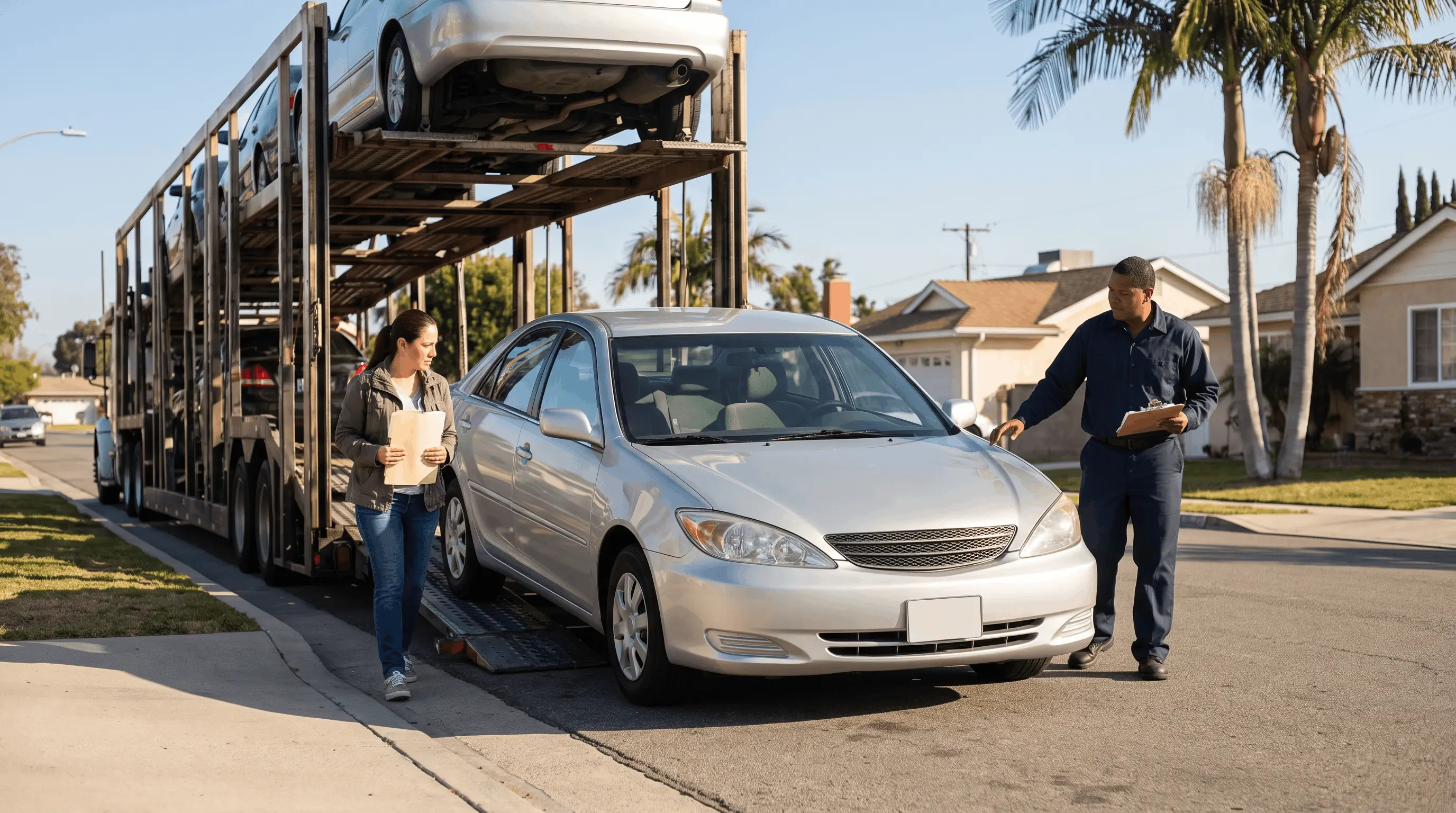
Keep the title, registration card and insurance papers with you rather than in the car. At delivery, inspect the car with the driver and note any damage on the bill of lading before you sign. Rivalane coordinates door to door transport into California with licensed, insured carriers. Price your route with the car shipping calculator, or read more about car shipping in California.
Frequently Asked Questions
How long do I have to register an out-of-state car in California?
Does an out-of-state car need a smog check to register in California?
Where can I get a VIN verification in California?
Can I register my car in California if a lender holds the title?
Will I owe use tax when I register an out-of-state car in California?