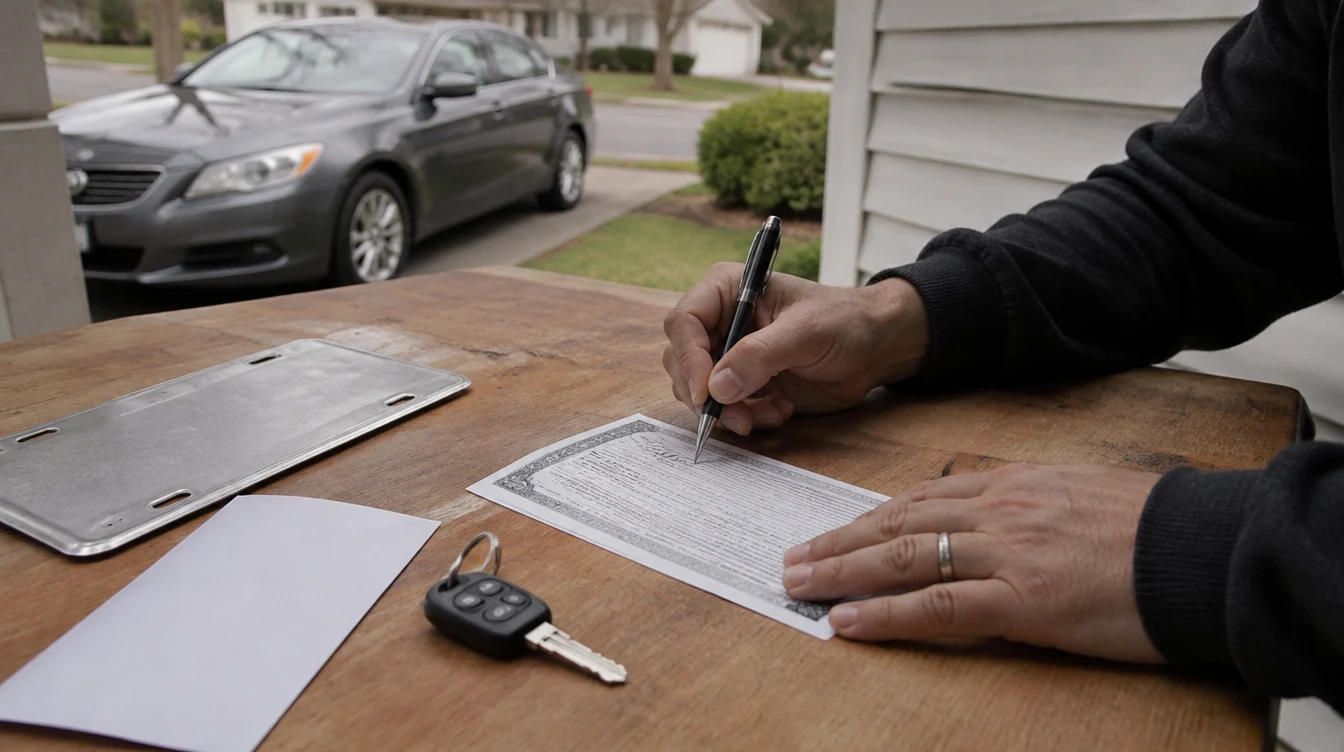
To sell a car in Ohio, a private seller completes the assignment on the back of the title, has the signature notarized, hands the title to the buyer and takes the plates off the car. The Ohio Bureau of Motor Vehicles (BMV) describes the notarized assignment on its vehicle titles page, and it covers an electronic title with a separate form. A seller whose buyer lives in another state follows the same steps and has one thing to settle before the car ships: how the title is handed over, which the clerk of courts title office can confirm.
This guide takes a private seller through each step, then walks through a Columbus seller whose buyer in Orlando has booked the transport. For the wider picture on payment and releasing a car to a carrier, see our guide to getting paid when the buyer lives in another state.
What Do You Need Before You Sell a Car in Ohio?
Start with the title and check three things on it: whether it is a paper certificate or held electronically, which owners are listed, and whether a lender is still recorded. Each one changes what you can hand over, and the owners named on the title are the people who sign the assignment.
Then agree the terms in writing with the buyer: the price, the payment method and who books the transport. Wait for your bank to confirm that the funds are final before you sign the title over or let the car leave.
How Does the Notarized Title Assignment Work in Ohio?
On a paper title, the seller completes the assignment of ownership portion on the back of the certificate and has the signature notarized, then presents the title to the buyer, according to the BMV's titles page. The Franklin County Clerk of Courts, whose title offices serve Columbus, confirms the assignment details for a paper title and that the seller's signature is witnessed.
Sign in front of the notary rather than beforehand, so the notarization covers your signature, and fill in every line the assignment asks for while you are there. A blank buyer line or a missing price creates a problem later: Florida treats a title with the buyer or the price left off as an open title and asks for a bill of sale to go with it.
The BMV titles page does not say whether the buyer has to attend the signing when the buyer lives out of state. Before the car ships, confirm the paper-title process with the Ohio Clerk of Courts Title Office, including how they handle a seller whose buyer is in Florida, and ask the buyer to check with Florida.
What Do You Record About the Mileage?
The seller discloses the odometer reading in writing when the title changes hands. The federal rule, 49 CFR Part 580, requires the disclosure on the title, signed and dated. Its exemptions depend on the model year: a car from model year 2010 or earlier is exempt, and one from model year 2011 or later stays covered until it is 20 years old. Record the true reading even when the car is exempt, since the buyer will want a record of it.
Paper Title or Electronic Title: What Changes When You Sell?
Ohio holds a title electronically while a lien is recorded on it. According to the BMV's lien release and title resource, the title stays electronic until the lien is cancelled, and the owner then chooses between a paper title and an electronic one. An owner who holds an electronic title and wants paper later can ask for it at any County Clerk of Courts title office, for a fee. The same resource says you do not need a paper title to sell or transfer the vehicle.
The difference is in the paperwork. With a paper title, you assign the back of the certificate. For an electronic title, the BMV directs a private seller to a separate form, BMV 3770, in place of the back of a paper title, for a transfer to an Ohio resident or an Ohio-based company. Check which one you hold before you promise the buyer a date, because a title you have to order from the clerk takes time.
Can You Use BMV 3770 When the Buyer Lives Outside Ohio?
Take care here. Form BMV 3770, the ownership assignment and title application for a casual sale, rests on Ohio Revised Code section 4505.032 and applies only when the title is held electronically and neither party is a licensed Ohio dealer. The seller completes the first page, signs it in front of a notary and certifies that the title is free of liens. The BMV's titles page describes the process as a transfer to a resident of Ohio or a company located in Ohio, and the form is written for that situation.
That is the scope of the BMV instructions: an Ohio resident or an Ohio-based company on the receiving end. A seller whose buyer lives in Florida should not assume the BMV 3770 process applies. Before the car ships, confirm the paper-title process with the Ohio Clerk of Courts Title Office, including whether to request a paper title first, so that the buyer receives a title Florida can accept.
What If There Is an Active Lien on Your Ohio Title?
You cannot give a buyer a clear title while a lien is still recorded. The lender has to release it first, and the BMV says the title stays electronic until the lien is cancelled. The form itself has the seller certify that the title is free of liens, so the payoff has to come before the paperwork, not after.
Ask the lender for a payoff figure and ask how and when it will release the lien. The sources we reviewed do not describe how a payoff works when the sale and the payoff happen together, so settle that with the lender and build its timing into the date you give the buyer. A Florida buyer also needs the lien dealt with: Florida's procedure asks for a lien satisfaction when the out-of-state title shows a lien.
Do You Need a Bill of Sale in Ohio?
The Ohio BMV pages we reviewed describe the notarized title assignment as the transfer and do not require a separate bill of sale for a private sale. Write one anyway. It records the price, the date and the condition of the sale, and it gives you a document that matches what the buyer files in Florida. Include the year, make and vehicle identification number, the date, the price and the names and signatures of both parties, and keep a copy.
What Happens to Your Plates After You Sell?
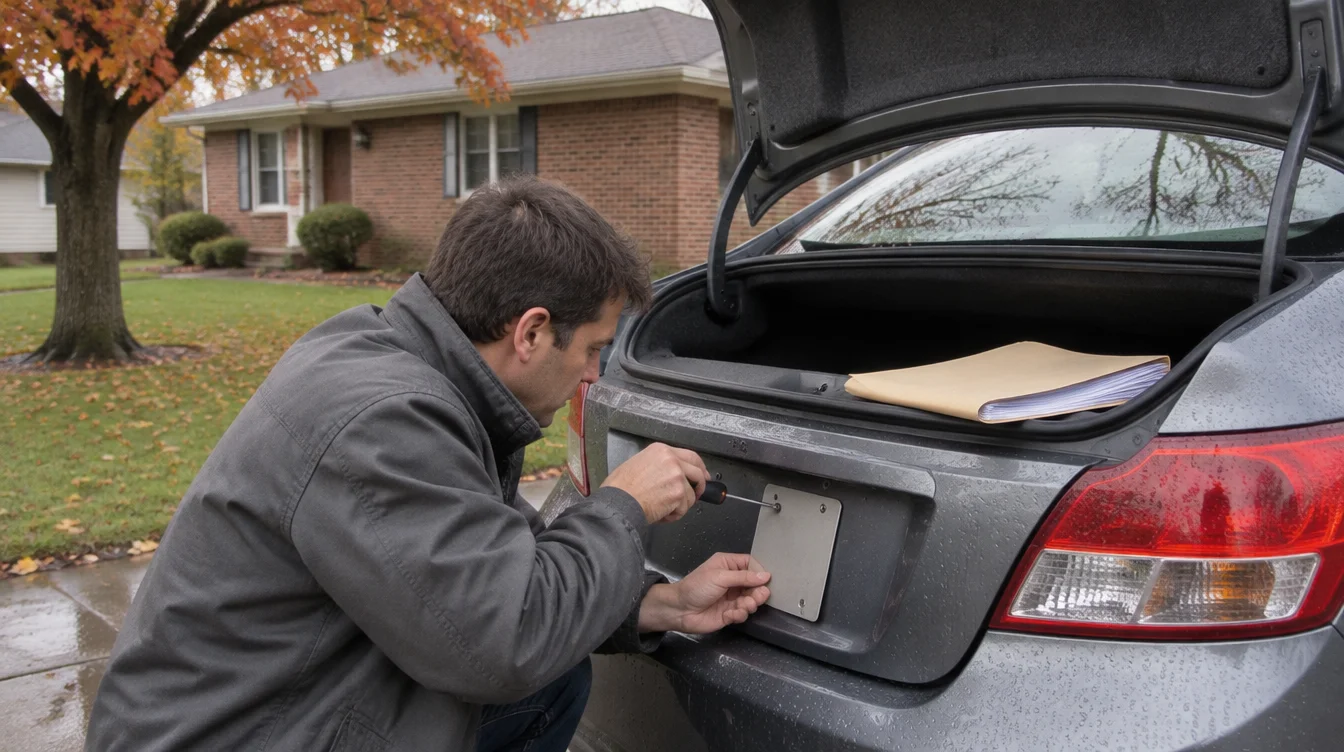
The plates stay with you. Under section 4503.12 of the Ohio Revised Code, the registration expires when ownership transfers, and on an ordinary sale the original owner immediately removes the license plates. The statute makes exceptions, such as moving the registration and plates to a replacement vehicle you buy, within the limits it sets, so check the current text if that is your plan.
If you are not moving the plates to another car, cancel the registration. The BMV's form BMV 4311 is the request to cancel a vehicle registration, and the form points to the BMV's online services as the quicker route. The form says documents and plates are not returned, so keep copies of what you send. Take the plates off before the carrier loads the car and tell your insurer the date the car left.
What Does a Florida Buyer Need to Bring?
Florida's Division of Motorist Services procedure for a first Florida title, TL-10 (the copy we reviewed is marked 05/25), lists what the buyer submits for a used car from another state, and the buyer should confirm the current requirements with the county tax collector before the car arrives:
- The Ohio title, properly assigned to the buyer
- A signed form HSMV 82040, the title application
- Identification, which Florida accepts from any state, or a passport
- A VIN verification, on HSMV 82042 or section 8 of the application
- Florida sales tax or proof of an exemption
- A plate number or a non-use statement, plus insurance and registration fees if the buyer is buying a plate
- A lien satisfaction, if the Ohio title shows a lien
- A bill of sale, if the title is open
The buyer has 30 days after delivery of the car to apply for the title under Florida Statutes section 319.23(6)(a), and a late fee applies after that. The procedure says notarization is not required on an out-of-state title, which is separate from the notarized assignment Ohio describes for the seller. Our guide on how a Florida buyer titles an Ohio car explains the insurance, the VIN verification and the service center visit.
What Changes When the Buyer Lives in Florida?
Your Ohio steps stay the same. You still assign the title, record the mileage and take your plates off, and the buyer titles and registers the car in Florida at home.
The handover is what changes, because the buyer is usually not there. The keys go to a carrier's driver, the title travels separately or with the car by agreement, and nobody can check a document at the curb. Settle who books the transport, who pays the carrier and when the title is sent before a pickup date is set. The bill of lading the driver has you sign is the other document to understand before pickup day.
Rivalane coordinates door to door transport with licensed, insured carriers. We typically assign a carrier within one to three working days after you book, and pickup and delivery dates are estimates, not guarantees. The car shipping calculator prices the trip for whoever is booking, and our Ohio car shipping page covers pickups across the state.
Example: A Columbus Seller Shipping a Car to a Buyer in Orlando
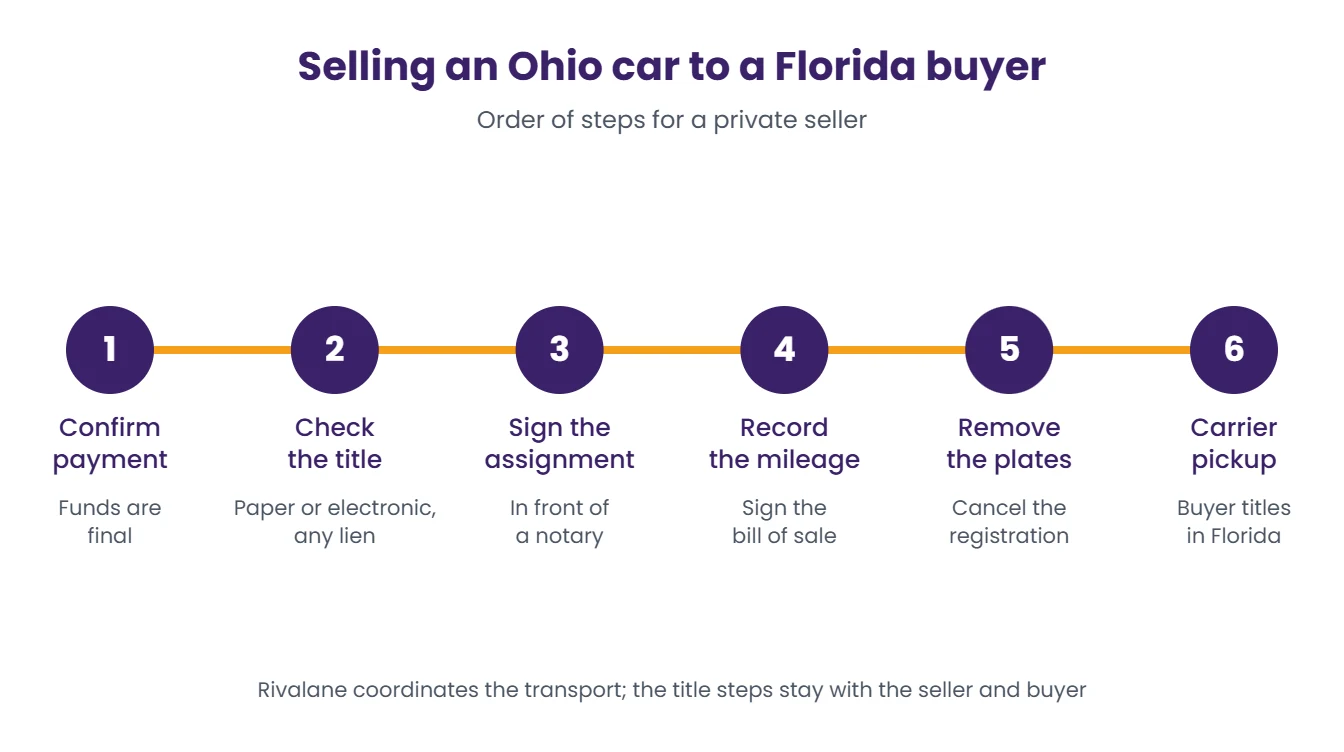
Here is how the steps fit together for a private seller in Columbus whose buyer lives in Orlando and has booked the transport.
- Payment. The buyer pays the agreed price, and you wait for your bank to confirm that the funds are final.
- The title. You check whether the title is paper or electronic and whether a lender is still listed. With a lien, the payoff and release come first.
- Signing. Before the car ships, you confirm the paper-title process with the Ohio Clerk of Courts Title Office, which for a Columbus seller is the Franklin County office. With a paper title you complete the assignment with your signature witnessed. With an electronic title you ask the office before you sign anything whether to request a paper title first.
- Mileage and bill of sale. You record the odometer reading, and you and the buyer sign a bill of sale.
- Sending the title. You agree how the assigned title reaches the buyer, because Florida asks for the Ohio title itself when a used car is titled there.
- Plates. You remove the plates before the carrier loads the car and cancel the registration, or move the plates to another vehicle you own.
- Pickup. You walk the car with the driver, check the condition report and send the buyer a copy of what you sign.
- The buyer's side. The buyer finishes the Florida steps in Orlando, starting with Florida insurance and the VIN verification.
The lane itself, from Columbus, Cleveland and Cincinnati pickups to deliveries across Florida, is covered on our page for moving an Ohio car to Florida.
Frequently Asked Questions
Does an Ohio title have to be notarized when I sell my car?
Can I sell a car in Ohio if the title is electronic?
What happens to my Ohio license plates when I sell my car?
What if I still owe money on the car I am selling in Ohio?
Can I sell my Ohio car to a buyer in Florida?