


Sixteen measured Arizona to Florida pairs run 1,779 to 2,411 miles, and an open sedan costs $1,150 to $1,675 across them. Typical transit after pickup is 5 to 8 days. Florida end towns move the mileage by up to 482, Arizona starts by up to 151.
Which Highways Carry a Car From Arizona to Florida?
Each figure on this Arizona to Florida car shipping page comes from one of sixteen measured pairs, with pickups in Chandler, Apache Junction, Nogales or Cottonwood and deliveries in Panama City, Port Orange, Boynton Beach or Bonita Springs. The shortest pair, Nogales to Panama City, covers 1,779 road miles and the longest, Cottonwood to Boynton Beach, 2,411. The core pair, Chandler to Port Orange, totals 2,125: 1,893 on I-10, 86 on I-12 and 80 on I-95, with the remainder on loops and connectors around Phoenix, San Antonio and Jacksonville. Its halfway point falls about 64 miles from Austin. I-10 is the spine of every pair. Panama City pairs leave it for SR 20, SR 77 and US 331 near the end, Bonita Springs pairs add 319 miles of I-75, and Boynton Beach pairs add 107 of I-75 and 28 of I-95. The plain routing sent Apache Junction loads over US 60 and US 70, Nogales loads over AZ 82 and AZ 90 and Cottonwood loads over I-40, I-20, US 287 and US 49, so those twelve pairs were measured with stops that hold them to I-10: Casa Grande and Tucson for Apache Junction, Tucson for Nogales and Phoenix for Cottonwood. Nogales loads then run 60 miles of I-19 and Cottonwood loads 99 of I-17 before I-10. Distances are routing software output, and the carrier handling your load may choose different roads.

Which Adds More Miles on This Run, the Arizona Pickup or the Florida Drop?
Your quote depends on your vehicle, the exact pickup and delivery addresses, the season and the trailer type, so run the calculator for a figure on your dates.
Florida decides far more of the mileage than Arizona does. Pick one Arizona start and its Florida towns span 481 or 482 miles; pick one Florida town and its Arizona starts span just 150 or 151 miles.
Out of Chandler the Florida ends measure 1,809 miles to Panama City, 2,125 to Port Orange, 2,282 to Bonita Springs and 2,291 to Boynton Beach. Toward Port Orange the starts measure 2,095 from Nogales, 2,125 from Chandler, 2,151 from Apache Junction and 2,246 from Cottonwood.
Inside Florida, Port Orange lies 316 miles past Panama City from Chandler, Bonita Springs 157 past Port Orange and Boynton Beach 9 past Bonita Springs. Inside Arizona, Chandler adds 30 miles to Nogales toward Port Orange, Apache Junction 26 more and Cottonwood 95 more.
Include both town names and a pickup date range in the request; the quote then matches the exact pair.

An open trailer sedan runs $1,150 to $1,675 on this run; Nogales to Panama City anchors the low end and Cottonwood to Boynton Beach the high end. Use the calculator, entering both towns and a date range, to price your pair.
Vans and pickups cost roughly 100 to 200 dollars more. An enclosed trailer costs more since it holds fewer cars, and a vehicle that cannot run is loaded with a winch, a charge listed on the quote.
- Florida end. Per Arizona pickup, the four Florida drops differ by 481 to 482 miles.
- Arizona start. For a fixed Florida town, the Arizona starts span 150 to 151 miles.
- Cottonwood pairs. All four fall between 1,930 and 2,411 miles, and the other twelve reach 2,316 at most.
If a quote sits well under the band, find out who the carrier is and confirm a truck is really assigned.

What Factors Actually
Influence Pricing on This Route?
Five things move the price on any lane: the vehicle's size, whether it runs, how easy each end is to reach, the season and the trailer type. Booking early protects your timeline, keeps pricing steady and reduces the risk of last-minute carrier changes.


Type
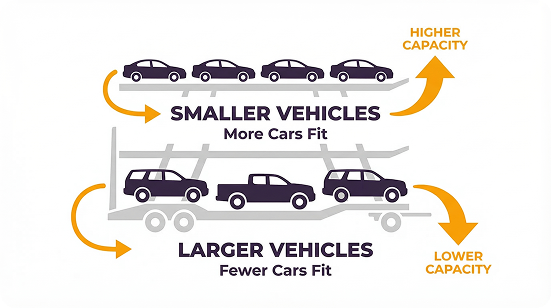
Size decides how much deck space your vehicle takes and how many other cars fit alongside it. A standard sedan is the cheapest thing to move because it slots almost anywhere on the trailer. SUVs, pickups and vans take more room and usually cost more on the same lane.


Is a Carrier or Your Own Drive the Better Fit From Arizona to Florida?
Letting a Carrier Haul It
Nogales to Panama City is the short pair at 1,779 miles and about 31.2 hours of driving, while Cottonwood to Boynton Beach is the long pair at 2,411 miles and about 42.3 hours.
A carrier suits a household moving east with a second car to bring along, a car bought from an Arizona seller and wanted in Florida, or anyone who would rather fly than spend days on I-10.
Driving It Yourself
Behind the wheel, the core pair, Chandler to Port Orange, needs roughly 37.1 hours by routing software, plus fuel, meals and motel nights. Its halfway point sits about 64 miles from Austin.
Line up fuel, a run of motel stays, meals and the flight home next to the carrier quote. A road trip fits one car and a free calendar; a second car, or a Florida start date that cannot slip, tilts the choice toward a carrier.
How Long Does Arizona to Florida Car Shipping Take?
Transit after loading typically comes to 5 to 8 days. Nogales to Panama City is the short pair at 1,779 miles and Cottonwood to Boynton Beach the long pair at 2,411.
That count starts at loading. Ahead of it, the truck search by dispatch takes 1 to 3 working days from booking, so keep pickup dates flexible. Schedules can slide; the cross country timing guide explains why.
A Gulf Coast storm, a late handoff or a delay at an earlier stop can each push delivery back. No delivery date is promised, so plan around the range loosely.
How Soon Should You Book Arizona to Florida Auto Transport?
Settle your dates first, then say how many days either side of pickup you can flex. Wider windows reach more trucks, some of them already running east on I-10 from the Phoenix area.
The four starts sit well apart: Chandler in the southeast Phoenix area, Apache Junction on its eastern edge, Nogales at the Mexican border south of Tucson and Cottonwood in the Verde Valley of central Arizona. Cottonwood adds 151 miles over Nogales toward the same Florida town, so say which pickup town you mean.
Ahead of pickup day, go through the car prep guide.
Open or Enclosed Trailer for an Arizona to Florida Car?
On this run the usual choice is an open trailer, a two deck rack with no walls or roof. Across 1,779 to 2,411 miles an open load meets desert sun, Gulf Coast humidity and heavy rain.
An enclosed trailer shields the car for the entire trip and costs more because it holds fewer cars.
Collectors, owners of low sports cars and anyone with fresh paint may find the cost worth paying; an everyday car usually goes open.
Enclosed Car Transport
Enclosed demand rises for high-value, specialty and seasonal vehicles, and enclosed trailers protect against road debris and weather, which matters most on longer hauls. Enclosed rigs are a small fraction of the trailers working any given lane, and that scarcity is what drives both the higher price and the longer booking lead time.
Open Car Transport
Most vehicles move on open trailers, and for most routes that is the more cost-effective way to ship a car.
Open transport works well for standard vehicles and keeps costs predictable. It also offers the widest carrier availability.
Delivery Day in Florida
Dispatch needs the full Florida address, plus any unit number or gate code, well before pickup. Keep your phone on during delivery day, because the driver will call to arrange where to meet. Should the final turn defeat a full size rig, the driver may offer a broad intersection or a parking lot nearby.
After unloading, inspect it in daylight, one panel at a time, against your loading photos. Any new mark, scratch or dent goes on the delivery report in writing before you sign: ask the driver to write it down, then photograph the signed form.
Where Will the Truck Meet You at Each End, in Arizona and in Florida?
Car haulers are long, tall and heavy, so a number of residential streets rule them out. A cul de sac in Chandler, a tree lined lane in Cottonwood, a crowded block in Apache Junction or a narrow road near Nogales may mean meeting on a main avenue or in a supermarket lot. The Arizona car shipping page lists further pickup areas.
Delivery runs into the same limits. A beachside street in Boynton Beach, a gated community in Bonita Springs, a busy block in Port Orange or a narrow road near Panama City may mean meeting at a parking lot close by. The Florida car shipping page describes more delivery areas.
Whichever end you stand at, circle the car with the driver, compare each panel with the inspection report and take dated photos. File the signed report alongside the bill of lading afterward.

Which Details Belong in an Arizona to Florida Quote Request?
As a broker, Rivalane has no trucks or drivers; the car rides with a carrier that holds the required license. Florida towns can add as much as 482 miles and Arizona towns as much as 151, so name both towns in the quote request.
Frequently Asked Questions