


A sedan shipped open on any of sixteen measured Colorado to Texas pairs costs $825 to $1,225 over 566 to 1,171 miles, with transit typically 3 to 6 days. The Texas end can shift the total by up to 524 miles, the Colorado start by up to 206.
Which Roads Carry a Car From Colorado to Texas?
The measurements here cover Colorado to Texas car shipping on sixteen town pairs. The Colorado starts are Fort Collins, Boulder, Colorado Springs and Grand Junction, and the Texas ends are Houston, Dallas, Austin and El Paso. The pairs run from 566 to 1,171 road miles. No pair needed a forced stop, and each one ran on interstates and US highways. Houston loads finish on I-45, which carries 238 miles for every start. Austin loads share US 84 for 153 miles and I-27 for 109. El Paso loads from the three Front Range towns use US 54 for 210 miles, while the Grand Junction load uses US 550 for 300. Dallas loads from Boulder, Colorado Springs and Grand Junction ride US 287 for 172 miles, and the Fort Collins load stays on that highway for 423. A routing engine picked these roads, and the carrier given your booking may choose different ones.

What Moves the Mileage More on This Haul, the Start or the End?
Your quote depends on your vehicle, the exact pickup and delivery addresses, the season and the trailer type, so run the calculator for a figure on your dates.
On this haul the Texas end moves the total far more than the Colorado start. For any Colorado start, the four Texas ends land 379 to 524 miles apart, while for any Texas end the four Colorado starts land 133 to 206 apart.
Hold the Texas end at Dallas and the four starts measure 727 miles from Colorado Springs, 824 from Boulder, 839 from Fort Collins and 932 from Grand Junction. Hold the start at Boulder and the four ends measure 663 miles to El Paso, 824 to Dallas, 946 to Austin and 1,063 to Houston.
Houston sits 239 miles beyond Dallas for all four starts. Austin sits 121 to 142 miles beyond Dallas, and El Paso sits 140 to 285 miles short of it. On the Colorado side, measured to Dallas, Boulder runs 97 miles longer than Colorado Springs and Grand Junction runs 93 longer than Fort Collins. Vehicle size matters too: an SUV or truck takes more trailer room than a compact.
Name both towns and your pickup window in the quote request, and the figure reflects the pair you will actually ship.

A sedan hauled open runs $825 to $1,225, with Colorado Springs to El Paso near the low end and Grand Junction to Houston near the high end. The calculator takes your two towns and dates and returns a figure for your own pair.
Enclosed service costs more, since a trailer holds fewer vehicles. Large vehicles such as a pickup or van typically add 100 to 200 dollars to the price. A non running car needs winch loading, billed as a separate line.
- Texas end. Pairs from one Colorado start differ by 379 to 524 miles across the four ends.
- Colorado start. Pairs into one Texas end differ by 133 to 206 miles across the four starts.
- Texas roads. From the three Front Range starts, Houston loads run I-45 for 238 miles, Austin loads US 84 for 153 and El Paso loads US 54 for 210.
Be wary of a bid far under this band, and ask which carrier will load the car and whether a truck is assigned.

What Factors Actually
Influence Pricing on This Route?
Five things move the price on any lane: the vehicle's size, whether it runs, how easy each end is to reach, the season and the trailer type. Booking early protects your timeline, keeps pricing steady and reduces the risk of last-minute carrier changes.


Type
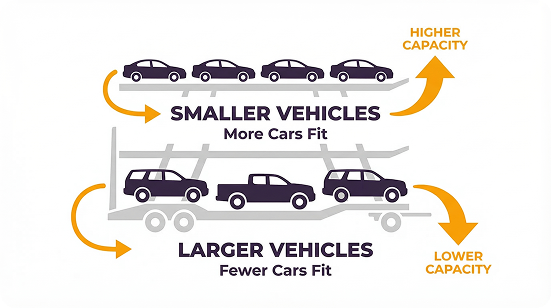
Size decides how much deck space your vehicle takes and how many other cars fit alongside it. A standard sedan is the cheapest thing to move because it slots almost anywhere on the trailer. SUVs, pickups and vans take more room and usually cost more on the same lane.


Is a Carrier or Your Own Driving Better From Colorado to Texas?
Putting the Car on a Truck
The shortest pair, Colorado Springs to El Paso at 566 miles, still means about 11.0 hours of driving, and Grand Junction to Houston takes about 22.4 hours over 1,171 miles.
A carrier fits when one driver has to move two cars, when a new Texas job starts soon, or when a vehicle is sold or bought in the other state.
Taking the Wheel
Boulder to Dallas means about 14.9 hours at the wheel on I-25 and US 287, before any stops.
Fuel, motel stays, meals and the ride home all belong in the comparison. Ask for a quote on your two exact towns to get a number to set beside them. Driving suits one car and plenty of time, while two vehicles or a set start date point toward a carrier.
How Long Does a Car Take to Get From Colorado to Texas?
After loading, a truck typically needs 3 to 6 days to cross from Colorado to Texas. Colorado Springs to El Paso at 566 miles is the short end, and Grand Junction to Houston at 1,171 miles is the long end.
Counting begins at loading. Before it, a carrier has to be lined up, about one to three working days counted from booking, so leave some give in the pickup window. The cross country timing guide covers what moves a schedule.
Winter weather on I-25, a breakdown or a delayed handoff can add about a day. Treat the range as a planning figure, not a delivery date promise.
When Should You Book Colorado to Texas Transport?
Book once your move dates are firm, and tell dispatch whether pickup can shift by a day or two. A flexible window can put a car on a truck already heading south on I-25.
Colorado keeps Mountain time, and Texas keeps Central time everywhere except El Paso, which stays on Mountain time, so the clock moves one hour ahead for Houston, Dallas and Austin. Fort Collins, Boulder and Colorado Springs sit on the Front Range, while Grand Junction sits across the mountains on the Western Slope. That gap makes Colorado Springs to El Paso 605 miles shorter than Grand Junction to Houston.
The car prep guide lists what to handle before the truck arrives.
Open or Enclosed for a Car Moving From Colorado to Texas?
Open transport uses an uncovered carrier and is the usual pick on this lane. Over 566 to 1,171 miles the finish sees road grit, sun and some weather.
Enclosed trailers keep the car covered from pickup to drop off and cost more, since each load holds fewer cars.
A vintage car, a show winner or a new paint job has a real case for paying more, while an everyday car typically rides open and arrives in good shape.
Enclosed Car Transport
Enclosed demand rises for high-value, specialty and seasonal vehicles, and enclosed trailers protect against road debris and weather, which matters most on longer hauls. Enclosed rigs are a small fraction of the trailers working any given lane, and that scarcity is what drives both the higher price and the longer booking lead time.
Open Car Transport
Most vehicles move on open trailers, and for most routes that is the more cost-effective way to ship a car.
Open transport works well for standard vehicles and keeps costs predictable. It also offers the widest carrier availability.
Planning the Texas Delivery
Share the full Texas delivery address with dispatch early, along with a unit number or gate code if there is one, and take the driver call that fixes the meeting time. When the street is too narrow for a full size trailer, suggest a wide road or a nearby lot.
Inspect the car in daylight once it is unloaded and compare it with the photos you took at pickup. Add any new mark to the driver paperwork ahead of signing, then hold on to your copy.
Pickup and Delivery: What to Plan For in Colorado and Texas
Auto haulers are big rigs, and plenty of residential streets are too narrow or too steep for one. A steep driveway, a tight cul-de-sac or a hillside lane in Boulder, Colorado Springs, Fort Collins or Grand Junction can push the handoff to a wide side street or a mall parking area. Other Colorado pickup areas appear on the Colorado car shipping page.
Delivery in Texas follows the same logic. A gated community in Austin, a crowded block in Houston or a downtown street in Dallas may need a handoff in a nearby lot, and El Paso has similar limits. More Texas delivery areas appear on the Texas car shipping page.
Both at pickup and at drop off, inspect the car beside the driver and tick each panel against the written condition report. Add your own dated photos, then sign the final report and keep a copy beside your bill of lading.

What Should You Know Before Requesting a Colorado to Texas Quote?
Rivalane works as a broker, and the trucks belong to the carriers it books. The licensed carrier assigned to your booking does the hauling. The Texas end can change the total by 524 miles, the Colorado start by 206, so give exact towns when you request a quote.

How to Ship a Car to the Goodguys Colorado Nationals in Loveland: What Actually Happens Behind the Scenes
Read moreFrequently Asked Questions