Rivalane arranges open and enclosed car shipping to and from Colorado, along the I-25 and I-70 corridors and out to the towns that sit off them. Every shipment moves under the carrier's cargo insurance, and you get one point of contact from booking through to delivery.





5-Star Average Rating
Fully Insured
Top Rated Service
Nationwide Coverage
Vetted Carriers
Shipping a vehicle to or from Colorado is mostly a question of access. The Front Range is easy to reach and the rest of the state is not, so the work is matching your route to a carrier already running it and being straight with you about the days that route is available. Rivalane arranges the shipment, checks the operating authority and cargo insurance of the carrier that loads your car, and keeps one point of contact on it from booking through to delivery. If your pickup or delivery sits west of the Divide or out on the plains, we tell you what that does to the schedule before you book rather than after.


Cost and timing depend on your route, trailer type, vehicle size, and the time of year. The ranges below reflect typical market pricing and transit windows by distance, not a commitment on either. Your actual quote is based on real carrier availability on your specific route at the time of booking.
Colorado prices the way it does because of what is not near it. Denver is the most isolated major metro in the country, with Albuquerque roughly 450 miles away, Salt Lake City 525 and Kansas City 600. There is almost no short regional market to price against, so a short Colorado move is quoted closer to the cost of sending a carrier out than to the cost of adding a car to a load already running. Longer moves work the other way. I-25 north to south and I-70 east to west carry heavy through-freight, so a vehicle heading to California, Texas or the East Coast joins traffic that was already moving and prices competitively for the distance.
Where you are in Colorado matters as much as how far the vehicle is going. Most of the population sits on the I-25 Front Range corridor, and addresses in Fort Collins, Longmont, Boulder, Denver, Colorado Springs and Pueblo price near the low end because carriers run that line constantly. West of Denver the picture changes. I-70 climbs through the Eisenhower Tunnel and over Vail Pass, and between roughly September and May the state can impose traction and chain requirements on that stretch. A carrier that has to fit the route around a closure or a traction restriction is a carrier making one delivery rather than several, and mountain addresses price accordingly. The Western Slope around Grand Junction and the eastern plains sit off the corridor for the same reason.
Vehicle size, whether the car runs, and trailer type all move the number, and enclosed transport runs roughly forty percent above open because fewer vehicles fit on the trailer. The factor most within your control is lead time. Booking a week or two ahead puts your vehicle on a truck already running I-25 or I-70 rather than one routed out to collect it, and that gap widens for mountain and Western Slope addresses. Winter widens it again on the I-70 corridor, so if the delivery point is above the tunnel it is worth giving us a wider pickup window rather than a fixed date.
Get your Colorado quoteShipping a vehicle to or from Colorado runs through the same five steps whether the car is going door to door in Denver or coming off an address west of the Divide. Here is what happens at each one.





Start by entering your pickup and delivery ZIP codes in the quick form. Your estimate is built from the distance, the route and whether you choose open or enclosed transport.

Select a pickup time that fits your schedule. We coordinate directly with your assigned carrier, verify availability and keep you informed from the moment your shipment is booked.

Before pickup, take out personal belongings and make sure the car is ready to be inspected. The driver records the vehicle's condition at collection and you get a copy of that report, so there is an agreed record of how the car looked before it went on the trailer.

The carrier loads your car and secures it for the route ahead. On Colorado runs that usually means planning the I-25 or I-70 leg around conditions, and through winter around traction restrictions, so the vehicle moves when the road is open rather than waiting at a yard. You keep one point of contact for the whole trip, and if the schedule shifts we tell you.

At drop-off the car is inspected again against the report from pickup, so anything that changed is documented at the point of delivery rather than after the fact. The paperwork is finished there and the shipment is complete.

Rivalane arranges open, enclosed and expedited transport on Colorado routes, and matches each shipment to a carrier already working that lane. Which option fits depends on the vehicle, the route and how much flexibility you have on dates.
We handle everything from local moves to cross-country transport, whether the car is going across Denver or to the other side of the country. Every carrier we work with holds active operating authority and cargo insurance.
The standard choice for most vehicles, and the same method dealerships use to move their own stock. Your car travels on an open trailer alongside others, which is why it costs less than enclosed and why most Colorado shipments go this way.
For luxury, classic and exotic vehicles, an enclosed trailer keeps the car away from weather and road debris for the whole route. It runs roughly forty percent above open because fewer vehicles fit on the trailer, and it is what most owners choose when the condition of the car matters more than the saving.
When the timing is tight, expedited narrows the pickup window and puts your vehicle ahead in the queue for carrier assignment. It suits urgent relocations and business deliveries, though the date still depends on what is running your route that week.
Most Colorado shipments start or end on the I-25 corridor, but plenty do not. We arrange pickup and delivery on the Western Slope around Grand Junction, in the mountain towns off I-70, and out on the eastern plains where the nearest interstate can be an hour away. Those addresses need a carrier willing to leave the through lane, so tell us the exact location early and we will match one to it.
Every shipper claims to be reliable, and that claim is hard to test from the outside. Here is what actually separates a well-run Colorado move from a risky one, and what to ask before you book.
Ask whether the company can name a real Colorado constraint before you raise it, such as the VIN verification every out-of-state vehicle needs before it can be registered, or how they reach an address above the Eisenhower Tunnel in February.
Ask whether the price you are quoted is based on your actual route and vehicle, or a generic distance estimate that gets revised once a carrier is assigned.
Ask what happens if no carrier is available on your exact date. A shipper working from an existing carrier network can usually offer options faster than one starting from scratch, and that gap is widest for pickups away from the I-25 and I-70 corridors.
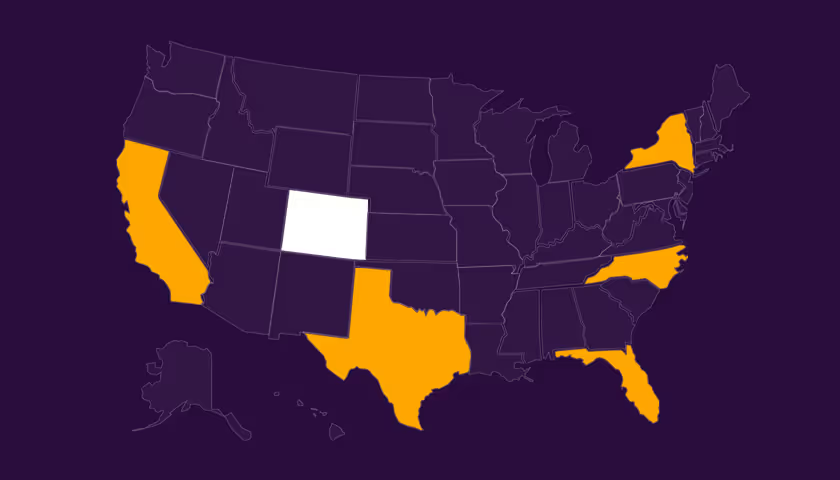
Get your Colorado quoteColorado sends out more vehicles than it takes in, and the demand runs in a few clear directions, with California and New York the busiest. Here is who ships, and what each one needs to have ready.
.svg)
Many Colorado buyers purchase sight unseen from another state. We arrange pickup from the seller or the dealership and deliver to your Colorado address, so nobody has to fly out and drive it back. Every vehicle titled in another state needs a VIN verification on form DR 2698 before Colorado will register it, and depending on where you live it may also need an emissions test. Whether that applies depends on your exact address, so confirm it with the county motor vehicle office. A car you have never seen has to pass that test before it can be registered, so ask the seller about the exhaust, the check engine light and any recent repairs before you buy. Keep the out-of-state title with the paperwork, because Colorado surrenders it before issuing one of its own.
Estimate your shipment →.svg)
A car you already own runs on a 90-day clock. It starts when you take a job here, open a business, or simply live here for 90 days, whichever comes first. Colorado's registration requirements are worth planning around, because the meter starts before you reach the counter. Registration fees and the annual specific ownership tax are prorated back to the date your residency began rather than the date you register. That ownership tax is set against what the vehicle listed for when it was new rather than what it is worth today, which catches people bringing in an older car that was expensive once. Tell us your arrival dates and we will plan the drop-off around them.
Vehicle transport services →
A vehicle that does not start needs a carrier with a winch and the right loading setup, and that is a smaller pool than standard open transport. Tell us the condition up front, including whether it rolls, steers and brakes, and we match it to a carrier equipped for it rather than discovering the problem at pickup. The same applies to a project car coming home from a workshop or a long-stored vehicle leaving a garage.
Quote a non-running vehicle →
Work and family moves take vehicles in and out of Colorado, and the distance is the part people underestimate. Denver sits further from the next major metro than any other large city in the country, so almost every Colorado move is a long one and the carrier is committing to the route rather than adding you to a short local run. I-25 north to south and I-70 east to west carry most of that traffic. We arrange pickup across Denver, Colorado Springs, Aurora, Fort Collins, Boulder and Pueblo, then hand the vehicle to a carrier already working that direction. On a long lane the date matters more than it does on a regional hop, because fewer trucks run any given route in a given week.
Estimate a long-distance move →Looking to ship your car to another state or across the country? Rivalane ships to all 50 states. Select a state to see how car shipping works there, including what it costs, how long it takes, and what the state asks of your vehicle on arrival.
The list below tracks how unusually concentrated Colorado's population is. The great majority of the state lives in the Front Range urban corridor, a strip running roughly 175 miles from Fort Collins down through Denver to Pueblo, which is why most pickups and deliveries cluster along I-25. Grand Junction is the notable exception, sitting on the far side of the Continental Divide. Pick a city to see the ZIP codes covered there.