


Across sixteen measured legs from eight Idaho towns to Long Beach and Oakland, the road leg runs 653 to 1,114 miles, with an open sedan at $825 to $1,200 for that leg. Most cars reach the port in 3 to 5 days. Oakland is the shorter port from seven of the eight starts, by 38 to 461 miles.
How Do You Get a Car From Idaho to Hawaii?
Idaho to Hawaii car shipping is two jobs, and the figures on this page describe the road leg: the drive from an Idaho pickup to a mainland port. Eight Idaho towns, Weiser, Mountain Home, Hailey, Rupert, Salmon, Driggs, Soda Springs and Preston, were each routed to Long Beach and to Oakland, both in California, which gives sixteen legs of 653 to 1,114 miles. Thirteen come in under 1,000 miles and three reach 1,000 or more. Weiser to Oakland is the shortest at 653 and Weiser to Long Beach the longest at 1,114. The core leg, Mountain Home to Long Beach, totals 1,000: 679 on I-15, 257 on I-84, 19 on I-10 and 15 on I-605, with about 30 on connecting roads. The Oakland legs lean on I-80 instead, for 546 or 547 miles from six of the eight starts and 374 from Weiser and Mountain Home. Past the port gate the shipping line takes over: it controls the ocean crossing, the sailing schedule and the ocean price, none of which this page covers. Every mileage and hour figure comes from routing software, and carriers sometimes pick other roads for a load.

How Much Does the Choice of Port Change an Idaho Road Leg?
Your quote depends on your vehicle, the exact pickup and delivery addresses, the season and the trailer type, so run the calculator for a figure on your dates.
That depends on the start. Oakland is the shorter run from seven of the eight Idaho towns, by as little as 38 miles from Soda Springs or as much as 461 from Weiser, and Preston is the one start where Long Beach comes out 39 miles shorter.
Down the Long Beach column the starts run from 813 miles at Preston to 1,114 at Weiser, a spread of 301. The Oakland column runs from 653 at Weiser to 921 at Salmon, which is 268 apart.
The western starts feel the port most. Choosing Oakland saves 461 miles from Weiser and 326 from Mountain Home, then 250 from Hailey, 175 from Rupert, 155 from Salmon and 93 from Driggs, while Soda Springs and Preston barely notice.
A quote needs three things: your Idaho town, the port on your sailing booking and the dates you could hand the car over. With those the desk can price that one leg.

A sedan on an open trailer pays $825 to $1,200 for the road leg across these sixteen legs. Short runs like Weiser to Oakland price toward the bottom of that range, and the long Weiser to Long Beach run toward the top. The calculator takes your Idaho town, port and dates and prices that exact leg.
That figure is for the drive to the port alone. Ocean freight is billed by the shipping line, and Hawaii use tax, where it applies, is calculated once the car lands.
A van or pickup typically costs roughly 100 to 200 dollars more than a sedan. Enclosed carriage costs extra, and a vehicle that has to be winched onto the truck carries its own charge.
- Idaho start. Toward Long Beach the eight starts differ by 301 miles.
- Port. The two ports differ by 461 miles from Weiser, and by 39 miles the other way from Preston.
- Eastern starts. Soda Springs and Preston barely change with the port, by 38 and 39 miles.
A quote far below this range is a prompt to confirm the carrier name and that a truck is truly assigned.

What Factors Actually
Influence Pricing on This Route?
Five things move the price on any lane: the vehicle's size, whether it runs, how easy each end is to reach, the season and the trailer type. Booking early protects your timeline, keeps pricing steady and reduces the risk of last-minute carrier changes.


Type
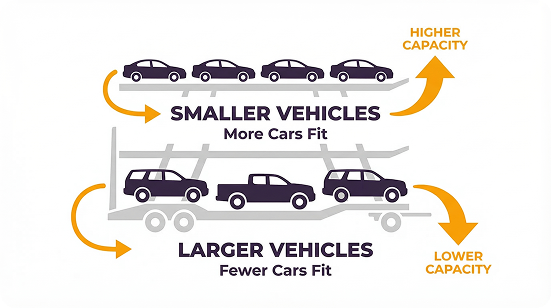
Size decides how much deck space your vehicle takes and how many other cars fit alongside it. A standard sedan is the cheapest thing to move because it slots almost anywhere on the trailer. SUVs, pickups and vans take more room and usually cost more on the same lane.


Hire a Carrier, or Drive Yourself to the Port From Idaho?
Using a Carrier
Rupert to Long Beach runs 883 miles and 15.4 hours, while Salmon to Long Beach runs 1,076 miles and about 19.1 hours, so the town you start from decides how much road a truck covers.
A carrier fits a driver who cannot take two days off for I-84 and I-15, a car already holding a sailing slot, or a household move with nobody free to take the car to the terminal.
Driving Yourself
Driving the core leg, Mountain Home to Long Beach, takes about 17.2 hours by the routing software before fuel, food and sleep. You also need a way home from the port, and from Long Beach that is a long trip back north.
Set the carrier quote beside fuel, hotels, the ride back and time away from work. Whichever day you pick, the shipping line limits how early the car may arrive and when its gate closes, so build the drive backward from the sailing date.
How Many Days Until the Car Reaches the Port From Idaho?
From pickup to the port gate, most loads take 3 to 5 days. Preston to Long Beach at 813 miles sits at the quick end, while Weiser to Long Beach at 1,114 miles takes the longest.
That count covers the road leg only. Once the sailing is booked and the road leg is requested, assigning a carrier occupies 1 to 3 working days before a pickup can be set, so a tight date may slip. The crossing follows a timetable owned by the shipping line, and this page gives no sailing time. For more on the two clocks, read the guide to how long it takes to ship a car.
Mountain weather or a late earlier stop can delay the port arrival, so treat each date as an estimate.
When Should You Book Idaho to Hawaii Auto Transport?
Start with the sailing, not the truck. The shipping line sets how early a car may be dropped off and a cutoff for each departure, so the Idaho leg is worked out in reverse from the date the car has to be at the terminal. Give dispatch a span of dates rather than a single day, because a wider span reaches more carriers, including some already routed to Southern California on I-15 or the Bay Area on I-80.
The eight pickup towns are spread out: Weiser and Mountain Home in the west, Hailey and Rupert in the south central part, Salmon and Driggs in the east, and Soda Springs and Preston in the southeast. Weiser adds 461 miles to the Long Beach run compared with Oakland, so name the exact town and the port.
Use the car prep guide to get the car ready, and photograph it ahead of the pickup.
Open or Enclosed Trailer for the Idaho Road Leg?
Most cars ride an open trailer, a double deck carrier with no enclosure. Across 653 to 1,114 miles an open load meets sun, dust and mountain weather.
An enclosed trailer shelters the car over that same road leg and costs more since a truck carries fewer vehicles. How the line stows the car at sea is its own call, whichever trailer you pick.
Enclosed suits a classic, a low coupe or a fresh respray, while an everyday sedan generally does well open.
Enclosed Car Transport
Enclosed demand rises for high-value, specialty and seasonal vehicles, and enclosed trailers protect against road debris and weather, which matters most on longer hauls. Enclosed rigs are a small fraction of the trailers working any given lane, and that scarcity is what drives both the higher price and the longer booking lead time.
Open Car Transport
Most vehicles move on open trailers, and for most routes that is the more cost-effective way to ship a car.
Open transport works well for standard vehicles and keeps costs predictable. It also offers the widest carrier availability.
Delivering the Car to the Terminal Gate
Before pickup, send dispatch the complete Idaho address, any gate code and the port on your booking. Keep your phone on that day: the driver calls ahead to settle a meeting spot, and if the final stretch is too narrow the driver may suggest a wide intersection or a lot close by.
At the terminal gate the driver hands over the car and the road leg ends. The line, not the carrier, writes up the bill of lading there, tied to your booked sailing, and the island port gives the car back against it. Check three things with the line: the latest drop-off time, how much fuel may be in the tank, and which items it will not accept. The car should be clean inside and empty when the carrier loads it.
Where Is the Idaho Pickup Spot, and Where Does the Truck Stop at the Port?
A full size hauler cannot always reach a house. A steep driveway in Hailey, a farm lane outside Rupert or a tight street in Weiser can end with the driver waiting at a wider street corner or a big lot nearby. The Idaho car shipping page explains more about where trucks load.
The handoff to the line happens at the terminal gate, where the carrier finishes. From there the shipping line has the car, and Rivalane has no hand in the crossing, so confirm the terminal and gate hours with your shipping line when you book. For islands, ports and Hawaii rules, see the Hawaii car shipping page.
Before signing at pickup, check the car against the inspection report and your photos, and hold on to a copy of the report. The shipping line writes up the bill of lading at the terminal, not the carrier at pickup.

What Should You Tell Rivalane When Requesting an Idaho to Hawaii Quote?
Rivalane is a licensed broker, not a carrier: it has no trucks and no drivers on staff, and a vetted carrier hauls the car to the port. Share the Idaho town, the port your sailing uses and the island you are heading for, so the quote prices the correct leg.
Frequently Asked Questions