


A sedan moving from Kansas to California on an open carrier is priced at $825 to $1,250, with most deliveries landing 4 to 6 days after loading. Sixteen pairs measure 1,408 to 1,617 miles, and the Kansas start moves that figure by 172 miles against 37 to 38 for the California end.
Which Roads Take a Car From Kansas to California?
Kansas to California car shipping here rests on sixteen measured pairs. Four Kansas starts, Topeka, Salina, Manhattan and Overland Park, pair with four California ends, Riverside, San Bernardino, Ontario and Anaheim. Distances run from 1,408 miles for Salina to San Bernardino up to 1,617 for Overland Park to Anaheim, and nine of the sixteen pairs top 1,500 miles. Every pair follows I-70 westbound for most of the trip, from 923 miles for the Salina starts to 1,089 for Overland Park, and then turns onto I-15 for 454 to 472 miles into Southern California. Riverside and San Bernardino cars add a short stretch of I-215, Ontario cars stay on I-15, and Anaheim cars finish on CA-60 and CA-57. A driver may pick other roads.

Does the Kansas Start or the California End Change the Miles More?
Your quote depends on your vehicle, the exact pickup and delivery addresses, the season and the trailer type, so run the calculator for a figure on your dates.
Here the Kansas town sets most of the distance. With Riverside as the delivery city, Salina is 1,420 miles away, Manhattan 1,482, Topeka 1,526 and Overland Park 1,592, a spread of 172. Swap in Anaheim and the same four starts read 1,445, 1,507, 1,551 and 1,617, which is 172 again.
The California end counts for less. Hold Topeka as the pickup and San Bernardino reads 1,514, Ontario 1,523, Riverside 1,526 and Anaheim 1,551, only 37 apart.
Vehicle type moves the figure too, because oversize SUVs, vans and trucks occupy extra trailer length, and closed trailers hold fewer cars.
Put the Kansas town, the California city and your date flexibility into the quote request.

Expect an open trailer to run $825 to $1,250 for a sedan moving from Kansas to California. Salina to San Bernardino prices toward the low end and Overland Park to Anaheim toward the top. To refine the figure, enter your two towns in our calculator.
Enclosed pricing sits about half again higher than open. Oversize SUVs, vans and trucks cost about 100 to 200 dollars extra for the added deck room, and a non-running vehicle requires a winch to load, which adds a fee.
- Kansas start. Hold the California city fixed and the four Kansas towns still differ by 172 miles.
- California end. Hold the Kansas town fixed and the four California cities differ by only 37 to 38 miles.
- Final stretch. Riverside and San Bernardino cars add I-215 after I-15, Ontario cars stay on I-15, and Anaheim cars finish on CA-60 and CA-57.
If a quote comes in far under this range, ask the broker which carrier has agreed to that rate.

What Factors Actually
Influence Pricing on This Route?
Five things move the price on any lane: the vehicle's size, whether it runs, how easy each end is to reach, the season and the trailer type. Booking early protects your timeline, keeps pricing steady and reduces the risk of last-minute carrier changes.


Type
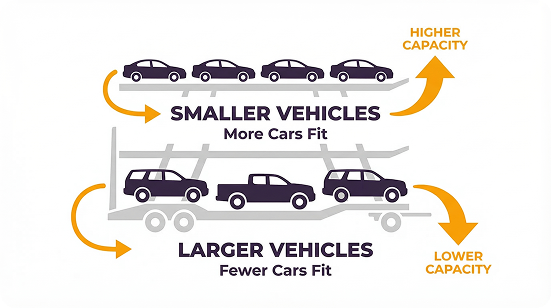
Size decides how much deck space your vehicle takes and how many other cars fit alongside it. A standard sedan is the cheapest thing to move because it slots almost anywhere on the trailer. SUVs, pickups and vans take more room and usually cost more on the same lane.


Ship or Drive: Kansas to California by Carrier or by Car?
When Shipping Makes Sense
Salina to San Bernardino is the shortest pair at 1,408 miles and about 24.4 hours behind the wheel, while Overland Park to Anaheim is the longest at 1,617 miles and about 28.1 hours.
Shipping fits a worker transferred to Orange County, a family settling in the Inland Empire with an extra car, or a Kansas car purchase that has to come west.
Driving It Yourself
Topeka to Riverside takes roughly 26.4 hours on the road, spread over several days of driving and motel nights.
Price out gas, hotel rooms, food and your trip back to Kansas, then line that total up against a shipping quote for the same pair. Driving one car on loose dates can come out ahead, yet an additional vehicle or a hard deadline usually favors a carrier.
Transit Time for Kansas to California: How Many Days?
Cars typically arrive 4 to 6 days after pickup. At 1,408 miles, Salina to San Bernardino has the least road to cover, and at 1,617 miles Overland Park to Anaheim has the most.
Once you book, finding a carrier tends to take 1 to 3 working days, and wider pickup dates give more trucks to choose from.
Snow or ice on the interstate, a closed lane or delayed loading can cost a day. Read the dates as estimates, not promises.
When Should You Book Kansas to California Auto Transport?
Reserve a truck as soon as the move date settles, and tell dispatch whether pickup could slide by a few days, because a looser window opens up more trucks.
The four Kansas starts sit in different places. Topeka is the state capital on the Kansas River, Salina lies in the middle of the state where I-70 meets I-135, Manhattan is in the Flint Hills, and Overland Park is a Johnson County suburb south of Kansas City. In California, Riverside and San Bernardino are Inland Empire cities, Ontario lies west of both in San Bernardino County, and Anaheim is in Orange County. Overland Park to Anaheim runs 209 miles longer than Salina to San Bernardino.
For a closer look at scheduling on long hauls, read the cross country timing article.
Open or Enclosed Trailer for Kansas to California?
Open carriers haul most cars on this lane. The vehicle shares a deck with others and meets whatever weather the route brings, from Kansas wind to California sun.
An enclosed carrier seals the vehicle off from the road for the whole trip. It carries fewer cars, which lifts the fare well above the open rate.
Closed trailers suit classics, new paint or low-slung sports cars. A standard sedan generally travels well on an open trailer.
Enclosed Car Transport
Enclosed demand rises for high-value, specialty and seasonal vehicles, and enclosed trailers protect against road debris and weather, which matters most on longer hauls. Enclosed rigs are a small fraction of the trailers working any given lane, and that scarcity is what drives both the higher price and the longer booking lead time.
Open Car Transport
Most vehicles move on open trailers, and for most routes that is the more cost-effective way to ship a car.
Open transport works well for standard vehicles and keeps costs predictable. It also offers the widest carrier availability.
What Should You Prepare for the California Delivery?
Give dispatch the full California address and a phone that stays on when the driver calls. Should the street be narrow, gated or busy, offer a main road or a large store lot as the handoff spot.
Walk around the car in good light with the pickup photos in hand, and look at the wheels, bumpers, glass and roof panels. Record any new mark on the handover form before signing and keep your own copy.
Ask the California DMV about registration, emissions and inspection steps once the vehicle arrives.
How Will Pickup and Drop-Off Work in Kansas and California?
A full length trailer cannot squeeze into every block, so a narrow street in Topeka, a busy lot in Overland Park or a cramped corner in Manhattan or Salina can shift loading to a nearby arterial road or an oversized parking lot. The Kansas car shipping page explains pickup elsewhere in Kansas.
California has limits of its own. A tight cul-de-sac in Riverside, a dense apartment block in Anaheim, a crowded commercial lot in Ontario or a steep driveway in San Bernardino may stop a big trailer short, so the handoff could move to a store parking lot beside a main road. The California car shipping page explains delivery elsewhere in California.
At both ends, inspect the car beside the driver and compare it with the bill of lading, which logs existing marks before anyone signs. Date-stamped photos support any later claim.

Which Details Matter Most Before Booking This Lane?
You book with Rivalane, a broker, and the trip itself is made by a licensed carrier. Lead your quote request with the Kansas town, which moves the distance by 172 miles, whereas the California city moves it by only 37 to 38.
Frequently Asked Questions