Rivalane arranges car shipping to and from California with licensed carriers working the state's main corridors, including collection and delivery at the Los Angeles and Long Beach ports. Every shipment moves under the carrier's cargo insurance, and your quote is built on your actual route rather than a flat statewide rate.





5-Star Average Rating
Fully Insured
Top Rated Service
Nationwide Coverage
Vetted Carriers
Moving a vehicle to or from California means working the busiest auto transport market in the country, where availability is good and the range between operators is wide. Rivalane matches your vehicle to a licensed carrier already covering your route, confirms the details before pickup, and keeps one point of contact from booking through to delivery. Every shipment moves under the carrier's cargo insurance.

Cost and timing depend on your route, trailer type, vehicle size, and the time of year. The ranges below reflect typical market pricing and transit windows by distance, not a commitment on either. Your actual quote is based on real carrier availability on your specific route at the time of booking.
California prices the way it does because of how much moves inside it. Los Angeles to San Diego is about 120 miles, San Francisco to San Jose about 50, and Sacramento sits roughly 90 miles from the Bay. Those pairs run constantly, so a short move here is usually a car added to a load already going somewhere rather than a carrier sent out to collect one. The long lanes work in your favour for a different reason. I-5, I-10, I-15, I-80 and US-101 carry heavy through-freight, and the Los Angeles and Long Beach port complex and the auction traffic around it keep trucks moving in and out of the state every week, so a vehicle heading to Texas, the Midwest or the East Coast joins a lane that was already running.
Where the vehicle starts or lands matters as much as how far it goes. Addresses across the Los Angeles basin, Orange County, the Inland Empire, San Diego, the Bay Area and the Sacramento region price near the low end because carriers work those markets daily. The exceptions are the parts of California that sit off the corridors. The far north above Redding, the Sierra communities, the desert east of the Coachella Valley and the stretch of US-101 north of Santa Rosa all take a carrier off the through lane to reach you, and price accordingly. Hillside streets and dense coastal neighbourhoods can also mean meeting the truck at a wider spot nearby rather than directly at the door.
Vehicle size, whether the car runs, and trailer type all move the number, and enclosed transport runs roughly fifty percent above open because fewer vehicles fit on the trailer. The factor most within your control is lead time. Booking a week or two ahead puts your vehicle on a truck already running one of the main corridors rather than one routed out to collect it, and on a state this large that gap is widest for the northern, Sierra and desert addresses. Winter adds to it over the Grapevine on I-5 and on the mountain passes, so if either end of the move sits up there it is worth giving us a wider pickup window rather than a fixed date.
Get your California quoteEvery California shipment runs through the same five steps, from the first quote to the inspection at delivery. Here is what happens at each one, and what we need from you.





Share the pickup and delivery ZIP codes, the vehicle, and roughly when you need it moved. The quote is built on that specific route and vehicle rather than a flat statewide rate, so the figure reflects what carriers are actually charging on your lane.

Pick a collection window that suits you. We confirm the carrier, the contact details and how reachable the address is before the day, so you know who is arriving and roughly when rather than waiting on a call.

Remove personal items, keep the fuel level low, and note any existing damage before the truck arrives. The vehicle is inspected and documented at pickup, and that record is what any later claim is assessed against under the carrier's cargo insurance.
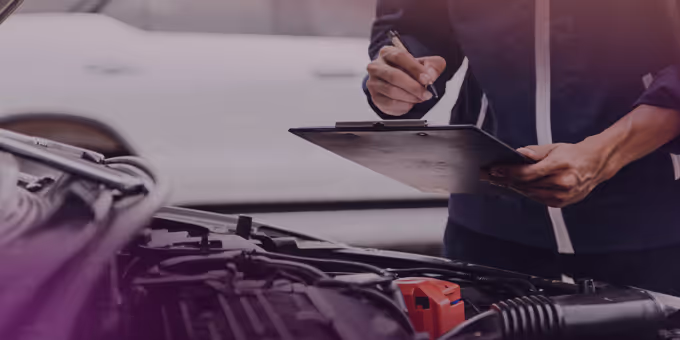
The vehicle is loaded and secured for the route, on an open trailer or an enclosed one depending on what you booked. Long California lanes usually cross more than one state, so you have a single point of contact for updates rather than having to chase the carrier yourself.
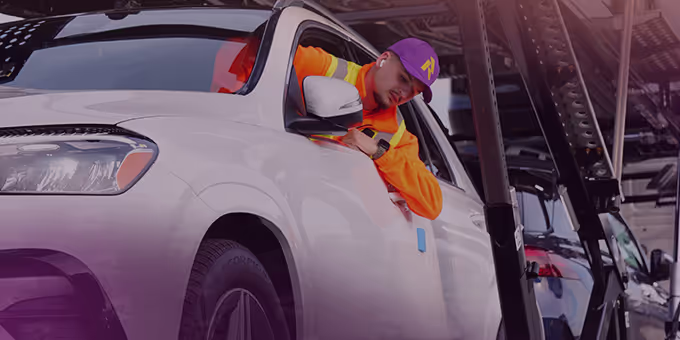
At delivery the vehicle is inspected again against the pickup record before you sign for it. If you are new to California, the vehicle arriving is what starts the 20-day registration clock, so it is worth having the title and your paperwork ready rather than looking for it afterwards.
Most California shipments come down to a handful of choices: open or enclosed, how quickly you need the vehicle moved, and how reachable each end of the route is. These are the services we arrange most often across the state.
The carrier collects from the address you give and delivers to the one you name, whether that is a home in the Inland Empire, a dealership in the Bay Area or a lot near the Los Angeles and Long Beach ports. Where a street is too narrow or too steep for a full-size trailer, the driver arranges a meeting point nearby instead. Door to door car shipping is the default on almost every California route.
Open transport carries roughly nine in ten vehicles that move in California, on the same trailers that deliver new cars to dealerships. It is the cheaper option and the easier one to schedule, because far more open carriers work the state's corridors than enclosed ones. Open auto transport suits standard cars, SUVs and trucks.
Enclosed transport moves the vehicle inside a covered trailer, out of the weather and away from road debris. It runs roughly fifty percent above open and fewer trailers are on the road, so it needs more notice. Enclosed car transport is the usual choice for collector, exotic, low-clearance and high-value vehicles, which California has no shortage of.
When the dates are tight, expedited moves your vehicle up the queue for carrier assignment rather than waiting for a load to fill. It costs more and it is not a guaranteed date, but on the busy California corridors it usually shortens the wait for pickup more than anything else you can change.
California runs over 800 miles top to bottom and not all of it sits on a freight corridor. Alongside the metros on I-5, I-10, I-15, I-80 and US-101, we arrange collection and delivery in the far north above Redding, the Sierra communities, the Central Coast and the desert. Those addresses need more notice and a wider window, and we say so when you book rather than after.
Every shipper claims to be reliable, and that claim is hard to test from the outside. Here is what actually separates a well-run California move from a risky one, and what to ask before you book.
Ask whether the company can name a real California constraint before you raise it, such as the smog check every out-of-state vehicle needs on first registration regardless of its age, or how they reach a Sierra address in February.
Ask whether the price you are quoted is based on your actual route and vehicle, or a generic distance estimate that gets revised once a carrier is assigned.
Ask what happens if no carrier is available on your exact date. A shipper working from an existing carrier network can usually offer options faster than one starting from scratch, and that gap is widest for pickups away from the main corridors.
Get your California quoteCalifornia moves more vehicles in and out than any other state, and the demand runs in every direction rather than one or two. Here is who ships, and what each one needs to have ready.
.svg)
Many California buyers purchase sight unseen from another state. We arrange pickup from the seller or the dealership and deliver to your California address, so nobody has to fly out and drive it back. If you already live here, a car bought out of state with under 7,500 miles can only be registered if it is certified to California emission standards rather than federal ones alone, so check the label under the hood before you buy. Almost every vehicle arriving from another state also needs a California smog check. That applies from the 1976 model year onwards whatever the vehicle's age, and a test done in another state is not accepted. A car you have never seen has to pass it before it can be registered, so ask the seller about the exhaust, the check engine light and any recent repairs before you buy. Keep the out-of-state title with the paperwork, because California surrenders it before issuing one of its own.
Estimate your shipment →.svg)
A car you already own runs on a 20-day clock. New residents have 20 days to register, and residency can begin when you take a job here, register to vote, open a business, or spend six months in the state within a twelve-month period. Your driver license runs on a separate 10-day clock. California's registration requirements are worth planning around before the vehicle lands. Registration is done in person, because the VIN verification and document check cannot be completed online, and the smog certificate has to be a California one, so that test cannot happen before the car ships. Use tax may be due, though a vehicle you owned for more than twelve months before establishing residency is generally exempt. Tell us your arrival dates and we will plan the drop-off around them.
Vehicle transport services →
A vehicle that does not start needs a carrier with a winch and the right loading setup, and that is a smaller pool than standard open transport. Tell us the condition up front, including whether it rolls, steers and brakes, and we match it to a carrier equipped for it rather than discovering the problem at pickup. The same applies to a project car coming home from a workshop or a long-stored vehicle leaving a garage.
Quote a non-running vehicle →
Work and family moves take vehicles in and out of California more than any other state, and the part people underestimate is direction. California trades heavily with Texas, the Southeast and the Northeast, and a lane that is busy one way is not always busy the other, so the same pair of cities can schedule quite differently depending on which way you are going. I-5, I-10, I-15, I-80 and US-101 carry most of that traffic. We arrange pickup across Los Angeles, San Diego, the Bay Area, Sacramento, Fresno and the Inland Empire, then hand the vehicle to a carrier already working your direction. Booking earlier widens the choice of pickup dates on any long lane, and it widens it most on the quieter return legs.
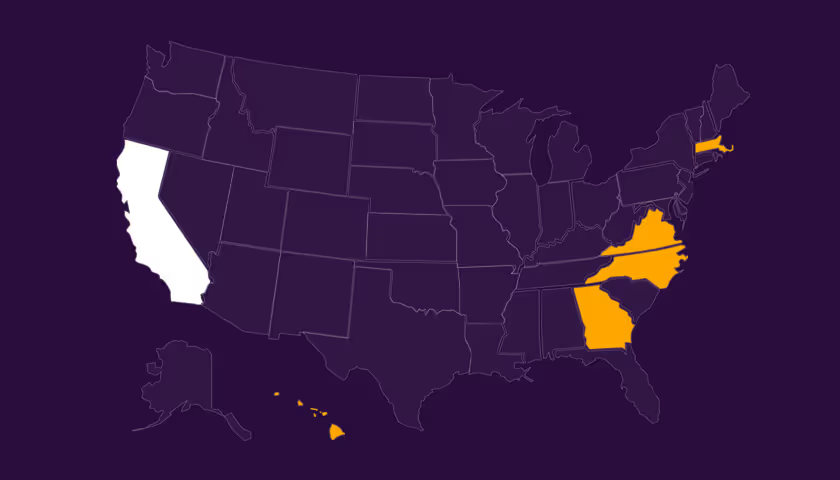
Estimate a long-distance move →Looking to ship your car to another state or across the country? Rivalane ships between California and all 50 states. Select a state to see what shipping to or from it involves.
California's metros are large enough that a move inside one of them can cover more ground than a state-to-state run somewhere else, and Los Angeles County alone has a larger population than most states. The cities below are where we arrange the most pickups and deliveries, with the ZIP codes each one covers.