


New Jersey to Florida pairs run about 850 to 1,290 road miles, and a loaded car typically spends 3 to 5 days in transit. An open sedan from Newark to Miami usually runs $750 to $1,200. Allow two to three weeks of lead time for a fall pickup, and put a Florida policy in place before titling the car.
How Car Shipping From New Jersey to Florida Works
Every New Jersey pickup we measured, from Paterson and Newark in the north to Camden and Atlantic City in the south, reaches I-95 by the time it passes Wilmington, Delaware. From there the truck works south past Baltimore and Washington, through Petersburg and Emporia in Virginia, then into North Carolina past Rocky Mount, Wilson and Fayetteville. On a Newark to Miami run the halfway mark falls about 15 to 17 miles south of Florence, South Carolina, and the interstate then crosses coastal Georgia past Brunswick before entering Florida near Yulee. Deliveries to Miami, Fort Lauderdale or West Palm Beach hold I-95 down the Atlantic coast past Daytona Beach, Melbourne and Fort Pierce, while Orlando loads turn inland on I-4 past DeLand and Sanford. Tampa and Fort Myers deliveries swing west of Jacksonville onto US 301 through Starke and Ocala, then finish on I-75; Tallahassee cars follow I-10 west past Lake City. Each trailer carries several cars, so dispatch groups New Jersey pickups that sit close together, and your address and dates decide which southbound truck takes the car.

How Much Does Car Shipping New Jersey to Florida Cost?
Your quote depends on your vehicle, the exact pickup and delivery addresses, the season and the trailer type, so run the calculator for a figure on your dates.
Across the 64 pairs we measured, the shortest is Camden to Jacksonville at about 849 road miles and the longest is Paterson to Miami at about 1,288. The Florida delivery city moves the mileage far more than the New Jersey pickup does.
On the Florida side, a Newark car bound for Jacksonville covers about 930 miles, Orlando about 1,070, Tallahassee about 1,090 and Tampa about 1,125, against about 1,273 for Miami. Drop offs in Fort Myers, Fort Lauderdale or West Palm Beach trim no more than about 65 miles from that Miami total.
In New Jersey, Newark, Jersey City and Paterson are never more than about 15 miles apart on the trip to Miami. Edison and Toms River start about 20 to 30 miles closer, Trenton and Atlantic City about 30 to 45, and Camden, across the river from Philadelphia, about 80.
Vehicle size and timing count too. A full size pickup or a van takes more deck space than a compact sedan, and a fall pickup costs more than the same move in late spring. Be wary of a quote far under the others until a carrier has accepted it, and enter both addresses in our car shipping calculator to get a realistic starting figure.

On an open trailer, Newark to Miami usually comes in at $750 to $1,200 for a running sedan. Deliveries to Jacksonville or Orlando generally price lower in that band, while Paterson to Miami and the other longest pairs run toward its upper end.
Budget roughly $100 to $200 more for a big SUV, a pickup truck or a van. Going enclosed typically adds 40 to 60 percent to what the same car costs on an open deck.
Three things shape a New Jersey to Florida quote most:
- The snowbird months. From fall into early winter, New Jersey snowbirds ship cars south, southbound space fills sooner and quotes tend to rise. Spring and summer usually leave more open spots heading to Florida.
- Where the car starts. A pickup near I-95 or I-295 slots easily into a southbound load. Narrow streets in Hoboken, Jersey City or Newark, or a shore town in July, can push the meeting point out to a parking lot nearby.
- Where it ends. Jacksonville is the nearest Florida drop and Miami the farthest, and gated communities on the southeast coast often shift delivery to a meeting point outside the gate.
Treat any number far below this band with caution until a carrier confirms it.

What Factors Actually
Influence Pricing on This Route?
Five things move the price on any lane: the vehicle's size, whether it runs, how easy each end is to reach, the season and the trailer type. Booking early protects your timeline, keeps pricing steady and reduces the risk of last-minute carrier changes.


Type
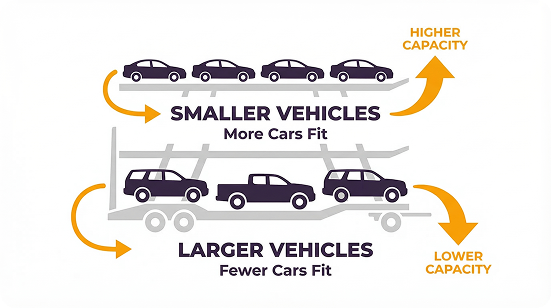
Size decides how much deck space your vehicle takes and how many other cars fit alongside it. A standard sedan is the cheapest thing to move because it slots almost anywhere on the trailer. SUVs, pickups and vans take more room and usually cost more on the same lane.


Is It Cheaper to Drive or Ship a Car From New Jersey to Florida?
Shipping Instead of Driving
Shipping fits a snowbird who flies south for the winter and wants the car waiting in Florida, a retiree relocating for good, or a Florida buyer who found a car at a New Jersey dealer. Nobody has to spend two or three days on I-95 to get it there.
It also spares someone the trip home. A driver who takes the car to Miami still faces close to 1,300 miles back north, usually as a one way flight after a hotel night or two on the way down.
Driving the Route Yourself
If everyone is moving down at once and the trunk is full anyway, driving often comes out cheaper, and we will tell you so. The distance-cities calculator puts Newark to Miami at about 20 hours behind the wheel, normally split over two or three days with fuel, tolls, food and a motel stop.
The numbers shift when the car goes without its owner. Paterson to Miami is close to 1,290 road miles, and whoever drives it there repeats that distance or pays for a flight home.
How Long Does Shipping a Car From New Jersey to Florida Take?
Once it is loaded, a New Jersey car is usually on the road for 3 to 5 days. Camden or Trenton to Jacksonville, under 900 miles, can come in at the short end, Paterson to Miami takes the longer part of the window, and Newark to Miami usually needs 3 to 4 days.
The wait before loading often matters more. Expect one to three working days, as a rule, before dispatch confirms a southbound truck with space, and a few days more when fall demand is at its peak.
A full hauler usually puts 400 to 500 miles behind it per driving day. At about 1,273 miles, Newark to Miami works out to close to three driving days, and the other cars on board add stops along the way. Offering several pickup dates instead of one usually gets the car rolling sooner.
When is the Best Time to Book Auto Transport From New Jersey to Florida?
Southbound demand peaks in the fall. As New Jersey snowbirds head south for the winter, trailers bound for Florida fill early and quotes usually climb. Our New Jersey to Florida snowbird checklist covers what to do before pickup, and the guide to wintering a car in Florida walks through the season.
For a fall pickup, booking two to three weeks ahead usually works. From late winter through summer, a week or two of notice is normally enough, and a range of possible pickup days lets dispatch use the first southbound truck with an open spot.
Leave some slack in winter as well. A coastal storm or heavy snow in northern New Jersey can push a pickup back a day or two between December and March.
Open vs Enclosed Auto Transport on a New Jersey to Florida Route
Open transport moves most New Jersey cars south, on the two level haulers that run I-95 every day. Over roughly 1,270 miles the car collects about the same dust and rain spotting it would if you drove it, and after a winter pickup some road salt.
With enclosed transport, the car travels fully covered from the New Jersey pickup to the Florida door. Because those trailers carry only a few vehicles, a spot costs more and books up sooner when the fall rush starts.
Classics, exotics, show cars and freshly painted cars are where a covered trailer earns its price. Daily drivers, family SUVs and most seasonal snowbird cars travel open.
Enclosed Car Transport
Enclosed demand rises for high-value, specialty and seasonal vehicles, and enclosed trailers protect against road debris and weather, which matters most on longer hauls. Enclosed rigs are a small fraction of the trailers working any given lane, and that scarcity is what drives both the higher price and the longer booking lead time.
Open Car Transport
Most vehicles move on open trailers, and for most routes that is the more cost-effective way to ship a car.
Open transport works well for standard vehicles and keeps costs predictable. It also offers the widest carrier availability.
What Florida Requires When Your Car Arrives
What Florida expects depends on whether the move is a winter stay or a new home. FLHSMV treats a person as a likely resident after taking a job in the state, enrolling children in a public school there, signing up to vote in Florida, claiming a homestead exemption, or living there for over six months straight.
Wintering south, New Jersey still home. A snowbird who has taken none of those steps has not started the Florida process, so the list below can wait.
Settling in Florida. After the move becomes permanent, these steps apply, roughly in this order:
- Insurance written in Florida. Buy coverage from a company licensed to sell in Florida, with minimums of $10,000 for Personal Injury Protection and $10,000 for Property Damage Liability. Keep it active for the entire registration period, parked or not.
- Number check. The VIN must be confirmed on HSMV 82042 or in the verification part of HSMV 82040. Florida accepts that check from a small set of people, including law enforcement officers, licensed Florida dealers, military police officers, staff at a county tax collector office and a compliance examiner with the state Division of Motorist Services. For the inspection itself, see how Florida VIN verification works.
- The title packet. If the car is paid off, the service center needs the original New Jersey title, proof of identity for all owners, evidence of Florida insurance and HSMV 82040 with every owner signature. Where a lender still holds the title, request a transfer of that title to Florida, and if the lender says no, ask for that refusal in writing on its letterhead, which a service center accepts when you apply to register the car. The steps are laid out in our guide to bringing an out-of-state car onto Florida plates.
- First registration charge. Expect a $225 charge for the first registration if there is no Florida plate or plate record to carry over, collected in person at a service center as part of titling.
- A Florida license. New residents get 30 days to swap the New Jersey license for a Florida one.
- Closing the New Jersey file. Once the car has Florida plates, return the New Jersey plates and registration to the MVC: at any agency, through the plate drop box outside one, or by mail. Inspection stations will not take them, and the MVC mails a receipt that is worth keeping. Leave the New Jersey policy running until the plates are back, since New Jersey law expects the registered owner to keep liability coverage, and a policy that lapses first can bring a suspension notice.
Sources: FLHSMV guidance on new residents, insurance and registration, plus the New Jersey MVC plate page and its uninsured motorist enforcement FAQ. Rules at both agencies change from time to time, so recheck them in the days before pickup.
What to Expect at Pickup and Delivery
Settle where each handover happens while the booking is being matched, since a loaded hauler is a long rig that needs space to pull over and swing around.
In New Jersey, a full trailer seldom fits the narrow older streets of Hoboken, Jersey City and Newark, and summer crowds in shore towns cause the same problem, so expect the driver to propose a shopping center lot or a wide avenue nearby. Most suburban streets in central and northern New Jersey let the truck stop near the driveway.
In Florida, high rise condos and guarded communities from Miami to Palm Beach often keep large trucks outside the gate, which moves delivery to a nearby plaza or public street. Single family homes around Orlando, Tampa and Jacksonville are usually reachable at the curb.
At pickup, the driver inspects the car with you and records any existing dents, chips or scratches on the bill of lading. Snap your own time stamped pictures of each panel in New Jersey, then compare the car with that record and those pictures before you sign for it in Florida.

Key Things to Know Before Shipping a Car From New Jersey to Florida
Rivalane coordinates New Jersey to Florida auto transport from its Melville office on Long Island and books each car onto a southbound truck that still has room. If the move is permanent, keep the New Jersey policy until the MVC has your plates back, because New Jersey requires the registered owner of a car to keep liability coverage.
Frequently Asked Questions