




Expect Pennsylvania to Texas to cost $1,025 to $1,475 for a drivable sedan on an open trailer, with roughly 4 to 6 days in transit after pickup. The 16 pairs we routed span 1,338 to 1,654 road miles. Book a truck about two weeks ahead, and plan a county tax office visit within 30 days of arrival.
How Does Car Shipping From Pennsylvania to Texas Work?
We routed four Pennsylvania pickup cities, Reading, York, Harrisburg and West Chester, against four Texas delivery cities, Dallas, Houston, Austin and Tyler. Those 16 pairs make pennsylvania to texas car shipping a run of 1,338 to 1,654 road miles. York to Tyler is the shortest pair and West Chester to Austin the longest. The Texas city does most of the work here. From any one Pennsylvania start, Austin sits about 238 miles beyond Tyler, while the four starts differ by only 78 or 79 miles for the same Texas address. By our routing, Harrisburg cars begin on I-81, Reading and West Chester cars cross central Pennsylvania on I-76 to reach it, and York cars take US 15 south and join it in Maryland. I-81 then carries every load through Virginia to Knoxville, Tennessee. Dallas, Austin and Tyler cars follow I-40 through Nashville and Memphis to Little Rock, Arkansas, and continue southwest on I-30, with Austin cars turning south on I-35 and Tyler cars leaving I-30 for US 271. Houston cars take I-75 from Knoxville to Chattanooga, then I-59 toward New Orleans and I-12 and I-10 across Louisiana.

What Does Car Shipping From Pennsylvania to Texas Cost?
Your quote depends on your vehicle, the exact pickup and delivery addresses, the season and the trailer type, so run the calculator for a figure on your dates.
Where the car lands in Texas moves the mileage far more than where it leaves Pennsylvania. From Reading, Tyler is about 1,396 road miles, Dallas 1,440, Houston 1,519 and Austin 1,634, a gap of 238 miles from Tyler to Austin.
The four Pennsylvania starts matter less. For any single Texas address, York is nearest and West Chester farthest, a difference of 78 or 79 miles. Harrisburg is 2 or 3 miles past York, and Reading is 58 or 59.
Beyond mileage, the vehicle and the trailer set the price. A larger vehicle uses extra deck space compared with a sedan, and enclosed carriers move fewer vehicles per trip, so each space costs more to fill.
Your pickup date and both street addresses give a quote worth more than any general range.

On open transport, a drivable sedan from Pennsylvania to Texas typically runs $1,025 to $1,475, with York cars heading for Tyler near the low end and West Chester cars heading for Austin near the top. The car shipping calculator takes both addresses and returns a quote for your lane.
A pickup, van or big SUV adds about $100 to $200 because it occupies more trailer space. A non-running car must be winched aboard, which carries a separate fee. A closed trailer costs 40 to 60 percent extra per car.
- The Texas city. Tyler is about 43 or 44 miles shorter than Dallas, Houston adds 79 or 80 and Austin adds 194.
- The Pennsylvania start. York is the closest start and West Chester the farthest, 78 or 79 miles apart for one Texas city.
- The road in. Houston cars leave I-40 for I-75 and I-59 toward New Orleans, while Dallas, Austin and Tyler cars stay on I-40 to Little Rock and then take I-30.
Be wary of a very low quote. Carriers tend to skip jobs priced under what they expect, so it can wait days without a driver.

What Factors Actually
Influence Pricing on This Route?
Five things move the price on any lane: the vehicle's size, whether it runs, how easy each end is to reach, the season and the trailer type. Booking early protects your timeline, keeps pricing steady and reduces the risk of last-minute carrier changes.


Type
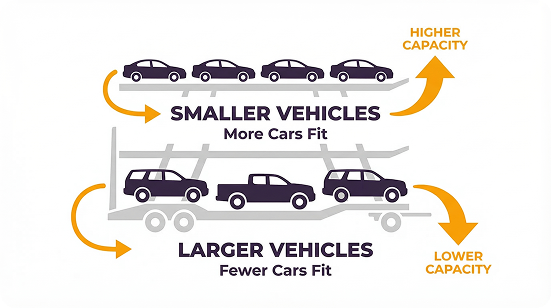
Size decides how much deck space your vehicle takes and how many other cars fit alongside it. A standard sedan is the cheapest thing to move because it slots almost anywhere on the trailer. SUVs, pickups and vans take more room and usually cost more on the same lane.


Should You Drive or Ship the Car From Pennsylvania to Texas?
Loading It on a Carrier
By our routing, York to Tyler is about 25 hours at the wheel and West Chester to Austin about 30, so one driver faces three or four long days on the interstate.
A carrier suits someone who flies to Texas, or a household moving a second car while only one driver is available.
Driving It Yourself
A drive is worth considering when two people can trade off at the wheel and no one needs the car by a fixed date. Even York to Tyler, our shortest pair, is about 1,338 miles and 25 hours.
Remember the return trip. Whoever drives down must get back to Pennsylvania, and an airline ticket home, fuel and a couple of hotel stays can approach what a carrier charges.
How Long Does Pennsylvania to Texas Car Shipping Take?
After loading, a car typically needs 4 to 6 days to reach Texas. York to Tyler, our shortest pair at about 1,338 miles and 25 hours of driving, usually finishes near the early end, while West Chester to Austin, about 1,654 miles and 30 hours, can use the whole window.
Booking comes first, though. Placing a licensed carrier on the car can take dispatch between one and three working days, so flexible dates help.
Winter weather along I-81 and I-40, a long string of other drop-offs ahead of yours and heavy traffic around Dallas can each add a day.
When Should You Book Pennsylvania to Texas Car Shipping?
Request a truck roughly two weeks before pickup, or at least a week out, so dispatch can find a driver already running south and west on I-81 and I-40. Pinning the car to one exact day shrinks the pool of eligible trucks, so mention in the request if the date can shift.
Our cross-country timing guide explains why long hauls slip or finish early. The Pennsylvania to Georgia route follows much of the same I-81 road if you are comparing another southbound lane.
Open or Enclosed Transport for a Pennsylvania to Texas Car?
Most cars on this lane ride open transport, on a roofless two-level trailer that leaves the car in the same weather it would meet driving south on I-81 and I-40.
Enclosed transport wraps the car in solid walls and a roof for the full run to Texas. Those trailers carry fewer cars, which makes each space pricier.
The extra cost tends to pay off for classics, exotics, fresh paint and low sports cars, while a daily-driver sedan from Harrisburg to Dallas usually rides open without trouble.
Enclosed Car Transport
Enclosed demand rises for high-value, specialty and seasonal vehicles, and enclosed trailers protect against road debris and weather, which matters most on longer hauls. Enclosed rigs are a small fraction of the trailers working any given lane, and that scarcity is what drives both the higher price and the longer booking lead time.
Open Car Transport
Most vehicles move on open trailers, and for most routes that is the more cost-effective way to ship a car.
Open transport works well for standard vehicles and keeps costs predictable. It also offers the widest carrier availability.
What Does the Texas Title and Registration Form Ask a Pennsylvania Owner to Prove?
The car spends 4 to 6 days on the truck, which leaves time to read the form Texas uses for incoming cars. Everything below comes from the Texas Department of Motor Vehicles Application for Texas Title and/or Registration, known as Form 130-U.
- The filing window. Within 30 days of establishing residency, a new resident files the form with a county tax assessor-collector, and the form puts the sales and use tax due date at 30 days after purchase or entry into Texas.
- VIN verification. Texas requires the vehicle identification number of a car already titled or registered elsewhere to be verified before registration. That can happen through an emissions inspection at a state appointed station or through certification by the applicant on the form.
- Self-certification. Box 38 carries a statement that the applicant has physically inspected the vehicle and verified the number.
- Photo identification. A title application must include one of the government-issued photo IDs listed in Box 15.
- What lies beyond the form. Fees, county emissions rules and proof of insurance come from the county tax office, so ask the office serving your Texas address before you plan the visit.
Source: TxDMV, Application for Texas Title and/or Registration (Form 130-U).
Where Will the Carrier Meet You in Pennsylvania and Texas?
Decide with dispatch where each handoff will happen before a carrier is picked. A full-length transporter needs space to pull over and drop its ramps, which a wide street or an open lot provides.
In Pennsylvania, tight streets in older parts of Reading and crowded blocks near downtown York can be too narrow for the truck, so a lot beside I-81 or I-76 may offer an easier spot. In Texas, gated subdivisions in the Dallas suburbs, big apartment complexes in Houston and shady older streets in Tyler can keep the truck away from the door, and the handoff then moves to a nearby lot. Both ends have a page of their own: Pennsylvania car shipping and Texas car shipping.
At pickup and drop-off, check the car over alongside the driver, and confirm the bill of lading records each dent or scratch already there prior to your signature. Photograph each side beforehand and take loose items out of the cabin.

What Is Worth Knowing Before You Book Pennsylvania to Texas Auto Transport?
Orders for this lane come to Rivalane in Melville, New York, where dispatch assigns a licensed carrier to the car, and tracking starts once it is loaded. When you request a quote, tell us the Texas delivery city: an Austin delivery covers about 238 miles more than a Tyler delivery from the same Pennsylvania address.
Frequently Asked Questions