To register a car in Delaware after a move, you deal with one agency for all of it: the Division of Motor Vehicles handles the title, the registration and the inspection, and the car itself goes through a DMV inspection lane before Delaware will title it. Delaware has no sales tax, but it charges a document fee when the car is titled, and new residents have 60 days to finish. This guide follows the steps in order for a car you already own, using a car shipped from New York as the example.
How Long Do You Have to Register a Car After Moving to Delaware?
Sixty days. Under Delaware Code title 21, section 2102, every vehicle owner must apply for Delaware registration within 60 days after taking up residence in the state, and the DMV's Guidelines for New Residents set the same deadline for titling and registering. A first offense carries a fine of $400 to $600. A repeat offense means a fine of $800 to $1,200, 10 to 30 days in jail, or both.
The law exempts members of the military and their families whose vehicles are registered in their home state, covered near the end of this guide. State law also requires changes of address to be reported to the DMV within 30 days, which matters once your Delaware title and registration are on file.
What Order Do the Steps Go In?
The order matters, because each step needs the result of the one before. For a car you own and are bringing from New York, the DMV's Guidelines put it in this sequence:
- Put Delaware insurance in place. The DMV verifies a Delaware policy before it titles or registers the car.
- Take the car through a DMV inspection lane. Bring the New York title or registration with you.
- Apply for the title. Hand in the Application for Certificate of Title (MV-212) with the inspection report (MV-210) that the lane gives you, plus the out-of-state title if you hold it.
- Pay the fees and get your plates. Once everything is accepted, the DMV issues the title, registration card and tag.
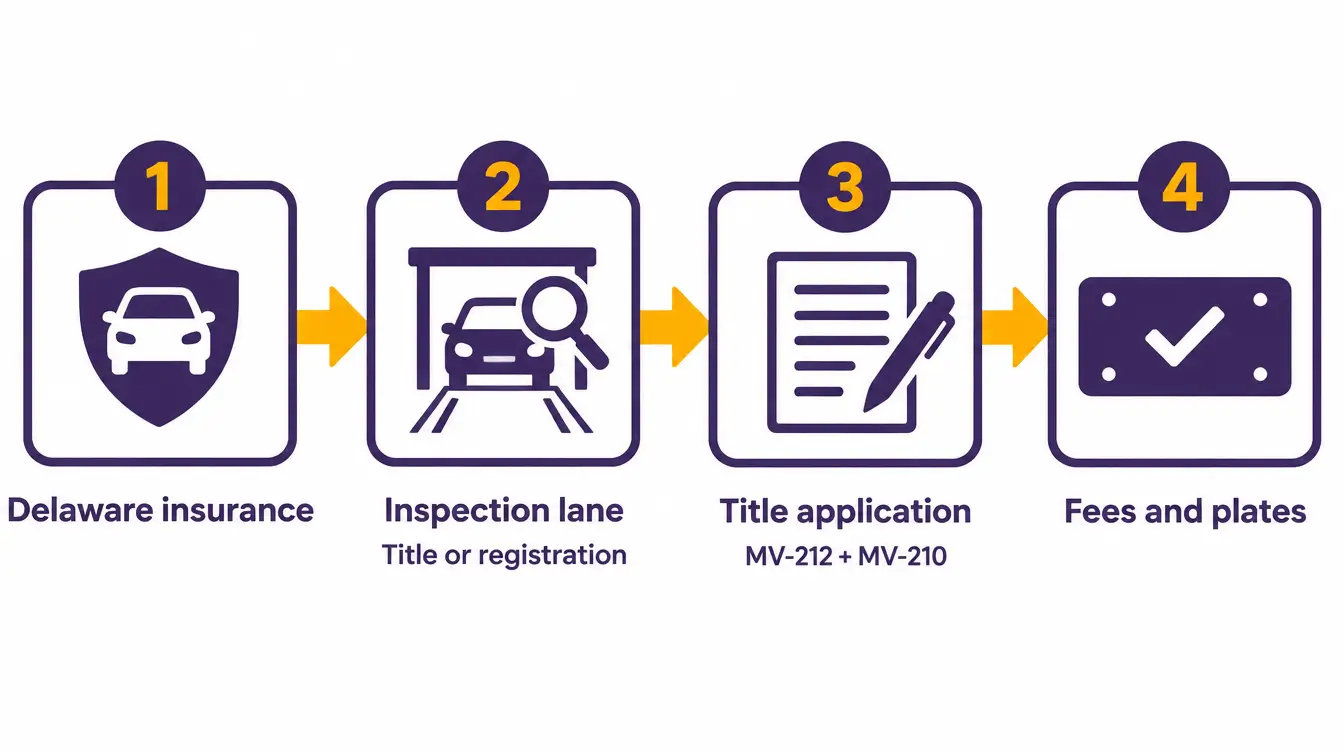
The inspection lanes sit at the same four DMV offices that handle titles. Two situations add time: a failed inspection, which means a repair and another trip through the lane, and a title held by a lender, which the DMV has to receive before it can finish.
What Car Insurance Do You Need First?
A Delaware policy. The DMV's Insurance Requirements page sets the minimum liability coverage at $25,000 per person and $50,000 per accident for bodily injury and $10,000 for property damage, plus personal injury protection of $15,000 per person and $30,000 per accident. It also says insurance from other states is not accepted to title and register a car in Delaware, so your New York policy will not work at the counter.
The Guidelines list four accepted forms of proof:
- An insurance ID card that shows the period of coverage and the NAIC code. An electronic card shown in your insurer's mobile app is accepted, but photocopies, photos and printouts of a card are not.
- A valid insurance policy.
- A written binder on the insurance company's letterhead, within 30 days of issue.
- A fax, accepted only when the insurance company sends it directly to the DMV.
The card has to be valid on the day of your visit, or the DMV will not accept it. Driving an uninsured vehicle carries a fine of not less than $1,500 or 30 days in jail, or both, plus a six-month license suspension. One rule matters later: once a car is registered in Delaware, its plates must be surrendered to the DMV before you cancel the insurance for any reason.
What Happens at the DMV Inspection Lane?
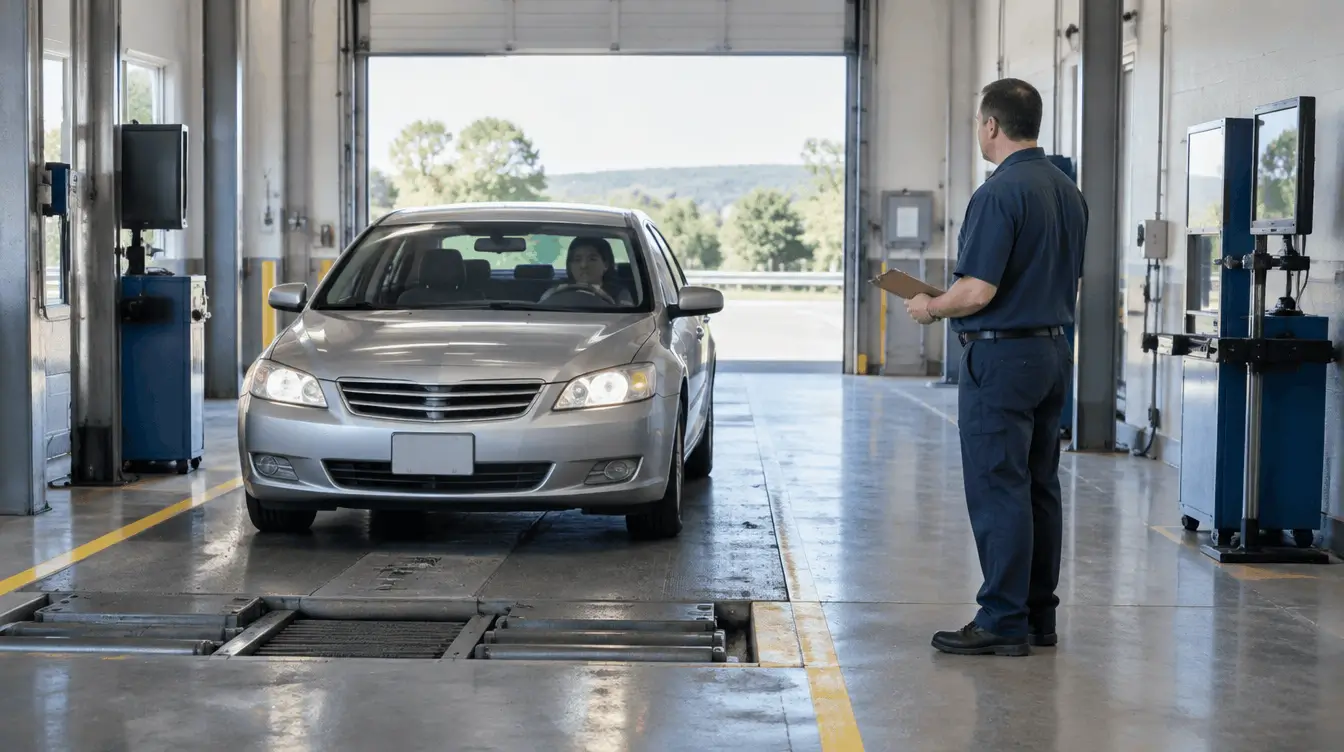
Every vehicle with an out-of-state title goes through inspection before Delaware titles it. The DMV runs inspection lanes at all four of its offices, in Greater Wilmington, Delaware City, Dover and Georgetown, and its Inspections page says there is no fee. Bring the car's certificate of title or registration, because the Guidelines say it must be presented at inspection.
Model year and registered weight decide whether the car gets a full inspection or a VIN verification. The Inspections page says a vehicle in the newest seven model years weighing 10,000 pounds or less may need only the VIN verification, and the Guidelines add that every vehicle receives a safety inspection regardless of model year and weight.
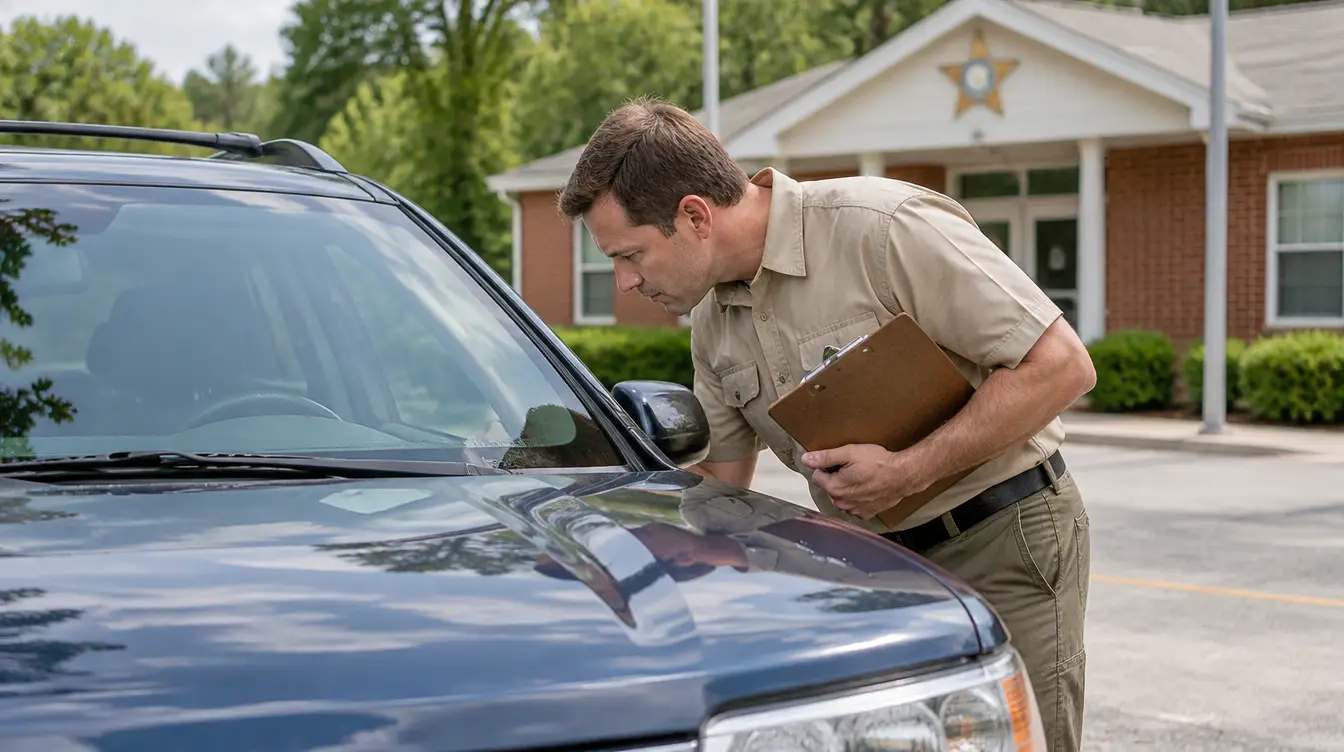
A full inspection covers safety equipment and emissions. The Guidelines suggest checking these items before you go, because a fail means a return trip:
- Lights clean, working and properly aimed, including brake lights, turn signals and the plate light.
- Brakes that stop the car within the required distances, and tires with no bulges, cuts or bald areas and at least 2/32 inch of tread.
- Glass with no holes or breaks, no windshield crack that interferes with vision, and no crack longer than 5 inches on any window.
- Unbroken mirrors, working wipers, horn and seat belts, and hood and trunk latches that hold.
- An exhaust system with no leaks, and the catalytic converter in place if the car came with one.
- Bumpers at least 22 inches from the ground, and no tint on the windshield or front side windows without an approved tint waiver.
For emissions, the Inspections page describes a curb-idle and gas cap test for older gasoline cars and an OBD II test for newer ones. The DMV also suggests arriving with the engine fully warmed up, switching off the air conditioning, heater and radio before you pull in, and bringing the key if the fuel cap locks.
If the car fails, the inspector gives you a report that lists the failed items. They have to be fixed and the car re-inspected before Delaware issues a title, registration card and plate.
What Documents Do You Need to Title the Car?
The title application comes after the lane. The Guidelines list what the DMV office needs:
- The out-of-state title, surrendered when you apply, if the car comes from a state that issues titles.
- The Application for Certificate of Title (MV-212), signed by every owner, by someone with power of attorney for them, or by a company officer if a business owns the car.
- The inspection report (MV-210), which the inspection lane issues along with the MV-212.
- Proof of Delaware liability insurance, as described above.
- An original, notarized power of attorney if someone signs for an owner. Copies are not accepted.
A leased car needs one more document: form MV-35 says the DMV must have a notarized power of attorney from the leasing company before the lessee can sign the title application. The leasing company also sends the title, as the next section explains.
What If a Lender Holds Your Title?
Delaware needs the original out-of-state title to issue its own, so a lender or leasing company has to send it. The DMV's form MV-35, Request of Title from Lienholder to DMV, handles this, and it runs in this order:
- You fill in the form with the lender's name and address, your details, the car's VIN and the DMV office where the title should go: Dover, Delaware City, Wilmington or Georgetown.
- You send it to the lender, not the DMV. The form tells you to mail or fax it to the lender and not to mail it to the DMV.
- The lender mails the form and the title to the DMV office you chose.
- The DMV contacts you by email, if you gave one, or by postcard, and you go to that office to finish the title and registration.
Act on the notice promptly, because the DMV holds titles for a maximum of 60 days. The new Delaware title lists the lender and is mailed to the lender, and a title with a lien costs $55 rather than $35.
Meanwhile, the New York registration does a real job. The inspection lane asks for the car's title or registration, so with the title at the lender, your New York registration card is what you show there. That gets the car inspected but does not transfer the title, which still waits for the MV-35 process. Keep the New York plates and registration until Delaware has titled and registered the car, then return them to New York. Our guide to returning your New York plates covers the PD-7 form and the FS-6T receipt.
How Much Does It Cost to Register an Out-of-State Car in Delaware?
The government fees on a new resident's first visit come from the DMV's Fees page and the Guidelines:
- Title: $35 without a lien, $55 with one.
- Registration: $40 a year for a passenger car.
- Alternative fuel fee: since October 1, 2025, an extra yearly fee of $60 for a hybrid, $85 for a plug-in hybrid and $110 for an electric car at a gross vehicle weight rating of 6,000 pounds or less, with higher amounts for heavier vehicles.
- Document fee: 5.25 percent of the car's value, with an $8 minimum, explained in the next section.
- Inspection: no fee.
You also choose how long to register for. Section 2109 of title 21 lets a used car no more than seven model years old be registered for 6 to 72 months under a DMV formula based on model year and mileage, while the Guidelines let a passenger car seven or more model years old register for one or two years after it passes inspection.
How Does Delaware's Document Fee Work for New Residents?
Delaware has no sales tax on cars. Instead it charges a document fee when the car is titled: 5.25 percent of the purchase price or the NADA book value, whichever is greater, with an $8 minimum, according to the DMV's Fees page.
For a car you bring with you when you move, the DMV's page on vehicles purchased from out of state explains which value it uses. When no sales tax or similar titling tax was paid on the car in the other state within the last 90 days, the DMV assesses the fee on the car's current NADA average trade-in value. You can also get an appraisal from a licensed Delaware dealer, and the DMV may consider it.
The fee is not charged in one narrow case. Delaware Code title 30, section 3002 exempts a car you bought and registered in another state when you paid that state's sales tax, transfer tax or a similar levy on the purchase within 90 days before titling it in Delaware. The DMV's Fees page adds that the car must also have been titled and registered in the other state within those 90 days, and that the 90-day rule is strictly enforced. A New York registration renewal is not a tax paid on the purchase and does not qualify, so most people moving with a car they have owned for a while pay the fee.
On a car the DMV values at $20,000, for example, the fee comes to a little over $1,000, and the DMV works out the exact amount when you title the car. Its online fee estimator, linked from the Fees page, gives a figure in advance, though the DMV notes the actual fee can be higher or lower. Delaware's trade-in credit does not apply here, because it covers trading in a Delaware-titled vehicle toward another purchase.
Already living in Delaware and buying a car out of state? That is a different case. The DMV says residents who buy from an out-of-state dealer get no credit for taxes paid there and can end up taxed twice in states that collect tax on every vehicle sale. Our guide to buying a car in New York as a nonresident covers New York's exemption for out-of-state buyers.
When Do You Need a Delaware Driver License?
Within the same 60 days. The Guidelines tell new residents with a valid license from another state to apply in person within 60 days of taking up residence, at one of the DMV offices in Delaware City, Dover, Georgetown or Wilmington. Bring:
- Your out-of-state driver license, which you turn in.
- Proof of legal presence, such as a U.S. birth certificate or passport.
- Proof of your Social Security number.
- Proof of any legal name change.
- Two proofs of Delaware residency.
A Class D license costs $50 and is valid for eight years. Check the DMV's full list of accepted documents before you go.
Second Homes and Military Members
Second homes. If you live in another state and keep a car at a second home in Delaware, you have two options. Section 2112 of title 21 lets a nonresident whose car is registered for the current year in their home state, and displays that state's plates, drive it in Delaware without registering it here. To register it in Delaware instead, the DMV's non-domicile registration asks for the registration and proof of insurance for a vehicle you own in your home state, your home-state license, Delaware insurance for the car kept here, a Delaware inspection with the usual fees, two proofs of the Delaware garaging address postmarked within 60 days, and a signed affidavit on form MV680.
Military members. Section 2102 exempts members of the military and their families whose vehicles are registered in their home state from the 60-day requirement, and the Guidelines say service members and their dependents do not need a Delaware license or registration until 60 days after separation from the service.
How Shipping the Car Fits Around the DMV Visit
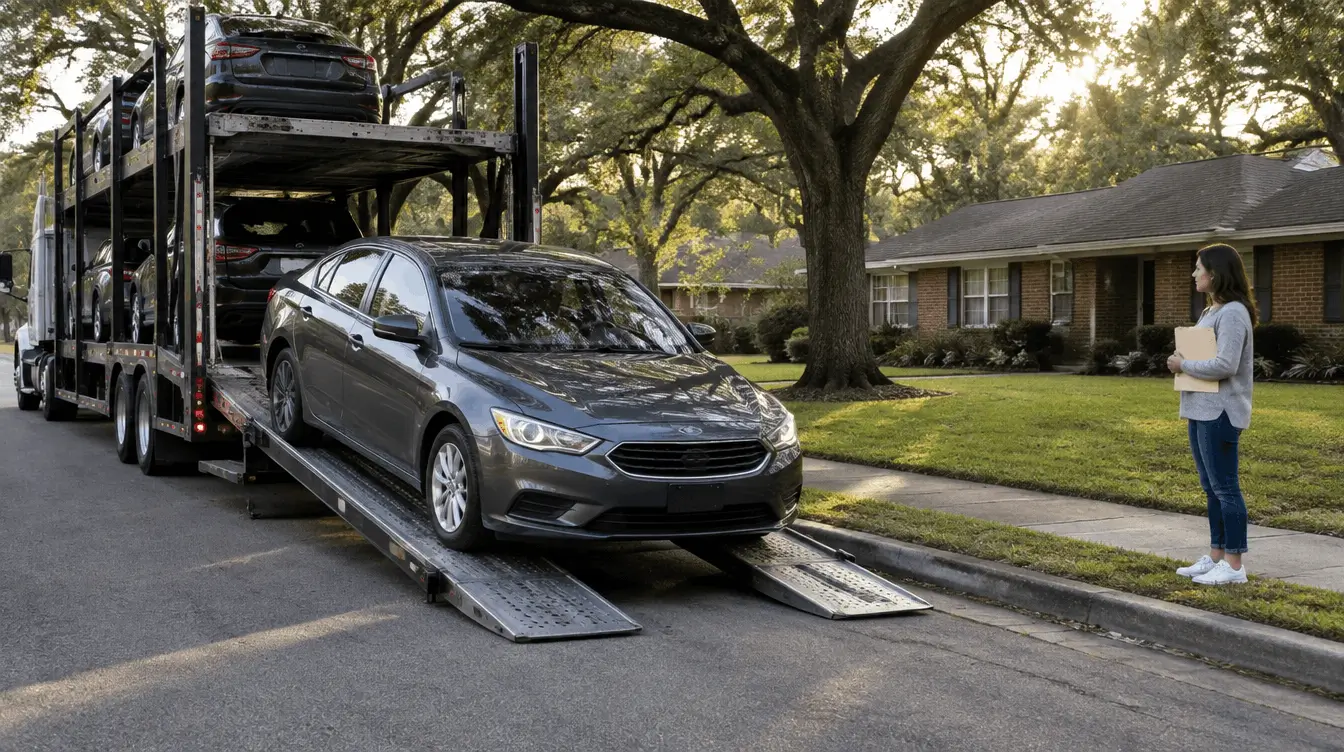
A car shipped from New York arrives on its New York plates, and it needs them, because it is driven to the inspection lane on its New York registration. The plates go back to New York only after Delaware has titled and registered the car.
The 60 days run from the day you take up residence, not from the day the car arrives, so plan the lane visit soon after delivery. Rivalane coordinates door to door transport with licensed, insured carriers and typically assigns a carrier within one to three working days after you book. Pickup and delivery dates are estimates, not guarantees, so leave room before the deadline. Our page on shipping a car from New York to Delaware covers the Turnpike and I-95 lane, our page on car shipping to Delaware covers pickups and deliveries across the state, and the car shipping calculator prices your move.
Frequently Asked Questions
How long do you have to register a car after moving to Delaware?
Do you pay sales tax on a car when you move to Delaware?
Does Delaware inspect cars from out of state?
What car insurance do you need to register a car in Delaware?
What if a lender holds your car title?