Does an Electric Car Ship Differently From Any Other Car?
Most of what gets written about shipping an electric car overstates the difference. An EV rides on the same open and enclosed trailers as everything else, over the same routes, with the same carriers. Wheels get chocked. Straps go over the tires. The truck leaves.
Three things genuinely change, and they are worth understanding before you book. The car is heavier than a combustion car of its size. Many models sit lower to the ground. The carrier will want to know what charge the battery is holding when the driver arrives. That is the list. If you came here worried that an electric car is some separate category of shipment, it is not. A company that treats it as one is usually building a reason to charge you for it.
Your EV Is Not Hazardous Freight
Plenty of pages on this subject claim that moving an electric car means hazmat compliance. The claim is wrong, and correcting it changes what you should expect to be asked for.
Federal rules draw a hard line between a lithium battery shipped on its own as cargo and a lithium battery bolted into a car that is being transported. The second case falls under 49 CFR 173.220(d), which excepts battery-powered vehicles from the other requirements of that subchapter when they are carried by highway, rail or vessel. The conditions are that the battery is securely installed and protected against heat, short circuits and terminal damage. PHMSA sets out the same position in its April 2023 safety advisory on transporting electric vehicles and lithium batteries.
Your intact EV travels as a vehicle. No dangerous goods declaration, no placards, no hazmat endorsement on the driver's license. If a company tells you otherwise and prices the job to match, ask them which regulation they have in mind.
What the Carrier Wants to Know About the Battery
Carriers commonly ask that an EV arrive with a partial charge rather than a full one. It needs enough power left to move on and off the trailer under its own steam. No federal rule sets that figure. It varies from one carrier to the next, and some leave it to the driver's judgment on the day.
Your owner's manual is the better starting point, because several manufacturers publish a transport recommendation for the model along with instructions for putting the car into a transport mode. Tell us the make, model and year when you ask for a price, and we will confirm the assigned carrier's requirement with you well before pickup. Nobody should be working this out in the driveway while a driver waits.
Weight and Ground Clearance Reach the Quote
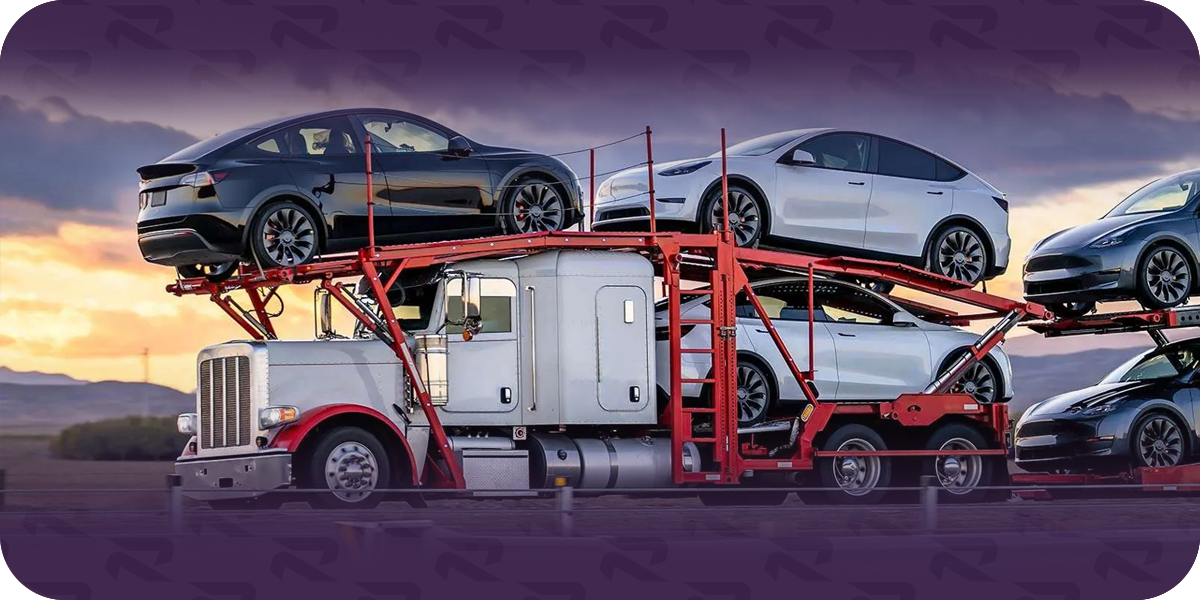
An electric car carries its pack under the floor, which makes it heavier than a combustion car of the same footprint. That weight counts against the trailer's limit, and a carrier filling a deck has to balance the load. It is one input among several, sitting alongside route, distance, season, transport type and how easily a truck can reach both ends. There is no fixed surcharge for an electric car, and anyone quoting one should be able to show you where it comes from.
Clearance works the other way, because a low car needs a shallower approach to get up a ramp without scraping, and a carrier running a liftgate handles that without difficulty. One without a liftgate may pass on the load. That is a scheduling constraint rather than a safety problem, though it does mean a low EV sometimes waits a little longer for the right truck.
Open or Enclosed
The electric drivetrain does not change this decision at all. Open transport costs less and is easier to schedule. Enclosed keeps the car away from weather and road debris and costs more. A new EV crossing the country on a busy lane is a straightforward open shipment. A collectible, a custom paint job, or a car you would rather nobody saw on a highway for four days is the usual case for enclosed. That is the whole decision.
Our guide to open versus enclosed car shipping works through the trade-off properly, including how the cargo insurance differs between them.
If the Car Does Not Run
An EV that will not move under its own power is handled the way any inoperable vehicle is handled. A car that rolls, steers and brakes can be winched aboard by most carriers. One that cannot needs dollies or a lift, which narrows the pool of trucks and lengthens the scheduling. It is still doable. Rivalane arranges those shipments. Our guide to shipping a non-running car covers what changes at each stage.
A damaged battery is a different question and we are not going to guess at it here. If the pack has been through a fire, a flood or a collision, or the car sits under an open recall, say so before you book. We will check what the carrier and the rules allow for that specific vehicle. Those cases get assessed one at a time rather than waved through as routine, and that is the honest answer rather than a reassuring one.
Who Covers Your EV in Transit
Coverage sits with the carrier assigned to your shipment rather than with Rivalane, and the terms differ from one carrier to the next. Ask to see the certificate of insurance before the vehicle loads. Photograph the car from every angle at pickup, and check the condition report at both ends. Both ends matter.
There is one thing we cannot tell you in advance. Whether a particular cargo policy responds differently to a battery-related loss is not something we can answer for you. An EV pack is usually the most expensive single component on the car. Read the cargo limit against what your vehicle is actually worth. Ask the carrier directly whether the battery is treated any differently from the rest of it. We would rather you asked that question than assumed the answer.
When You Should Not Ship It
Driving an electric car is cheap. That is an awkward thing for a company paid to move cars to point out, so here it is. Over a short or medium trip the charging cost is low enough that shipping rarely pays for itself, and you finish with the car already where you need it.
Shipping earns its place over distance. It earns it when the drive would swallow days you do not have, or when winter sits across the whole route. It earns it when a car is changing hands between two people who cannot meet in the middle. Two states on a weekend is usually a drive. Coast to coast in February is usually a shipment. If your situation looks like the first one, we would rather say so now than sell you the second.
Is Rivalane a Carrier?
No. Rivalane is a broker. We do not own trucks and we do not employ drivers. Every sentence above describing what a carrier does is describing a company we arrange your shipment with, not us.
Rivalane is the trade name of Zone Auto LLC, registered with FMCSA as a Broker of Property under USDOT number 4178374 and MC number MC-1608310. Check it yourself on the FMCSA SAFER Company Snapshot. The record shows broker authority, zero power units and zero drivers. The distinction matters. Our guide to auto transport brokers and carriers sets out how to verify any company you are weighing up.
Getting a Price for Your Route
Run your pickup and delivery locations through the car shipping cost calculator to see roughly where your shipment lands. Send us the make, model and year, tell us whether the car drives, and mention anything unusual about the pack. We will come back with a price and with the carrier's charge requirement, so both arrive before you have to commit to anything.
Frequently Asked Questions