


Across sixteen measured pairs, a sedan hauled open costs $1,000 to $1,525 for 1,857 to 2,091 miles, with transit typically 5 to 8 days. Shifting the Florida end alters the mileage by up to 171, while shifting the Colorado start alters it by up to 64.
How Does a Car Travel From Colorado to Florida by Road?
This page measures Colorado to Florida car shipping across sixteen town pairs. Starting points in Colorado are Castle Rock, Thornton, Longmont and Loveland, and the Florida ends are Clearwater, Cape Coral, Port St. Lucie and Pembroke Pines. Distances run from 1,857 to 2,091 road miles. The routing engine accepted every pair without a forced stop, and each one stayed on interstates and state highways. All sixteen routes head east on I-70 through Kansas and Missouri, which accounts for 767 miles from Castle Rock, 830 from Longmont and Loveland, and 839 from Thornton. Then I-64 for 75 miles and I-57 for 47 carry the load into southern Illinois, I-24 for 316 miles takes it past Nashville, and I-75 runs south through Tennessee and Georgia. Clearwater loads follow I-75 for 531 miles and finish on I-275, Cape Coral loads keep I-75 for 647 miles, and Port St. Lucie and Pembroke Pines loads leave I-75 after 477 miles for a state highway. These roads come from a routing tool, so the assigned carrier may choose differently.

What Moves the Mileage Most Between Colorado and Florida?
Your quote depends on your vehicle, the exact pickup and delivery addresses, the season and the trailer type, so run the calculator for a figure on your dates.
The Florida end moves the total more on this lane. Keep the Colorado start fixed and the four Florida ends land 171 miles apart, while keeping the Florida end fixed leaves the four Colorado starts only 63 or 64 miles apart.
From Castle Rock the ends measure 1,857 miles to Clearwater, 1,931 to Port St. Lucie, 1,959 to Cape Coral and 2,028 to Pembroke Pines. Into Clearwater the starts measure 1,857 from Castle Rock, 1,881 from Thornton, 1,906 from Longmont and 1,920 from Loveland.
Inside Florida the steps run 74 miles from Clearwater to Port St. Lucie, then 28 to Cape Coral and 69 to Pembroke Pines. In Colorado, Thornton sits 24 miles beyond Castle Rock, Longmont 25 beyond Thornton and Loveland 14 beyond Longmont. A bigger vehicle also takes extra trailer space.
Give both towns plus the pickup window, so the figure matches your actual pair.

A sedan on open hauling runs $1,000 to $1,525. Castle Rock to Clearwater lands toward the low end of that band and Loveland to Pembroke Pines toward the high end. Run your towns and dates through the calculator to price the exact pair.
Enclosed hauling costs more because each trailer carries fewer cars. A truck, a van or a bigger SUV usually adds roughly 100 to 200 dollars extra. A car that cannot run needs winch loading, shown separately on the quote.
- Florida end. From one Colorado start, the four ends span 171 miles.
- Colorado start. Into one Florida end, the four starts span 63 or 64 miles.
- Common roads. Every pair runs on I-70 and I-24.
Treat a bid well beneath this band as a prompt to ask which carrier holds the load and to confirm a truck is actually reserved.

What Factors Actually
Influence Pricing on This Route?
Five things move the price on any lane: the vehicle's size, whether it runs, how easy each end is to reach, the season and the trailer type. Booking early protects your timeline, keeps pricing steady and reduces the risk of last-minute carrier changes.


Type
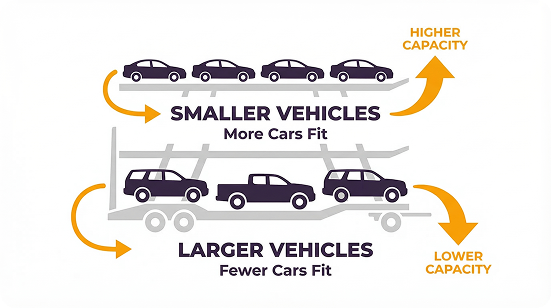
Size decides how much deck space your vehicle takes and how many other cars fit alongside it. A standard sedan is the cheapest thing to move because it slots almost anywhere on the trailer. SUVs, pickups and vans take more room and usually cost more on the same lane.


Is It Better to Ship or Drive a Car From Colorado to Florida?
Booking a Carrier
The shortest pair, Castle Rock to Clearwater at 1,857 miles, still means about 33.6 hours behind the wheel, and Loveland to Pembroke Pines takes about 37.5 hours over 2,091 miles.
Shipping works well when one person must move two cars, a Florida start date leaves no space for a lengthy drive, or the car is changing hands between the two states.
Doing the Drive Yourself
Castle Rock to Clearwater measures about 33.6 hours at the wheel, which leaves one driver facing several long days on I-70, I-24 and I-75.
Total the fuel, the hotel nights, the meals and the ride home. A quote for your two towns gives a figure to set beside that total. One car and spare days often make driving workable, while two vehicles or a tight start date usually point to a carrier.
How Many Days Does a Car Spend on the Road From Colorado to Florida?
Once loaded, trucks typically cover the Colorado to Florida run in 5 to 8 days. Castle Rock to Clearwater at 1,857 miles is the short end, and Loveland to Pembroke Pines at 2,091 miles is the long end.
The transit count begins at pickup. Before that, a carrier gets assigned, with 1 to 3 working days as the usual span, so give the pickup window some room. For more on what shifts the timeline, read the cross country timing guide.
Snow on I-70, a mechanical delay or a late handover can add roughly a day. Plan around the range, because a delivery date is never promised.
When Is the Right Time to Book Colorado to Florida Transport?
Book once your moving dates are fixed, and say early if the pickup day has room to move. A flexible window lets your car ride a truck already heading east on I-70.
Colorado runs on Mountain time and Florida on Eastern time, so clocks are two hours ahead on arrival. Castle Rock, Thornton, Longmont and Loveland all sit on the Front Range. Clearwater and Cape Coral sit on the Gulf side, while Port St. Lucie and Pembroke Pines sit on the southeast side, and Castle Rock to Clearwater is 234 miles shorter than Loveland to Pembroke Pines.
The car prep guide explains how to ready the car before pickup.
Should a Car Going From Colorado to Florida Ride Open or Enclosed?
Open transport uses an ordinary uncovered trailer and is the standard choice for this haul. Over 1,857 to 2,091 miles the paint takes road grit, rain and Florida sun.
Enclosed trailers cover the car from pickup to delivery and cost extra because the trailer holds fewer cars.
A classic, a show car or fresh paint can justify the enclosed premium, while a regular family car generally travels well on an uncovered rig.
Enclosed Car Transport
Enclosed demand rises for high-value, specialty and seasonal vehicles, and enclosed trailers protect against road debris and weather, which matters most on longer hauls. Enclosed rigs are a small fraction of the trailers working any given lane, and that scarcity is what drives both the higher price and the longer booking lead time.
Open Car Transport
Most vehicles move on open trailers, and for most routes that is the more cost-effective way to ship a car.
Open transport works well for standard vehicles and keeps costs predictable. It also offers the widest carrier availability.
Planning the Florida Delivery
Send dispatch the full Florida delivery address early, including any unit number or access code, and answer the driver call that sets a handover time. A street too tight for a full size trailer means choosing a wide street or a close parking lot.
Once unloaded, inspect the car in daylight panel by panel and set what you see against your pickup photos. Note any fresh scratch or dent on the driver report before you sign, then keep a copy for your records.
What to Plan For at Pickup in Colorado and Delivery in Florida
Car haulers are big rigs, and many streets cannot take one. A tight cul de sac, a steep driveway or a narrow lane in Castle Rock, Thornton, Longmont or Loveland may mean meeting at a broad street or inside a big parking lot. The Colorado car shipping page covers more pickup areas.
Delivery in Florida raises similar limits. A gated community in Cape Coral, a crowded block in Pembroke Pines, a Clearwater street lined with parked cars or a quiet road near Port St. Lucie may call for a handover at a nearby lot. For other delivery areas, see the Florida car shipping page.
At the handover, match each panel to the condition report from loading while the driver is present. Shoot some dated photos too, then sign the finished report and keep a copy with the bill of lading paperwork.

What Should You Settle Before Asking for a Colorado to Florida Quote?
Rivalane brokers the booking and runs no trucks of its own. The carrier that loads your car holds its own operating authority and cargo insurance. Your Florida town can add as much as 171 miles, while your Colorado town can add as much as 64, so name both in your request.

How to Ship a Car to the Goodguys Colorado Nationals in Loveland: What Actually Happens Behind the Scenes
Read moreFrequently Asked Questions