




Sixteen measured pairs spanning 545 to 1,300 miles price a sedan hauled open from Florida to Texas at $775 to $1,125, with transit usually 2 to 5 days. The Florida start adds as much as 424 miles and the Texas end as much as 332.
What Does the Road From Florida to Texas Look Like?
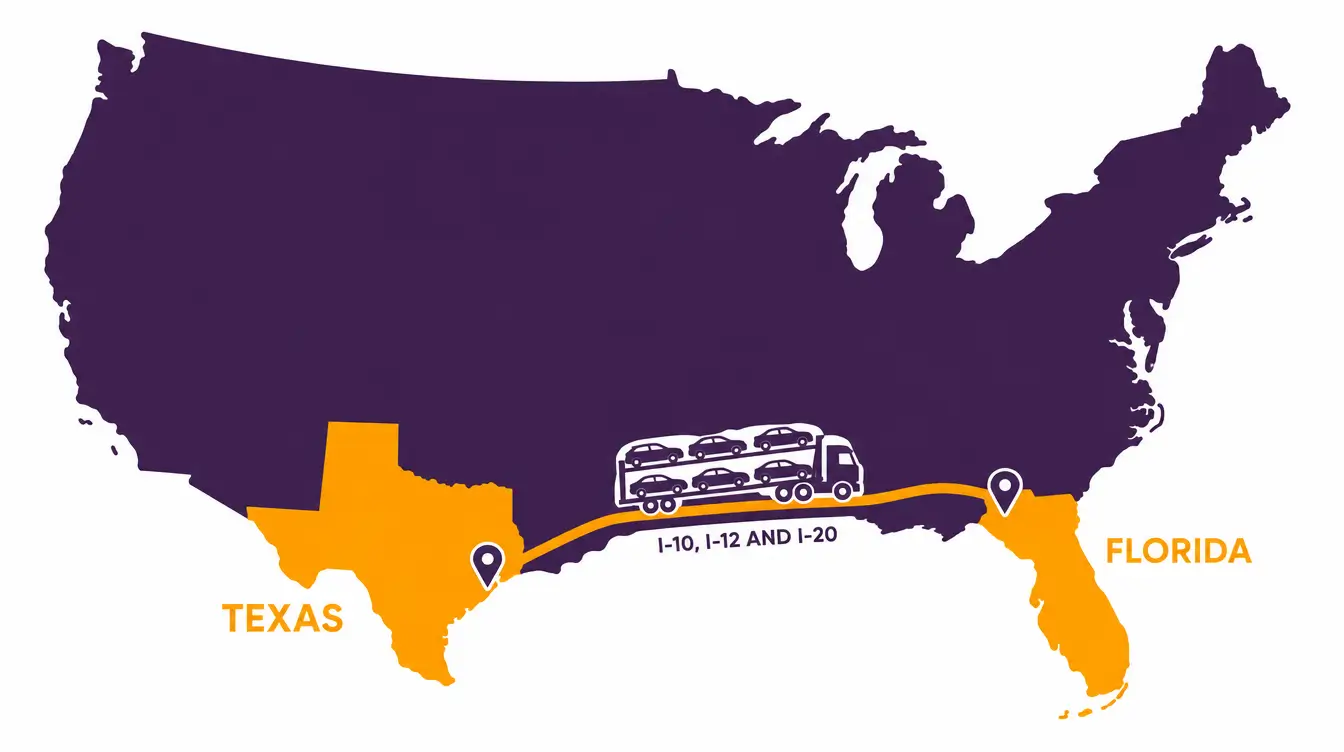
This page treats Florida to Texas car shipping as sixteen measured pairs. Panama City, Gainesville, Sebring and Port St. Lucie supply the four Florida pickups, and Orange, Lake Jackson, Weatherford and Boerne supply the four Texas drops. The shortest pair is Panama City to Orange at 545 miles, and the longest is Port St. Lucie to Boerne at 1,300. Twelve pairs stay on I-10 into Texas, and each of those twelve adds 86 miles of I-12 in Louisiana. I-10 carries 394 miles of the Panama City to Orange run and 606 miles of the same run from the other three starts, while a Boerne drop stretches it to 697 or 909 miles. The four Weatherford pairs break away from that line: they take US 98 for 65 miles and US 49 for 125, then follow I-20 for 416 miles. Sebring loads spend 80 miles on US 27 and 107 on I-75, Gainesville loads spend 47 miles on I-75, and Panama City loads start with 27 miles of SR 20. At the Texas end, Lake Jackson drops finish on 34 miles of TX 288 and Boerne drops on 25 miles of Loop 1604. These are the roads a router picks, and a carrier may choose others.
Which Town Changes the Mileage More, the Florida Start or the Texas End?
Your quote depends on your vehicle, the exact pickup and delivery addresses, the season and the trailer type, so run the calculator for a figure on your dates.
The Florida start moves the miles more on this lane. Pickups at Panama City and Port St. Lucie sit 424 miles apart for every Texas drop, while the Texas drops sit only 331 or 332 miles apart for any Florida start.
Hold the Texas end at Lake Jackson and the four starts measure 704 miles from Panama City, 908 from Gainesville, 1,073 from Sebring and 1,128 from Port St. Lucie. Hold the Florida start at Gainesville and the four ends measure 748 miles to Orange, 908 to Lake Jackson, 1,039 to Weatherford and 1,080 to Boerne.
Steps on the Florida side run 203 or 204 miles from Panama City to Gainesville, 165 or 166 more to Sebring and 54 or 55 more to Port St. Lucie. On the Texas side Lake Jackson sits 159 or 160 miles beyond Orange, Weatherford 131 or 132 beyond Lake Jackson and Boerne 40 or 41 beyond Weatherford. Vehicle size counts as well: an extended cab truck needs more trailer length than a hatchback does.
In your request, list both towns and the dates you could pick up.

Figure on $775 to $1,125 for a sedan hauled open, with Panama City to Orange toward the low end and Port St. Lucie to Boerne toward the high end. Run your two towns through the calculator for a tailored figure.
Enclosed hauling carries a premium because each trailer holds fewer vehicles. A lifted truck or cargo van usually adds 100 to 200 dollars. A dead battery or locked wheels means a winch, and the quote lists it separately.
- Florida start. For one Texas end, the four starts differ by 424 miles.
- Texas end. For one Florida start, the four ends differ by 331 or 332 miles.
- Common road. Every pair travels I-10.
A price far below these figures merits a call to confirm the carrier and the truck date.

What Factors Actually
Influence Pricing on This Route?
Five things move the price on any lane: the vehicle's size, whether it runs, how easy each end is to reach, the season and the trailer type. Booking early protects your timeline, keeps pricing steady and reduces the risk of last-minute carrier changes.


Type
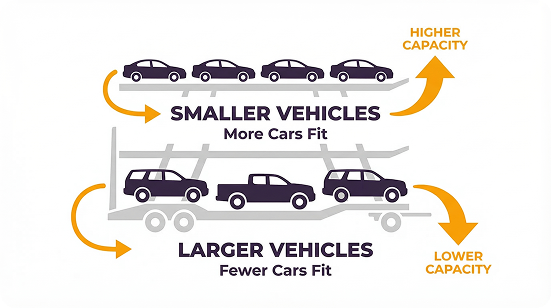
Size decides how much deck space your vehicle takes and how many other cars fit alongside it. A standard sedan is the cheapest thing to move because it slots almost anywhere on the trailer. SUVs, pickups and vans take more room and usually cost more on the same lane.


Carrier Hauling or a Solo Drive: Which Suits Florida to Texas?
Booking a Carrier
Even the shortest pair, Panama City to Orange at 545 miles, takes about 10.3 hours of driving, and Port St. Lucie to Boerne needs about 23.4 hours over 1,300 miles.
A carrier fits when another car must travel along with the household, when the car should reach Texas while you fly, or when a vehicle was sold to a buyer in Texas.
Making the Drive Yourself
Gainesville to Lake Jackson means about 16.7 hours behind the wheel, so most people plan two days of driving and an overnight stop near I-10.
Total fuel, lodging, meals and the ride home, then weigh that against the price a carrier gives for these towns. A lone car, loose dates and a spare weekend favor driving, while two vehicles or a fixed start date favor a carrier.
How Many Days Does Florida to Texas Car Shipping Take?
A carrier usually holds the car for 2 to 5 days between Florida and Texas, with Panama City to Orange at 545 miles on the short end and Port St. Lucie to Boerne at 1,300 miles on the long end.
Those days begin at loading. Carrier assignment comes earlier and is typically a one to three working day step, and a pickup day that can move helps it finish sooner.
Gulf weather, a late pickup or a stop for repairs can add roughly a day. Treat these as planning figures and never as a promise of a delivery date.
When Should You Book Florida to Texas Car Transport?
Book after your dates firm up, and mention to dispatch how flexible the pickup day is. A flexible window helps the car find a truck that is already headed west along the Gulf.
Gainesville, Sebring and Port St. Lucie keep Eastern time, one hour ahead of Texas, while Panama City already keeps Central time like Texas. Panama City sits on the Panhandle, Gainesville in the north of the peninsula, Sebring in the interior south and Port St. Lucie on the Atlantic coast. Orange lies on the Louisiana line, Lake Jackson south of Houston, Weatherford west of Fort Worth and Boerne northwest of San Antonio. Port St. Lucie to Boerne runs 755 miles longer than Panama City to Orange.
After a date is chosen, this guide to what happens after booking walks through dispatch and pickup.
Open or Enclosed for a Car Moving From Florida to Texas?
On open transport the car rides the unprotected decks of a standard hauler, the usual pick for this lane, and the finish faces road grit, Gulf storms and strong sun.
Enclosed trailers shield the paint over all 545 to 1,300 miles, at a higher price because they carry fewer cars.
A collector car, a show winner or newly painted bodywork may justify the enclosed premium. Most daily drivers, from a compact sedan to a crossover, ride open and arrive fine.
Enclosed Car Transport
Enclosed demand rises for high-value, specialty and seasonal vehicles, and enclosed trailers protect against road debris and weather, which matters most on longer hauls. Enclosed rigs are a small fraction of the trailers working any given lane, and that scarcity is what drives both the higher price and the longer booking lead time.
Open Car Transport
Most vehicles move on open trailers, and for most routes that is the more cost-effective way to ship a car.
Open transport works well for standard vehicles and keeps costs predictable. It also offers the widest carrier availability.
Preparing for Delivery in Texas
Send dispatch the complete Texas street address ahead of time, along with a gate code if one applies, and answer when the carrier calls about the handover time. If the street cannot take a long trailer, name a nearby crossroads or store lot where the truck can stop.
At the drop, inspect the car in daylight next to the loading pictures. List any fresh damage on the driver form before signing, and take a copy of the form for your records.
The state of Texas sets its own titling, registration and insurance steps, so check each with the state agencies before relocating.
What to Expect at Both Ends: Florida Pickups and Texas Drops
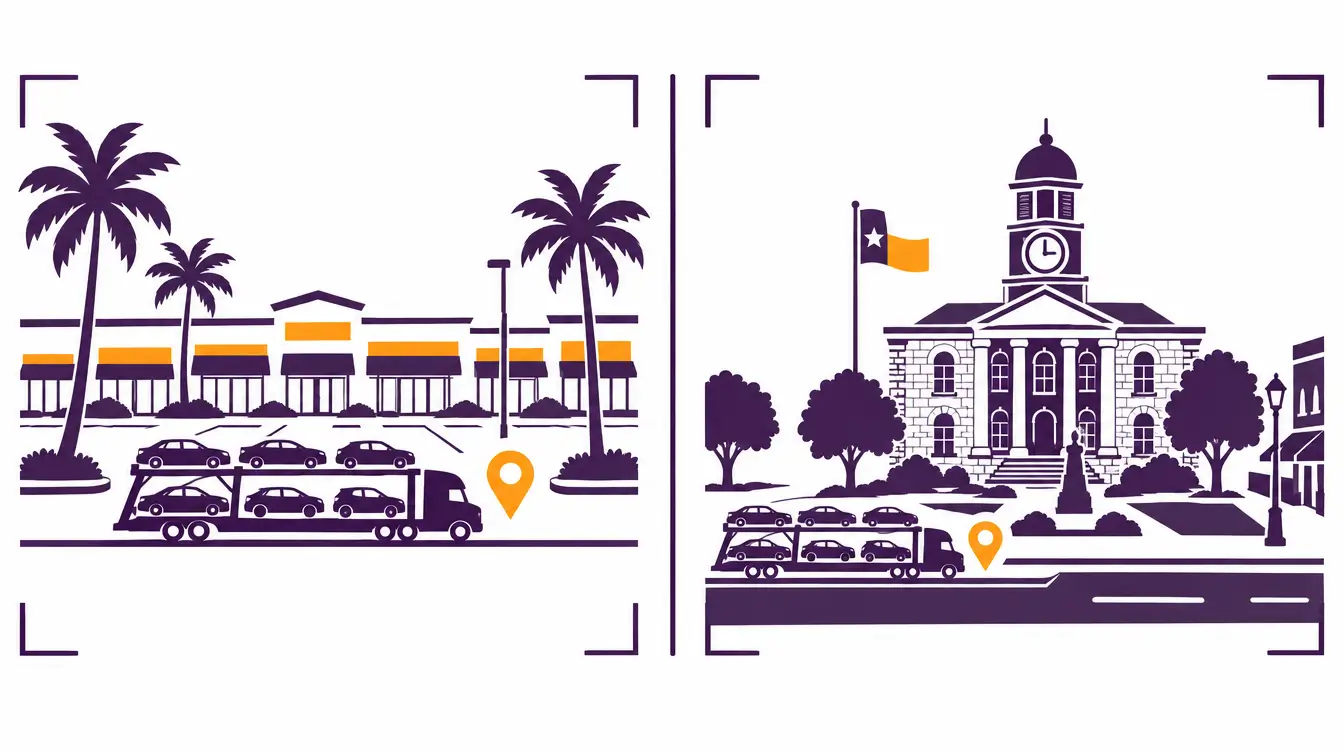
A full size hauler is a big rig, and plenty of streets will not take one. A gated community or a lane under live oaks in Gainesville or Sebring may send the meeting to a main road or a retail parking area, and Panama City or Port St. Lucie can bring similar limits. The Florida car shipping hub lists the rest of the state.
On the Texas side the limits shift. A tight subdivision near Lake Jackson, a Boerne street with sharp turns or a ranch road outside Weatherford may stop a full size rig, and an open lot close by tends to become the handover point. The Texas car shipping hub lists other drop areas.
Pickup and delivery both call for a slow lap around the car with the driver, checking each panel against the condition report. Timestamped photos support any note, and the report is filed with your bill of lading paperwork.
What Should You Know Before Requesting a Florida to Texas Quote?
Rivalane works as a broker and owns no trucks. Once you book, a licensed carrier accepts the load and sends its own truck and driver. A Florida start can move the total by up to 424 miles and a Texas end by up to 332, so state both towns in your quote request.
Frequently Asked Questions