To sell a car in Delaware, you complete Section 1 on the back of the title, report the sale to the DMV on a Seller's Report of Sale and deal with the license plate. A Delaware title does not need a notary. The DMV recommends that the seller go with the buyer to a DMV office, and its tips sheet tells a seller who cannot to follow the out of state buyer steps, which is the path this guide follows.
This guide takes a Delaware private seller through those steps in order, then follows one sale from start to finish: a California resident buys the car, the seller stays in Delaware and the car is shipped by carrier. For payment safety and carrier pickup that apply in any state, see our guide to selling a car to an out of state buyer.
How Do You Sell a Car in Delaware?
Work through the sale in this order:
- Check how the title is owned. The front of the Delaware title shows AND or &/OR between the owner names, which decides who has to sign.
- Wait for final payment. Sign nothing until your bank confirms the funds are final, not just visible in your account.
- Complete Section 1 on the back of the title. Add the buyer's name and address, the date of sale, the purchase price, the odometer disclosure and your signature and printed name.
- Complete the Seller's Report of Sale. Fill it out with the back of the registration card and mail both to the DMV.
- Remove the plate. Turn it in or mail it to any DMV office, or retain it first.
- Keep your records. Photograph the signed title, front and back, and keep a copy of the Report of Sale and any bill of sale.
How Do You Complete the Delaware Title?
The DMV's page on Delaware titled vehicles sold to an out of state buyer tells the seller to complete the Assignment of Certificate of Title, Section 1, on the back of the title. Section 1 takes the buyer's name and address, the date of sale, the purchase price, the odometer disclosure and the signature and printed name of the seller or sellers.
Look at the front of the title before anyone signs. Where ownership is shown as &/OR, the DMV says only one seller has to sign and print their name in Section 1. Where it is shown as AND, all sellers must sign and print their names. Leave nothing in Section 1 blank for the buyer to fill in later.
Delaware does not ask for a notary on the title. The DMV page on transfers between Delaware residents says so directly, and the seller steps for an out of state buyer do not mention one.
A bill of sale is a different matter. None of the DMV seller steps lists one as required, and the DMV's temporary tag steps accept either a bill of sale or the title signed over to the buyer, so it is one way to show the sale rather than the only way. It is still your own record. Show the vehicle, the VIN, the price, the date, the odometer reading and both people's printed names and signatures, and keep a signed copy.
What Do You Write for the Odometer on a Delaware Title?
The DMV's odometer disclosure page says the reading is mandatory when a vehicle with a model year of 2011 or newer changes ownership. Reporting is encouraged but not mandatory for a model year 2010 or older vehicle, a commercial vehicle with a gross vehicle weight above 16,000 pounds and a non-motorized vehicle. The sold vehicle page lists the odometer disclosure among the Section 1 items without a model year test, so completing it is the safer course for any car.
Write the miles shown on the odometer with no tenths. The DMV's example is an odometer reading 118,666.6 miles, which you disclose as 118,666. Two boxes on the title cover the cases where the number alone would mislead:
- Box 1, mileage in excess of mechanical limits. Check it when the odometer only reads to 99,999 miles and has rolled over, and write the miles currently showing.
- Box 2, odometer reading is not the actual mileage. Check it when the odometer was replaced or is broken, and write the miles showing. The title labels this an odometer discrepancy.
The title warns that failing to complete the odometer statement or giving a false one may bring fines or imprisonment, and the seller signs under penalty of perjury. Write the number you can stand behind.
How Do You Send the Seller's Report of Sale to the Delaware DMV?
The Seller's Report of Sale tells the DMV that you no longer own the car. It is the detachable bottom portion of newer Delaware titles and also appears on the back of the registration card, and the DMV publishes a Seller's Report of Sale form as well. State law backs it up: 21 Del. C. § 2502 says an owner who transfers a registered vehicle endorses the transferee's name and address and the date of transfer on the registration card and immediately gives or sends the card to the DMV.
The DMV's sold vehicle page says to complete the back of the registration card and the Report of Sale and forward them to the Division of Motor Vehicles at P.O. Box 698, Dover, Delaware 19903. It lists what the Report of Sale needs: the buyer's name and address, the selling price, the date of sale, your signature, and the buyer's driver license number and signature. The older tips sheet for private sellers and the transfer page ask for the date and hour of the sale rather than the buyer's license number. Collect all of it, including the hour, so the form is complete whichever list applies.
Which Mailing Address Is Right for the Report of Sale?
The two DMV sources agree on the box and differ on the line above it. The sold vehicle page addresses the Data Management Section, P.O. Box 698, Dover, Delaware 19903. The tips sheet addresses the Vehicle Services Help Desk at the same box and ZIP code. Because the box, city and ZIP match, the mail goes to the same post office box either way. To match the attention line exactly, call the DMV in Dover at 302-744-2500 before you mail, and send the form by a service that gives you a tracking record.
Skipping these steps carries a risk. The tips sheet warns that a seller who neither returns nor retains the plate may receive violations, such as red light, toll or parking violations, for a car that was not properly transferred to the new owner.
What Happens to Your Delaware Plate After a Private Sale?
The plate belongs to you, not the buyer, and the buyer will register the car in their own state. Delaware gives you two ways to handle it when the car is sold out of state.
Turn the plate in or mail it
The DMV's sold vehicle page says the plate must be removed from the vehicle and turned in or mailed to any DMV office. The tips sheet words it as returned to any DMV office. Take the plate off before the buyer or the carrier drives the car away.
Retain the plate
The DMV's tag retention page says you can retain a plate from any vehicle you sell, trade or gift, privately or through a dealership. Retaining puts the tag number on hold until the tag expires. You can then move it to another vehicle registered in your name, hold it for a future purchase or give it to someone else using the retention form. If you leave the plate on a car and sell it without retaining it first, you lose the plate.
For a car sold to an out of state buyer, the DMV runs an online sold out of state retention application, which the tag retention page links at dmv.de.gov/app/dmv/sos. The DMV's online services FAQ sets the limits. Only the registered owner can apply, the tag must still have an active expiration date, and where owners are joined by AND both must apply. A tag cannot be retained online when the vehicle was not sold to an out of state buyer, the tag is expired, there is an uninsured motorist case or suspension, the driver license status is invalid, the registration is suspended or has violations, the vehicle is registered through Motor Carrier or as a public carrier, or the vehicle was sold or traded into a Delaware dealership. Retaining in person at any DMV location takes the Delaware title, with both owners present for AND and one for &/OR.
Insurance comes after the plate. The DMV's general FAQ says plates must be surrendered to the Division before insurance is canceled for any reason on a vehicle with an active registration, so keep the policy in place until the plate is turned in. If you retain the plate instead, ask the DMV when the policy can end. The pages we read name no deadline for either step.
What if You Still Owe Money on the Car?
The DMV's tips sheet for private sellers does not address a loan, and none of the seller steps describes a payoff. What the DMV does publish for a financed car is the plate retention process, in its retaining a Delaware license plate sheet. When you trade or sell a vehicle with a lien and want to keep the plate, you obtain Form MV-35 from the DMV website and mail or fax it to your bank, lien holder or leasing company. The form asks them to send your title to the DMV. When the DMV receives the title, it emails you at the address on the form and sends a postcard. You then go to the DMV with your driver license and, if you plan to re-tag a vehicle for the purchaser, proof of insurance.
So MV-35 applies to one situation: keeping your plate while the car is financed and you retain in person. It is not a form every seller files, and it is not how you pay off the loan. The DMV's online sold out of state FAQ adds that a tag can be retained online with the lien still listed on the vehicle record, and says a lien release can be forwarded to the DMV Help Desk once the loan is paid.
For the sale itself, Section 1 needs your signature on the title, so ask your lender how and when it releases the title before you agree on a pickup date. A buyer cannot take a title that is still in the lender's hands.
What About the Buyer's Temporary Tag?
The temporary tag is the buyer's paperwork, not the seller's. The DMV's sold vehicle page says the Division issues a temporary tag so the buyer can drive the vehicle to the state where it will be titled, and that it can be purchased at any DMV office. The buyer provides a driver license or ID, valid proof of insurance on the vehicle being purchased or on a vehicle titled in the buyer's home state, a bill of sale or the title signed over to the buyer, and the vehicle identification number, make and year. The DMV's temporary tag FAQ adds that Delaware temporary tags are sold in person at DMV locations and cannot be bought online.
Keep that list apart from your own. Those items are what the buyer shows to get the tag. They add no step for the seller, and the bill of sale appears there as an alternative to the signed title, which is why this guide does not call a bill of sale a general requirement. The DMV's sources also differ slightly: the tips sheet ties the tag to a Delaware registration that has expired, and the sold vehicle page does not. A buyer who plans to drive the car away should confirm with the DMV first. A buyer whose car ships on a carrier does not drive it, so the tag may never come up.
Worked Example: A California Buyer and a Delaware Private Seller
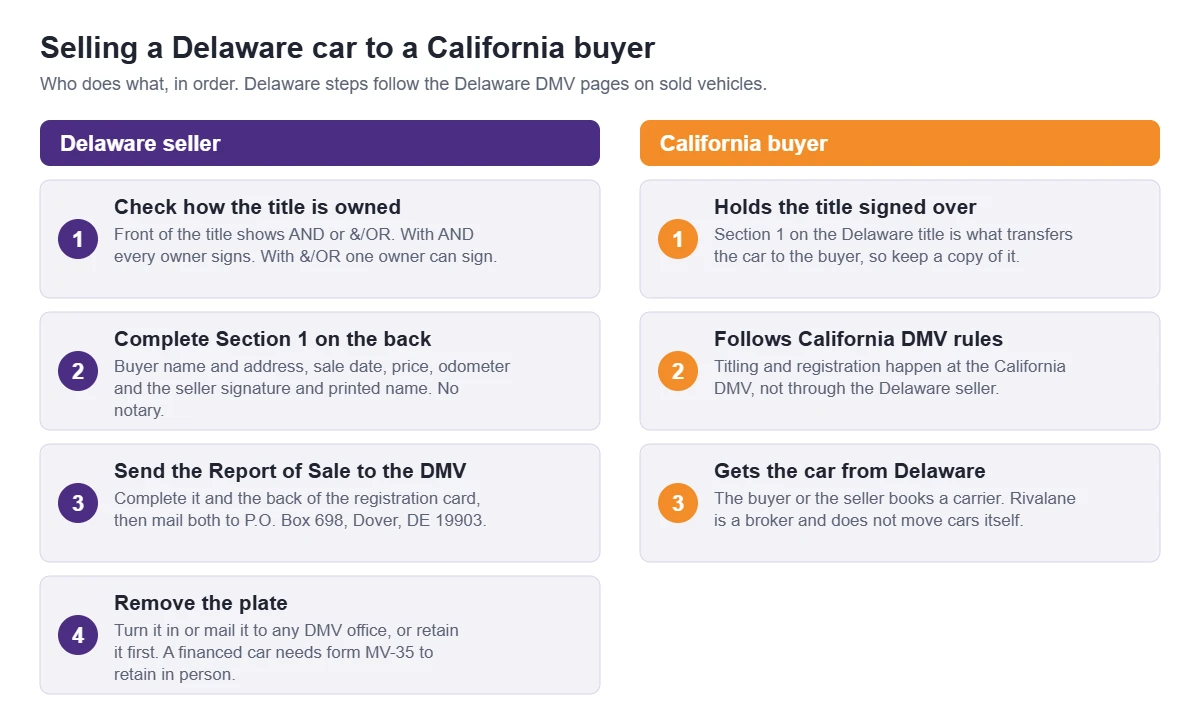
Here is the sale from both sides. A California resident buys a car from a private seller in Delaware. The seller stays in Delaware, the buyer will title and register the car in California, and the car travels by carrier. The graphic shows the two lists side by side, and the sections below spell them out.
What the Delaware seller does
- Checks whether the title says AND or &/OR, so the right owners sign.
- Waits for final payment, then completes Section 1 with the buyer's California name and address, the price, the odometer disclosure and the signatures. No notary is needed.
- Completes the Seller's Report of Sale and the back of the registration card, and mails them to P.O. Box 698, Dover, Delaware 19903.
- Removes the plate and turns it in, mails it to any DMV office or retains it. A financed car retained in person needs Form MV-35.
- Sends the signed title to the buyer by a method that gives a tracking record, after the payment has cleared, and keeps a photo of the signed front and back.
What the California buyer does next
The buyer follows the California DMV, not the Delaware DMV. Our guide to buying a car out of state in California covers the purchase from the buyer's side, and our guide to registering an out of state car in California walks through titling and registration, so this guide does not restate them.
How Do You Get the Car to California?
For a car going from Delaware to California, a carrier is the usual option. Rivalane is a broker: we coordinate door to door transport with licensed, insured carriers, and the carrier, not Rivalane, moves the car. We typically assign a carrier within one to three working days after you book, and pickup and delivery dates are estimates, not guarantees. Our page on shipping a sold car from Delaware to California covers the lane, and the car shipping calculator prices the trip for whoever books it.
Settle three things in writing before the car leaves: who books the carrier, who pays it and when, and that the seller is the pickup contact. Then handle pickup day this way:
- Walk the car with the driver and sign the bill of lading as the person releasing it. Send the buyer a copy. Our guide to the bill of lading explains the form.
- Hand the driver every key that goes with the car.
- Remove personal items, garage openers and any toll transponder, such as an E-ZPass, so the buyer's driving does not post to your account.
- Keep the title out of the car. Send it separately after the payment has cleared, by a method that gives a tracking record, and time it to reach the buyer when the car does.
One more Delaware rule is easy to confuse with the sale steps above. When an owner moves out of Delaware and registers the same car in another state, the plate rule is different from a sold car: the DMV's general FAQ answers yes when asked whether the plate must be returned, and the statute is 21 Del. C. § 2507. That rule is about moving yourself, and everything in this guide is about selling the car.
Frequently Asked Questions
How do I sell a car in Delaware to a private buyer?
Does a Delaware title need to be notarized?
Where do I mail the Delaware Seller Report of Sale?
Do I have to return my Delaware license plate when I sell the car?
When do I need Form MV-35?
Do I have to write the mileage on a Delaware title?