To sell a car in Florida, a private seller clears any loan on the car, signs the Transfer of Title by Seller section of the title, records the odometer reading, removes the license plate and files a Notice of Sale, form HSMV 82050, with the Florida Highway Safety and Motor Vehicles department (FLHSMV). Which title steps apply depends on whether the title is paper or electronic, and a buyer in another state adds one more question: how the signed title reaches them.
This guide takes a Florida private seller through the steps in order, then follows one sale from start to finish: a Washington resident buys the car, the seller stays in Florida and the car is shipped across the country. For payment safety and carrier pickup that apply in any state, see our guide to selling a car to an out of state buyer.
How Do You Sell a Car in Florida?
Work through the sale in this order:
- Pay off any loan. FLHSMV says a car with an existing lien cannot be legally sold in a private sale until the lien is satisfied.
- Get the title in hand. A paper title must be in your possession, or replaced with a duplicate. An electronic title needs either a paper copy printed or both parties at a service center.
- Verify the VIN and odometer if the car was not titled in Florida before. FLHSMV requires this of the seller in that case only.
- Complete the seller section of the title. Enter the buyer name and address, the odometer information, the selling price and the date sold.
- Remove the license plate. In a Florida sale the plate stays with the seller.
- File the Notice of Sale. Florida law requires form HSMV 82050 from every seller.
FLHSMV's Selling a Vehicle page lists the same sequence in a seller checklist. It also encourages sellers to complete the sale in a motor vehicle service center, which it says protects the seller by confirming the title has left their name and protects the buyer by confirming the seller handed over the proper ownership documents.
What Should You Check Before You List the Car?
Start with the title. FLHSMV says that for a sale to be legal in Florida the seller must transfer the title to the buyer. If a paper title was lost or misplaced, the seller must apply for a duplicate before selling, using form HSMV 82101 at a motor vehicle service center.
Then check for a loan. FLHSMV says the lien must be satisfied before the car can be legally sold in a private sale, and that the title can be transferred once the lienholder reports to FLHSMV that the lien has been satisfied. A dealer trade is the exception FLHSMV describes: a car with a lien can be traded in at a dealership, and the dealer has 10 days to satisfy the lien before selling it to another customer.
Finally, keep records. FLHSMV tells sellers to keep copies of the bill of sale, the certificate of title or another transaction document showing the car was sold.
Paper Title or Electronic Title: Which Applies to Your Car?
With a paper title, the seller completes the Transfer of Title by Seller section on the front of the certificate, including the name and address of the buyer, the odometer information, the selling price and the date sold. The buyer then completes an Application for Certificate of Title with or without Registration, attaches it to the title and submits both to a motor vehicle service center, according to FLHSMV.
With an electronic title there is no paper certificate to sign. FLHSMV says the seller and buyer must visit a motor vehicle service center to complete a secure title reassignment (form HSMV 82994 or 82092) and disclose the odometer reading, and that both must be present and provide photo identification.
What If the Title Is Electronic and the Buyer Lives Out of State?
Do not assume a remote sale fits the standard electronic process. The FLHSMV pages we read put the reassignment at a service center with both parties present, and they describe no way to complete it when the buyer stays in another state. A Washington buyer who never visits Florida therefore cannot be the other half of that visit. You have three options:
- Convert the title to paper. If all liens have been satisfied, FLHSMV's paper liens and titles page says an electronic title can be converted to paper online through MyDMV Portal, by mail to your county tax collector office or in person at the county tax collector office. You then sign the paper title as described above. On the pages we read, FLHSMV states the both parties present requirement for electronic titles only.
- Have the buyer come to Florida. Both of you visit a service center for the secure title reassignment, with photo identification.
- Trade or sell to a licensed Florida dealer. FLHSMV says a paper title does not have to be requested before a dealer trade. The buyer is then the dealer, not the Washington resident.
The conversion details matter for a shipped car. FLHSMV says a paper title requested online or by mail is mailed to the address on the motor vehicle record and cannot be printed at home or picked up from a county office after an online transaction. A same day printing, which FLHSMV calls a fast title, must be requested in person and carries an additional fee. Whichever route you use, order the paper title before you agree a pickup date, because the car should not leave until the signed title can reach the buyer.
When Does Florida Require VIN and Odometer Verification?
Only when the car was not titled in Florida before. FLHSMV says the seller must then complete a Vehicle Identification Number and Odometer Verification, and that the form needs verification by the owner and one of four people: a Florida FLHSMV compliance examiner or officer, a licensed Florida motor vehicle dealer, a Florida notary public or a law enforcement officer.
That makes it a requirement about the car's title history, not about where the buyer lives. A car with a Florida title skips it, and a Washington buyer does not trigger it. One example is a seller who moved to Florida with a car still titled in another state. Our Florida VIN verification guide covers the form and who can sign it.
How Do You Record the Odometer and Handle the Bill of Sale?
Florida titles include space for the odometer disclosure. FLHSMV says the odometer reading at the time of purchase is required on the title application, and that both the buyer and the seller must acknowledge the odometer disclosure on a title transaction.
For the bill of sale, the FLHSMV seller page names no separate Florida form. It tells sellers to keep copies of the bill of sale and recommends having it notarized. It also says form HSMV 82050, covered next, documents the sale and is the legal receipt.
If the buyer lives in another state, ask whether that state wants its own form. Washington's Department of Licensing tells a buyer and seller to complete its Vehicle/Vessel Bill of Sale form and says the sale price on it is used to calculate the use tax, as the DOL page on buying and registering a vehicle explains. A Florida seller with a Washington buyer should therefore expect to sign Washington's form as well.
How Do You File the Notice of Sale (HSMV 82050)?
Florida law requires every seller to file form HSMV 82050, according to FLHSMV, which says the requirement has applied since July 2009. FLHSMV says filing it with a motor vehicle service center removes the seller's registration from the vehicle and helps the seller avoid civil liability for the car's operation after the sale. Once it is filed, applying for the title and registration becomes the buyer's responsibility. A seller who does not file, with a buyer who never titles the car, can be held liable for what happens with it.
The deadline comes from the statute. Section 319.22 of the Florida Statutes says an owner who has made a bona fide sale and delivered possession to a purchaser must notify FLHSMV within 30 days after the sale or transfer, on the form FLHSMV prescribes. The notice includes the VIN and the buyer's full name and identification, such as a driver license number. Collect the buyer's full legal name and identification in writing before the car leaves, especially when you will never meet in person.
What Happens to Your Florida License Plate?
The plate stays with you. FLHSMV says the seller must remove it from the sold car and may then transfer it to a new or replacement vehicle. The seller must surrender the plate to a motor vehicle service center if moving to another state or cancelling the insurance on the vehicle the plate is tied to. Do not leave the plate on the car for the buyer. Our Florida license plate surrender guide covers the surrender options and the order of plate, insurance and title, so this guide does not repeat them.
Can You Sell a Car Without Being Treated as a Dealer?
For one personal car, the practical risks are two rules on the FLHSMV page. First, curbstoning: Florida law prohibits parking a vehicle on a public right of way, or on private property without the owner's permission, for the purpose of sale. Second, the dealer presumption: FLHSMV says Florida law presumes a person who buys, sells, offers for sale, displays for sale or deals in three or more motor vehicles in any 12 month period to be a motor vehicle dealer, who must hold a state license.
The statute behind it, section 320.27, calls this a prima facie presumption. The same section says the term motor vehicle dealer does not include people not engaged in the purchase or sale of motor vehicles as a business who are disposing of vehicles acquired for their own use, provided the vehicles are acquired and sold in good faith. The exclusion covers people who are not in the business and are disposing of their own vehicles, while buying, selling or displaying three or more in 12 months is what raises the presumption. This is general information, not legal advice, so ask a lawyer if you buy cars to resell.
Which Deadlines Apply: 30 Days in Florida or 15 Days in Washington?
Several clocks run after a Florida sale, and they belong to different people:
- The seller's Notice of Sale: 30 days. This is the only clock in the list that binds the seller.
- A buyer who titles the car in Florida: 30 calendar days. FLHSMV says the buyer must submit the title application within 30 calendar days to avoid a late transfer penalty. This applies only when the car is titled in Florida.
- A buyer who titles the car in another state: FLHSMV says the buyer must contact that state for its titling procedures. The buyer may buy a temporary tag at a Florida service center that is valid for 30 days to drive the car there, and FLHSMV says the buyer pays Florida sales tax when purchasing the temporary tag. Our Florida car sales tax guide covers how Florida taxes a car sold to an out of state buyer.
- A Washington buyer: 15 days. The DOL buying page says a buyer has 15 days after buying a vehicle to transfer the ownership into their name, with penalties after that.
The 15 days belong to buying a vehicle. DOL's moving to Washington page gives a different period, 30 days after moving to Washington, for people who bring a vehicle they already own, and it does not mention purchases. Do not apply one of these deadlines to the other, and keep Florida's two 30 day periods apart as well: one is the seller's, one is the Florida buyer's.
Worked Example: Selling a Florida Car to a Washington Buyer
Selling a Florida car to a Washington buyer looks like this from both sides. A Washington resident buys a car from a private seller in Florida. The seller stays in Florida, the buyer will title and register the car in Washington, and the car travels by carrier. The graphic shows the seller's steps in order and keeps the seller's 30 days apart from the buyer clocks.
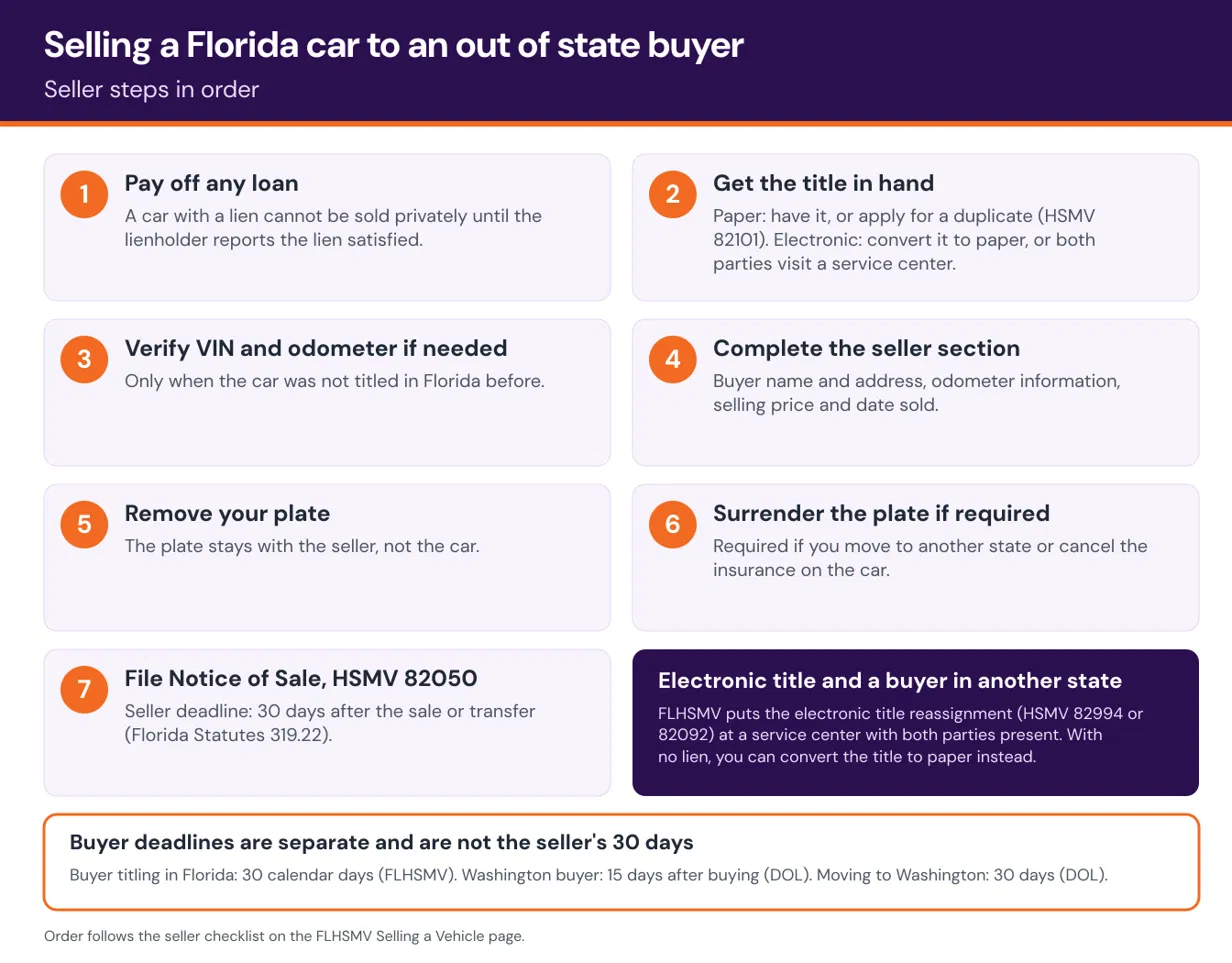
What the Florida seller does, in order
- Before the sale: pays off any loan, makes a copy of the title and, if the title is electronic, requests a paper title because the buyer will not be at a Florida service center.
- Before the car moves: waits until the buyer's payment is final, as our guide to selling a car to an out of state buyer explains.
- On the title: if the car was not titled in Florida before, completes the VIN and odometer verification first, then completes the Transfer of Title by Seller section with the buyer's name and address, the odometer information, the selling price and the date sold, and keeps a copy.
- On the bill of sale: keeps a copy (FLHSMV recommends having it notarized) and signs Washington's Vehicle/Vessel Bill of Sale form as well.
- Plate: removes it and either moves it to another vehicle or surrenders it if the seller is moving to another state or cancelling the insurance tied to it.
- Notice of Sale: files HSMV 82050 within 30 days, with the buyer's full name, identification and the VIN.
The title itself is a separate handoff. Agree in writing how and when it reaches the buyer, because DOL's list of paperwork starts with the current title signed by all owners, so the buyer needs it in hand.
What the Washington buyer does
The buyer follows Washington's rules, not Florida's. The DOL page on buying and registering a vehicle lists the paperwork:
- The current title, signed by all owners of the vehicle.
- A Vehicle Title Application, which the buyer should not sign until in front of a licensing agent who can notarize it, or otherwise in front of a notary.
- An odometer disclosure on the title when the model year is 2011 or newer. DOL says a model year 2010 or older car qualifies for an odometer exemption.
- The Vehicle/Vessel Bill of Sale form, completed by the buyer and the seller.
The same page says a buyer may mail in the completed forms, and that this is a good option when buying a vehicle out of state and not returning right away. The buyer must also get new Washington license plates, since the vehicle has changed ownership. For the use tax calculated from the price on the bill of sale, see our Washington vehicle sales tax guide.
A buyer who is also moving to Washington is in a second situation. Washington State asks new residents to get the driver license first and register the car second, both within 30 days of moving, and the two happen at separate DOL offices. Our guide to registering an out of state car in Washington covers that visit.
How Do You Get the Car to Washington?
If the buyer will not drive to Florida, a carrier can move the car. Rivalane is a licensed property broker, not a carrier: we arrange transport with licensed carriers, and the carrier, not Rivalane, physically moves the car. Carrier assignment typically takes one to three working days, which covers assignment only and not transit time, and pickup and delivery dates are estimates, not guarantees. Our page on shipping a car from Florida to Washington State covers the lane, and the car shipping calculator prices the trip.
Plan around the buyer's 15 days. DOL counts the 15 days from buying the vehicle, so agree who books the carrier, who is at each end and how the signed title reaches the buyer before the car leaves. If the title is electronic, settle the paper title first, because a converted title is mailed rather than handed over.
Frequently Asked Questions
How do I sell a car privately in Florida?
Do the buyer and seller both have to be present to transfer a Florida electronic title?
Do I have to file a Notice of Sale when I sell a car in Florida?
Do I keep my Florida license plate after I sell the car?
When does Florida treat a seller as a car dealer?
How many days does a Washington buyer have to transfer a car bought in Florida?