


Shipping a running sedan on an open trailer between Newark and Los Angeles typically costs $1,150 to $1,650. Road distances on our 64 routed pairs span about 2,686 to 2,971 miles on I-80 or I-40, and delivery generally falls 7 to 9 days after pickup. Two to three weeks of notice gives the widest choice of carriers.
How Does a Car Travel by Road From New Jersey to California?
New Jersey to California car shipping covers about 2,686 to 2,971 road miles, measured over 64 pickup and delivery town pairs and checked against a second mileage source, and which interstate carries the car depends on both ends of the trip. Cars going to San Jose, San Francisco or Sacramento stay on I-80 across the Midwest and the West, by Des Moines, Omaha, Cheyenne, Salt Lake City and Reno. Newark, Paterson and Morristown cars headed for Los Angeles, Riverside, Irvine or Fresno also take I-80 past Youngstown, then leave it in western Nebraska for Denver, run I-70 through Colorado and Utah and reach Southern California on I-15 by Las Vegas and Barstow. Pickups from New Brunswick south to Cherry Hill and Atlantic City go west by way of Harrisburg toward Southern California and Fresno, following I-70, I-44 and I-40 through Columbus, St. Louis, Tulsa, Albuquerque and Flagstaff. San Diego deliveries from every part of the state finish on that southern road. Across all 64 pairs, I-80 is the longest single road on 36 and I-40 on 28.

What Does New Jersey to California Car Shipping Cost?
Your quote depends on your vehicle, the exact pickup and delivery addresses, the season and the trailer type, so run the calculator for a figure on your dates.
From Newark, the delivery city shifts the mileage more than the pickup town does. Riverside is the nearest of the eight California cities we routed, at about 2,750 road miles, with Irvine and Los Angeles close behind near 2,780 and San Diego near 2,790. Sacramento comes in around 2,810, San Francisco near 2,900 and Fresno near 2,910, since Newark loads for Fresno come in by way of Barstow and then turn north, and San Jose runs longest at about 2,930. More delivery cities are on the California car shipping page.
At the New Jersey end the spread is small. Measured to Los Angeles, every pickup we mapped lands within about 60 miles of Newark: Cherry Hill is the shortest at about 2,720 and Trenton about 2,730, while Newark, Paterson, Toms River and Atlantic City all sit between about 2,770 and 2,785. Other pickup towns are listed on the New Jersey car shipping page.

Recent quotes for a running sedan going Newark to Los Angeles on an open trailer land in a band that runs $1,150 to $1,650. Check your own pickup and delivery towns in the car shipping calculator.
Larger vehicles such as a full-size SUV, minivan or pickup add roughly $150 to $250 because they take a bigger slot on the deck, and an enclosed trailer pushes the open price up by 40 to 60 percent.
Three things move the price on this route more than anything else:
- The California city. Riverside and Irvine are the shortest runs from Newark, and San Jose is the longest, about 180 miles past Riverside.
- North or south Jersey. Pickups around Newark use I-80 for every California city except San Diego, while central and southern New Jersey cars bound for Southern California take I-40, so each road meets different weather.
- The season. Winter snow in the Wyoming and Colorado high country, and chain rules in the California mountains, can cost a truck a day or more.

What Factors Actually
Influence Pricing on This Route?
Five things move the price on any lane: the vehicle's size, whether it runs, how easy each end is to reach, the season and the trailer type. Booking early protects your timeline, keeps pricing steady and reduces the risk of last-minute carrier changes.


Type
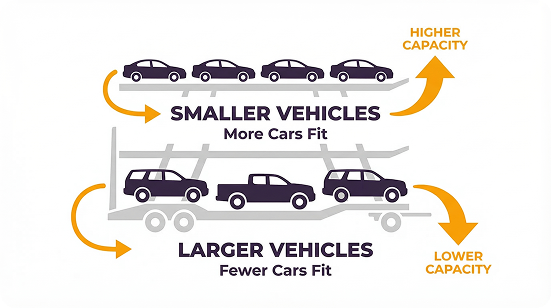
Size decides how much deck space your vehicle takes and how many other cars fit alongside it. A standard sedan is the cheapest thing to move because it slots almost anywhere on the trailer. SUVs, pickups and vans take more room and usually cost more on the same lane.


Should You Ship or Drive a Car From New Jersey to California?
Reasons to Ship
Shipping suits moves where flying takes an afternoon and driving takes most of a week: a job offer in Southern California or the Bay Area with a fixed start date, a New Jersey lease that ends the same week a California one begins, or a newer car whose owner would rather not put close to 2,800 more miles on it.
It also spares a week of fuel, motel nights and restaurant meals. Heading to the Pacific Northwest instead? New Jersey to Washington car shipping covers that run.
Reasons to Drive
A road trip can work out cheaper for two travelers with flexible dates who want to see the country on the way, and Rivalane will tell you plainly when driving looks like the better deal. Our routing puts Newark to Los Angeles at close to 50 hours behind the wheel, which turns into most of a week, or a little more, once fuel stops, meals and sleep are counted.
A solo driver has a harder time of it. Even the shortest pair we mapped, Cherry Hill to Riverside, runs about 2,690 miles. The cost guide for cross-country car shipping compares the two side by side.
How Long Does It Take to Ship a Car From New Jersey to California?
After loading, most California deliveries typically take 7 to 9 days. Cherry Hill to Riverside, our shortest pair at about 2,690 road miles, generally finishes near the front of that window, while Atlantic City to San Jose, the longest at roughly 2,970, can stretch to the end of it.
Rivalane normally names the carrier one to three working days in, and a pickup date with some give in it lets more westbound carriers fit the car in.
Cars on I-80 pass the halfway mark in Nebraska, while cars on I-40 reach theirs in central Oklahoma. From December into March, snow in Wyoming and the Colorado mountains, or on the high desert stretches of I-40 in New Mexico and Arizona, can cost an extra day or two.
When Should You Book Car Shipping From New Jersey to California?
Two to three weeks of notice is the sweet spot here. It gives Rivalane room to match the car with a licensed carrier that has a California run on its calendar and an empty slot on the trailer, rather than settling for whatever truck is free. If the pickup date cannot move, say so at booking, since a fixed date shortens the list of carriers that can take the car.
Leave more slack between December and March, when mountain weather can hold trucks for a day or more. For a second car leaving New York City, see New York to California car shipping, and for a pickup across the Delaware River there is Pennsylvania to California car shipping.
Open or Enclosed Transport From New Jersey to California: Which Fits?
Open transport is how the large majority of cars make this trip, on one of the two decks of a standard carrier. Over close to 2,800 miles the car sees what a road trip would bring, from winter salt on New Jersey and Pennsylvania roads to dust and strong sun on the desert stretch into California.
With enclosed transport, hard trailer walls keep weather, salt and grit away from the car the whole way. Enclosed trailers carry fewer cars, so each spot costs more and short-notice requests can take longer to fill. Collector and classic cars, high-value cars and anything with fresh paint usually go enclosed, and everyday cars go open.
Enclosed Car Transport
Enclosed demand rises for high-value, specialty and seasonal vehicles, and enclosed trailers protect against road debris and weather, which matters most on longer hauls. Enclosed rigs are a small fraction of the trailers working any given lane, and that scarcity is what drives both the higher price and the longer booking lead time.
Open Car Transport
Most vehicles move on open trailers, and for most routes that is the more cost-effective way to ship a car.
Open transport works well for standard vehicles and keeps costs predictable. It also offers the widest carrier availability.
Who Handles Which Step When a New Jersey Car Is Registered in California
Several parties have a hand in moving a New Jersey car onto California registration. Here is who does what, and in which state. The DMV visit itself is laid out step by step in how to register a car from another state in California.
The California DMV. The deadline is 20 days, and it starts either when you take up residence or when the car arrives in California. Residency begins with a plan to spend six months or more of a year in the state, and the DMV reads a local job, voter registration there, a rented primary residence or a California license as signs of it. Bring the REG 343 application signed by all of the registered owners, plus the last title and registration card New Jersey issued for the car. If the New Jersey title cannot be surrendered, for example because a lender holds it, California marks the registration card Nontransferable and issues no California title. Expect registration, transfer and use tax fees, and send in the application and fees on time even with an item outstanding, which the DMV says avoids penalties.
A vehicle verifier. Form REG 31, the vehicle verification, is filled out by an authorized DMV employee, a California-licensed vehicle verifier or a law enforcement officer.
A smog check station. Gasoline cars from model year 1976 forward need a smog certification, as do diesels from 1998 forward rated below 14,001 pounds gross, and motorcycles are exempt. Nearly new cars face one more rule: residents cannot bring a vehicle younger than 2 years and showing fewer than 7,500 miles into the state or register it there, unless it left the factory meeting California emission standards or an exemption fits.
The New Jersey MVC. It takes plates back through staff at any MVC agency, the drop box outside one, or the mail, but not at an inspection station, and it mails a receipt as proof of the surrender. At the DMV counter California normally keeps out-of-state plates, apart from cases such as expired plates and plates the issuing state asks to have back, so ask there whether to hold on to the New Jersey plates for the MVC.
Your insurer. In New Jersey, the registered owner must carry liability insurance by law, and once an insurer reports a policy as dropped, the MVC can send a suspension notice. Leave the New Jersey policy in place until the plate receipt arrives, and set up the California policy so there is no gap.
Sources: the DMV New California Resident Portal and HTVR 9 brochure for California, and New Jersey MVC guidance on returning plates and on insurance enforcement. Both agencies revise rules and fees, so confirm each side before shipping.
What Should You Expect at Pickup in New Jersey and Delivery in California?
Settle both handover spots before a carrier is assigned. A loaded hauler needs plenty of open road to park, drop the ramps and drive off again, and many streets cannot give it that room.
In New Jersey, the dense blocks of Hudson County and older Newark neighborhoods, and the cul-de-sacs of newer subdivisions, are where a pickup most often moves to a shopping center or office park lot near the highway. Wider streets in many Morris, Somerset and Burlington County towns can usually take the truck at the curb.
In California, gates and homeowner association rules can keep a large truck off private streets, and steep, winding hillside roads around Los Angeles and the Bay Area are rarely an option, so a nearby retail lot often becomes the meeting point. Newer neighborhoods in the Central Valley usually have more room.
When the driver arrives, walk around the car together and mark any chips, dents or scratches that are already there on the inspection report before loading, then repeat that check at delivery before you sign.

Key Things to Know Before Shipping a Car From New Jersey to California
Rivalane coordinates New Jersey to California shipments from its office in Melville, New York, booking each car onto a licensed carrier with a westbound schedule and tracking it in real time until delivery. A carrier is usually confirmed within one to three working days. Plan for paperwork at both ends: California wants the car registered within 20 days after you become a resident or bring it into the state, and New Jersey takes its plates back through the MVC.
Frequently Asked Questions