





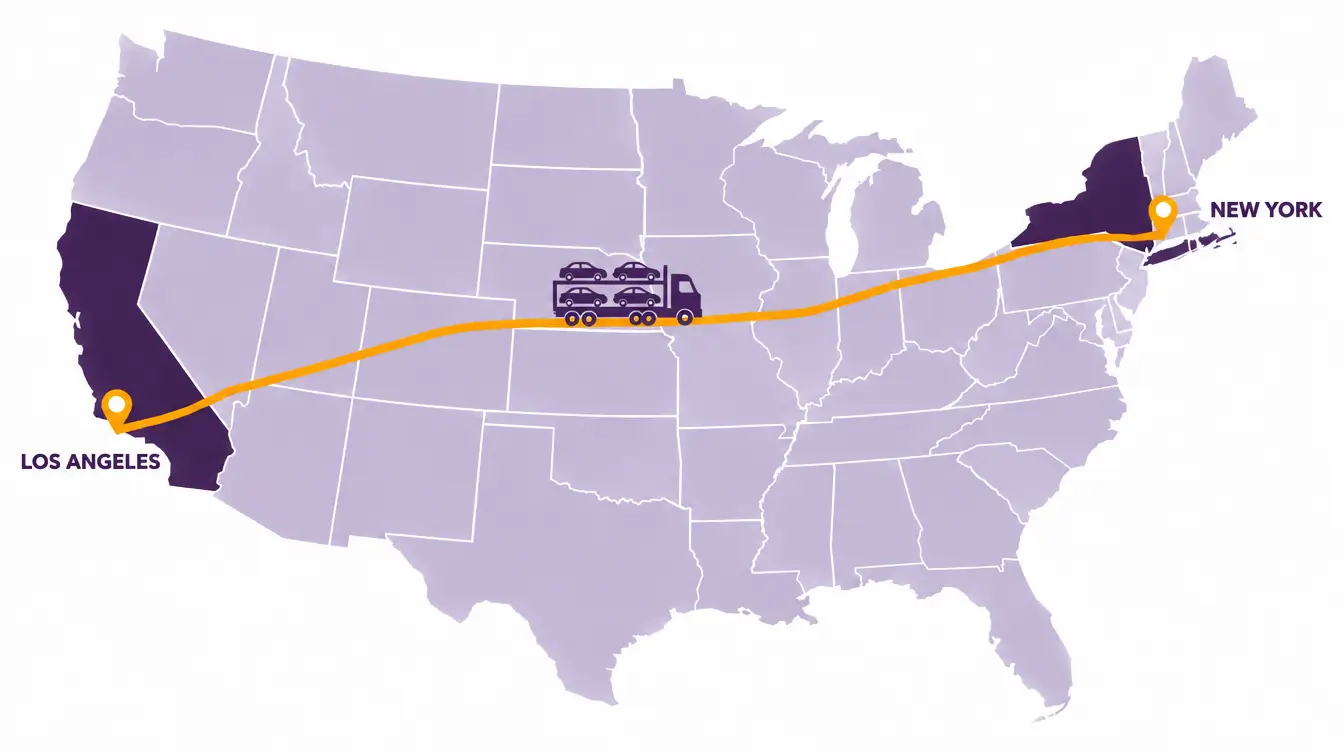
The road distance runs from 2,540 to about 2,970 miles, and most loads are delivered within 7 to 9 days. A running sedan riding uncovered from New York City to Los Angeles is quoted from $1,300 up to $1,850. Give dispatch two weeks, and finish the California registration within 20 days.
How Car Shipping From New York to California Works
Which interstate a westbound load takes depends on where in California it is going. From New York City, I-40 is the interstate the route calculator lists for Los Angeles, San Diego, Fresno and Bakersfield. From Long Island, Westchester or an upstate city, deliveries to Los Angeles, Fresno or Bakersfield are routed on I-70 through the center of the country instead. Every run to San Francisco, San Jose, Sacramento or Redding uses I-80 and finishes with the climb over the Sierra Nevada. No New York start sits closer to California than Buffalo, which is about 260 miles shorter to Los Angeles than Yonkers. Loads are usually gathered from the city, the island and upstate over a few days before the truck commits to the long drive, which is why the pickup window matters as much as the mileage.
How Much Does Car Shipping New York to California Cost?
Distance fixes the starting price, and nearly every quote on this lane covers 2,500 miles or more, so what separates one quote from another is mostly the two addresses and the vehicle.
In New York, cars in Buffalo, Rochester and Syracuse start well west of the city and give a truck its shortest run. Manhattan pickups add access time, and Long Island or the North Country add distance. At the other end, Los Angeles and Bakersfield sit near the short end of the lane, Sacramento runs about 30 miles farther, Redding about 90 to 95 and the Bay Area around 150.
Size counts too, since a big SUV or a crew-cab truck fills a slot two compact cars could share.
Treat an unusually cheap quote with suspicion. If no carrier accepts the price, the car simply waits in New York while someone looks for a truck. Flexibility on pickup dates tends to lower the price more reliably, and the car shipping calculator gives a starting figure for your two addresses.
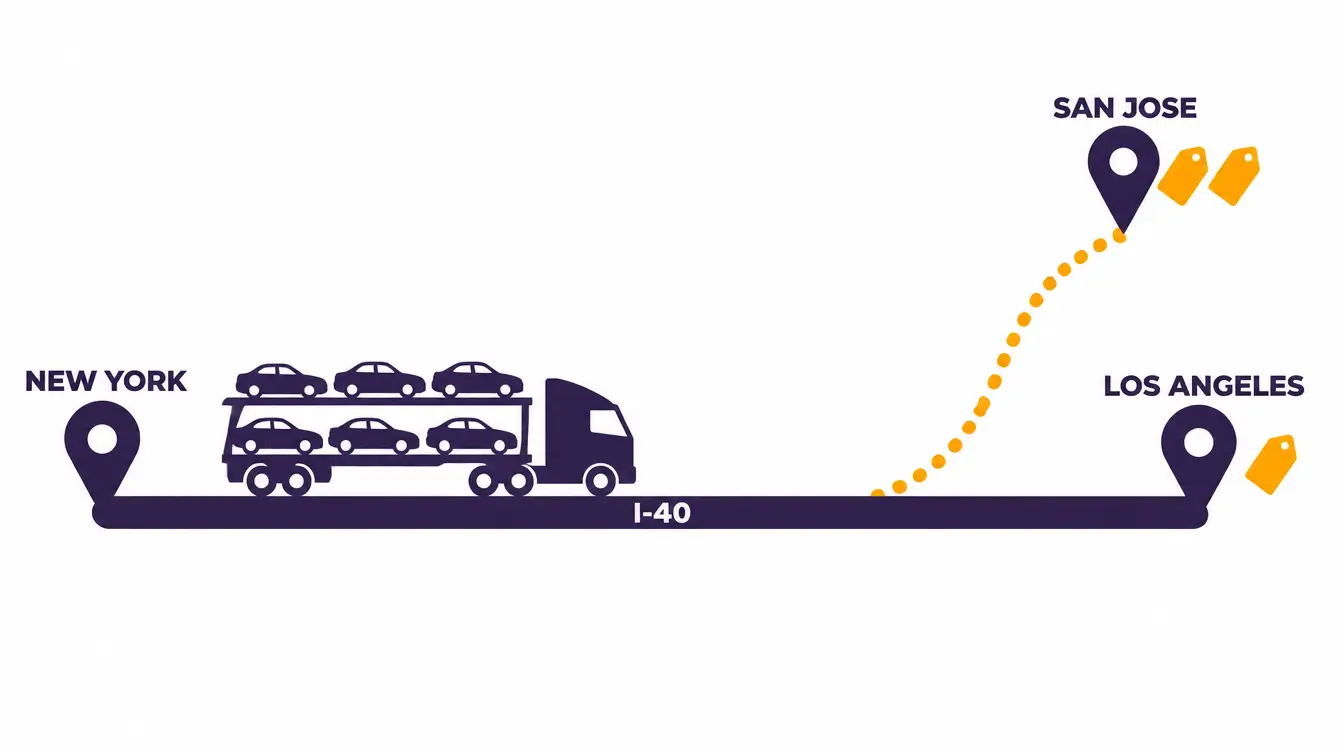
Figure on $1,300 at the low end and $1,850 at the high end for New York City to Los Angeles, with a sedan that runs and rides uncovered. Upstate pickups, a Southern California address and loose dates lean toward $1,300, while Manhattan pickups, Bay Area or Redding deliveries and fixed dates lean toward $1,850 and occasionally beyond.
Every SUV or pickup brings its own surcharge, $150 to $250. Shielded service in an enclosed trailer carries its own premium, typically 40 to 60 percent of the open figure on top, and it depends on the car.
Three things shift the number most:
- The California city. From the same New York start, Sacramento runs about 30 miles past Los Angeles, San Jose sits roughly 145 to 150 past, and Redding, farthest north, about 90 to 95 past.
- The New York address. The calculators measure Buffalo at 2,536 and 2,544 miles from Los Angeles. Rochester adds around 60 to 65 miles to that, Syracuse around 140, and Yonkers, Albany and Hempstead all begin 2,800 miles or more out.
- Dates and the vehicle. Fixed dates, a non-running car or an oversized truck all shrink the group of carriers willing to take the load.
Read every figure here as a planning guide until a carrier agrees to haul your car at that price.

What Factors Actually
Influence Pricing on This Route?
Booking early protects your timeline, keeps pricing steady, and reduces the risk of last-minute carrier changes.
Many customers on this route relocate permanently or move seasonally, which makes predictability more important than speed.
This article explains how auto transport Alabama to New York works, what it costs, and how long it takes, so you can make a clear, informed decision before you schedule your shipment.


Type
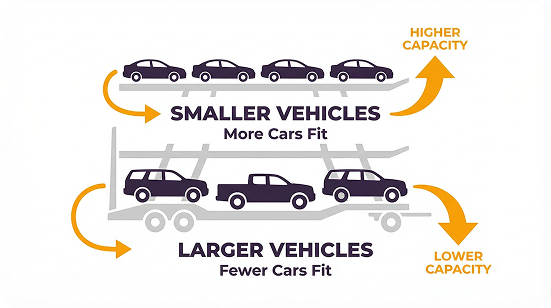
Size decides how much deck space your vehicle takes and how many other cars fit alongside it. A standard sedan is the cheapest thing to move because it slots almost anywhere on the trailer. SUVs, pickups and vans take more room and typically add a few hundred dollars on the same lane.


Is It Cheaper to Drive or Ship a Car From New York to California?
Shipping Instead of Driving
Shipping makes sense for a relocation by air, a car headed to a student or family member already out west, or a household with more vehicles than drivers. It also suits anyone unwilling to spend a week of leave on the interstate.
One pickup in New York means the odometer never gains the 2,500 miles or more of the drive, and you skip the motels, meals and fuel stops.
Driving the Route Yourself
Both calculators estimate about 41 hours of driving between New York City and Los Angeles, which most drivers split across five or six long days with a motel stop each night. Add fuel, meals, tolls at the eastern end and the miles on the car.
Driving may come out cheaper when the whole family travels together and wants the car along. Flying anyway, needing the car before you land, or protecting a low odometer all tip it toward shipping.
How Long Does Shipping a Car From New York to California Take?
Transit time after loading usually falls between 7 and 9 days. Buffalo to Los Angeles typically sits near the short end, and Albany or Long Island to the Bay Area near the long end.
Getting assigned to a truck is the variable step. It often takes several business days, and listing several acceptable pickup days gives dispatch more westbound trucks to consider.
Counting stops and other drop-offs, a loaded hauler covers somewhere around 400 or 500 miles in a working day, so the drive itself usually takes six to eight days, with the Bay Area at the long end.
When is the Best Time to Book Auto Transport From New York to California?
Book about two weeks ahead. Two weeks of notice lets dispatch wait for a truck already committed westbound rather than grabbing the first offer, and extra notice helps if the delivery date cannot move.
In winter, leave slack on any Bay Area, Sacramento or Redding delivery. Caltrans puts chain controls on I-80 over Donner Summit during Sierra storms and can close the pass for a time, which can hold a westbound truck short of the summit.
Open vs Enclosed Auto Transport on a New York to California Route
The default here is an open car hauler, the cheaper option and the one with the most westbound departures. Expect the car to show the same light road film a cross-country drive would leave.
With an enclosed trailer, walls and a roof keep rain, winter salt and desert dust away from the finish from pickup to delivery. Capacity is smaller, which raises the price and means spots fill earlier.
Enclosed is worth paying for when the car is a collectible, an exotic, freshly painted or sits too low for ordinary loading ramps. Daily drivers ride perfectly well uncovered.
Enclosed Car Transport
Enclosed demand rises for high-value, specialty and seasonal vehicles, and enclosed trailers protect against road debris and weather, which matters most on longer hauls. Enclosed rigs are a small fraction of the trailers working any given lane, and that scarcity is what drives both the higher price and the longer booking lead time.
Open Car Transport
Most vehicles move on open trailers, and for most routes that is the more cost-effective way to ship a car.
Open transport works well for standard vehicles and keeps costs predictable. It also offers the widest carrier availability.
What California Requires When Your Car Arrives
Once you settle in California, the paperwork clock is short, and part of it starts back in New York.
- Register within 20 days. California gives 20 days, counted from your move or from the car entering the state, to register a car last registered elsewhere. The DMV treats taking a job, registering to vote, renting a primary home or spending six months in a year there as signs of residency.
- Bring the right papers. The DMV asks for an Application for Title or Registration (REG 343), the New York title and last registration, and a Verification of Vehicle (REG 31) completed by a DMV employee, a law enforcement officer or a licensed vehicle verifier. If the New York title sits with a lender, California issues a registration marked Nontransferable and no California title.
- Plan on a smog check. Gasoline cars from the 1976 model year onward need a smog certification from a California smog station, as do most diesels from 1998 onward. Motorcycles are exempt.
- Insure it to California minimums. Liability coverage must reach at least $30,000 for injury or death of one person, $60,000 when the injuries involve more than one person, plus $15,000 for damaged property, and insurers report policies to the DMV electronically.
- Mind the low-mileage rule. California residents and businesses generally cannot bring in or register a vehicle under 2 years old with fewer than 7,500 miles unless it was built to California emission standards or qualifies for an exemption, so read the label under the hood before a New York purchase ships.
- Expect a use tax question. The California Department of Tax and Fee Administration presumes use tax applies to a vehicle bought outside California and brought in within 12 months of purchase, unless records show it was bought for use elsewhere.
- Return the New York plates first. New York expects its plates and registration back at its DMV before the New York insurance is dropped. Dropping the policy first is treated as a lapse, and New York may then suspend both the registration and the driver license, even once you live elsewhere.
Official source: the California DMV page for new California residents, with its guide to registering a vehicle from out of state, its insurance requirements, the CDTFA 12-month test and the New York DMV page for residents moving away. Requirements are revised from time to time, so confirm the current version before booking.
What to Expect at Pickup and Delivery
Manhattan is the hard case. On most of the island, and on plenty of Brooklyn and Queens blocks, a full car hauler cannot legally park, so expect a phone call from the driver and a handoff somewhere the truck can stop, often a wide avenue or a store parking lot. Suburban Long Island driveways, Westchester streets and upstate towns are usually easier, often with loading right at the curb, and the truck keeps to the interstates rather than the parkways.
Delivery in California depends on the neighborhood. Suburbs around Fresno, Bakersfield and Sacramento, plus large parts of Greater Los Angeles, usually have room for the full truck, while steep San Francisco blocks and narrow canyon roads often mean meeting at a nearby lot.
At both ends, you and the driver inspect the car and sign the bill of lading together. Take dated photos of every side before pickup so any question at delivery has an answer.

Key Things to Know Before Shipping a Car From New York to California
Rivalane runs the planning for this lane out of Melville on Long Island and lines up, for each car, a carrier already committed to a westbound run. Name the exact California city at the quote stage, because a Bay Area delivery sits roughly 150 miles past Los Angeles and changes both the interstate and the price.
Frequently Asked Questions



