


A running sedan going from Charlotte, North Carolina to Seattle by open carrier typically costs $1,300 to $1,850, going by recent quotes. Across the 64 town pairs we mapped, the trip runs about 2,409 to 3,061 road miles, mostly on I-90, and usually lasts 7 to 9 days on the road. Book two to three weeks ahead when you can.
How Does a Car Travel From North Carolina to Washington State?
North Carolina to Washington car shipping covers about 2,409 to 3,061 road miles across the 64 town pairs in our routing, and the delivery city in Washington State decides which of two long corridors the truck follows. Seattle, Tacoma, Everett, Bellingham and Spokane cars, plus most Olympia runs, take the northern line. From Charlotte, Greensboro and the eastern towns, that line climbs I-77 past Charleston, West Virginia, angles northwest through Ohio, Indiana and Illinois to Iowa and turns north on I-29 to Sioux Falls, while Asheville and Hickory cars head west by Knoxville, Nashville, St Louis and Kansas City before they reach I-29. For most of the remaining distance the load rides I-90, across South Dakota by Rapid City and through Montana by Billings and Missoula to Spokane, and western Washington deliveries carry on past Ellensburg. Vancouver and Kennewick cars, along with Olympia runs from Charlotte, Asheville and Hickory, use a southern line instead: I-70 from St Louis to Kansas City, I-80 across Nebraska and Wyoming by Cheyenne, then I-84 past Boise and Pendleton.

What Does North Carolina to Washington Car Shipping Cost?
Your quote depends on your vehicle, the exact pickup and delivery addresses, the season and the trailer type, so run the calculator for a figure on your dates.
The delivery city on the Washington State end shifts the price more than most people assume. From Charlotte, Spokane is the nearest delivery at about 2,520 road miles and Kennewick follows at about 2,610, while Vancouver, Seattle, Tacoma and Everett sit between about 2,765 and 2,820, and Olympia and Bellingham stretch to about 2,865 and 2,885. Our Washington State car shipping page lists delivery to other towns.
The North Carolina pickup counts as well. Compared with Charlotte, an Asheville car starts about 110 miles closer to Seattle and Hickory or Greensboro cars about 30 to 40, while Raleigh and Fayetteville add roughly 45 to 65 miles, Greenville about 125 and Wilmington about 180. Other pickup towns appear on our North Carolina car shipping page.
Vehicle size and the season settle most of the rest. A full-size SUV or pickup claims extra deck space, and winter snow on the mountain stretches of I-90 or I-84 can push a schedule back.

A running sedan picked up in Charlotte and delivered to a Seattle address by open trailer usually runs $1,300 to $1,850. For your own towns and vehicle, try the car shipping calculator.
A full-size SUV, minivan or pickup often adds $150 to $250 because it takes more of the deck, and enclosed service tends to add 40 to 60 percent to the open figure.
Three details decide where a quote lands on this lane:
- Washington city. From Charlotte, Spokane and Kennewick are the nearest drops, and Olympia and Bellingham the farthest.
- North Carolina town. Measured to Seattle, Asheville, Hickory and Greensboro pickups shorten the trip compared with Charlotte, while Greenville and Wilmington lengthen it.
- Season. Snow and chain rules in the northern mountains can push a winter delivery back by a day or more.

What Factors Actually
Influence Pricing on This Route?
Five things move the price on any lane: the vehicle's size, whether it runs, how easy each end is to reach, the season and the trailer type. Booking early protects your timeline, keeps pricing steady and reduces the risk of last-minute carrier changes.


Type
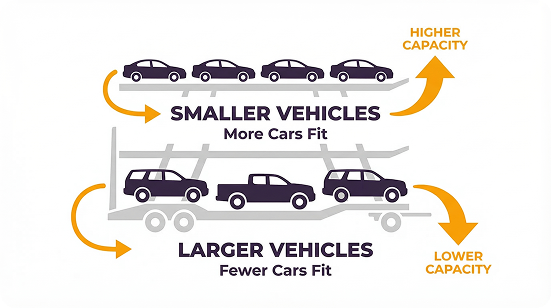
Size decides how much deck space your vehicle takes and how many other cars fit alongside it. A standard sedan is the cheapest thing to move because it slots almost anywhere on the trailer. SUVs, pickups and vans take more room and usually cost more on the same lane.


Should You Ship or Drive From North Carolina to Washington State?
Reasons to Ship
A few kinds of move fit shipping especially well on this lane: a new job around Seattle when a week behind the wheel would cut into the first days of work, a household bringing more vehicles than it has drivers, and anyone heading west in winter who would rather not take a car across the northern Plains and the Rockies in snow.
Shipping also keeps about 2,800 miles of wear off the car and spares you the fuel, meals and motel nights a cross-country drive runs up.
Reasons to Drive
Two drivers sharing the wheel with no fixed arrival date can sometimes make driving the cheaper choice, and if that matches your plans, we are happy to point it out. By our routing, Charlotte to Seattle takes about 50 hours behind the wheel, which most people spread over six or seven days once fuel, food and sleep are added.
The math shifts for a single driver facing a start date, because even our shortest mapped pair, Asheville to Spokane, runs about 2,410 miles. For a closer look at both options, see our guide to cross-country car shipping costs.
How Long Does North Carolina to Washington Car Shipping Take?
Most deliveries in Washington State arrive 7 to 9 days after loading. Asheville to Spokane, the shortest pair in our routing at about 2,410 miles, tends to finish toward the low end, and Wilmington to Bellingham, the longest at about 3,060, can need the full span.
Before pickup, Rivalane matches the order with a carrier, a step that can take one to three working days. If you can offer more than one pickup day, dispatch has more trucks heading northwest to pick from.
Charlotte to Seattle works out to about 50 hours of driving, or roughly six days at the pace a hauler usually keeps. In winter, snow in the mountains of Montana and Idaho or on the I-84 grades can add a day or two.
When Should You Book a North Carolina to Washington Car Shipment?
Where you can, allow two to three weeks of notice before pickup. That gives Rivalane room to find a licensed carrier already scheduled to run northwest with an open position on its upper or lower deck, rather than settling for whichever truck is free that week.
Winter calls for more room in the plan. A storm in the northern Rockies or the mountains of the Northwest can slow the final days of the trip, and chain rules for heavy trucks may hold a hauler until roads clear.
Starting in Virginia instead? That lane has its own page, Virginia to Washington car shipping, and a North Carolina car bound for the Pacific coast farther south travels I-40 on our North Carolina to California car shipping route.
Should You Ship Open or Enclosed From North Carolina to Washington?
Most cars here move by open transport, riding the familiar two-level haulers seen on any interstate. Across roughly 2,800 miles that leaves the car exposed to Southern summer heat, Plains wind and dust, winter road treatment in the northern states and Pacific Northwest rain, about what driving it would bring.
Choosing enclosed transport puts solid trailer walls around the car for the full distance, shielding it from weather and from gravel thrown up by other vehicles. Each trailer holds fewer cars, so it costs more, and a booking made at short notice may take longer to place.
Owners of classic and exotic cars, or of a car with fresh paint, tend to pick it, and daily drivers mostly go open.
Enclosed Car Transport
Enclosed demand rises for high-value, specialty and seasonal vehicles, and enclosed trailers protect against road debris and weather, which matters most on longer hauls. Enclosed rigs are a small fraction of the trailers working any given lane, and that scarcity is what drives both the higher price and the longer booking lead time.
Open Car Transport
Most vehicles move on open trailers, and for most routes that is the more cost-effective way to ship a car.
Open transport works well for standard vehicles and keeps costs predictable. It also offers the widest carrier availability.
Questions About Washington Paperwork After a North Carolina Move
How long do I have after the move? The Washington State Department of Licensing, or DOL, sets a 30 day window from the move for two steps, a Washington driver license and the vehicle registration, and it will not register the car until the license is done.
Which office handles the car? Driver licensing and vehicle licensing happen at separate locations. Write down the odometer reading and take your current North Carolina title to a vehicle licensing office. If a lender holds the title, call that office for its fax number so the lender can fax a copy.
When do the plates arrive? Plates are handed over at the counter during an office visit, while an application sent by mail can take up to 3 weeks from the day DOL receives it. Not every office takes debit or credit cards.
Will I owe use tax? The Department of Revenue collects use tax when the car is licensed in Washington. A new resident may be exempt when the car was acquired and used in another state more than 90 days before the move and is licensed in Washington within 30 days of moving.
What happens to my North Carolina plate? After the car is registered in Washington, return the North Carolina plate to NCDMV at any license plate agency or by mail. Keep your North Carolina insurance until the plate is turned in, because canceling it first can bring a fine for a lapse in coverage. Our North Carolina plate return guide covers the steps. The Washington steps above come from the DOL vehicle registration page for new residents.
What to Expect at Pickup in North Carolina and Delivery in Washington State
Agree on meeting points for both ends of the trip before a carrier is assigned. A loaded rig of this size needs a straight, open piece of road where the driver can park, set down the ramps and pull out again, and many neighborhood streets have nothing like that.
In North Carolina, wide streets in newer subdivisions around Charlotte, Raleigh and Greensboro usually suit a hauler. Narrow mountain roads near Asheville, gravel farm lanes in the east and tight beach-town streets near Wilmington often move the meeting to a large parking lot beside a main highway.
In Washington State, steep hillside streets in Seattle and Tacoma, private roads through wooded lots and gated communities may mean meeting at a store lot close by.
Before the car is loaded, go over it with the driver and confirm that every chip and dent it already has appears in writing on the condition report, and only then sign it. On arrival, check the car against that same report before signing again.

Key Things to Know Before Shipping a Car From North Carolina to Washington State
Rivalane coordinates each shipment from its Melville, New York office and places the car with a licensed carrier already headed northwest, with real-time tracking until delivery. Start the Washington paperwork early: DOL allows 30 days from the move for both the driver license and the registration, and the license must be in hand before the car can be registered.
Frequently Asked Questions